456
CHAPTER 28
or third emission was found to be larger than the first. This may be accounted for by the
fact that in these cases there had been no ejaculation for very long periods before the
tests, and it would appear that, in some of them, accumulated stimuli were necessary
to set the whole mechanism of ejaculation into action.
In a number of cases, pH estimation of the seminal fluid was made which varied
between 7-7-5. In one case a pH of 8 was found. In future, this test should be carried out
systematically.
No relationship was found between volume and sperm concentration in the various
subjects or in repeated tests on the same subject. Considerable variations were found, and
the ejaculate may be just prostatic fluid with complete aspermia. Conversely, a small
volume of seminal fluid may contain a much higher sperm concentration than a large
volume.
The percentage of viable motile sperms was, as a rule, well below normal, especially
in complete lesions, but in a small number of patients there were 50 per cent and more of
viable sperms. Table 27 demonstrates examples of results obtained in 5 patients complete
and incomplete, of various level, who during the test had more than one emission. It is
known from fertility tests in normal subjects that, although a high motility of sperms is an
essential property of fertile spermatozoa, the ratio of motility provides only a rough
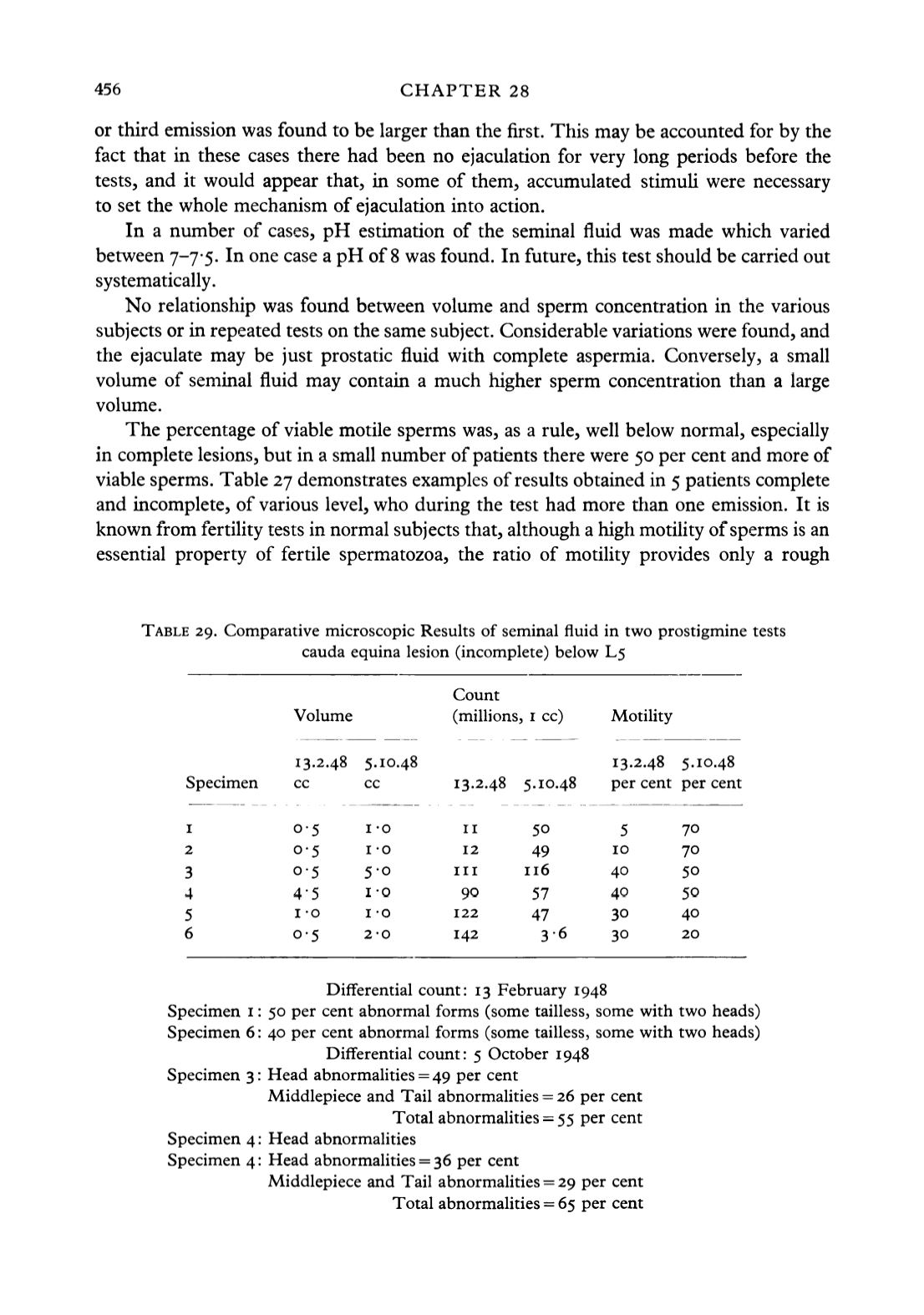
TABLE 29. Comparative microscopic Results of seminal fluid in two prostigmine tests
cauda equina lesion (incomplete) below L5
Count
Volume
(millions, I cc)
Motility
13.2.48
5.10.48
13.2.48
5.10.48
Specimen
cc
cc
13.2.48
5.10.48
percent percent
I
2
3
4
5
6
0-5
0-5
0-5
4'5
i -o
0-5
i -o
I -O
5-0
i-o
I -O
2-O
II
12
III
90
122
142
50
49
116
57
473-6
5
10
40
40
30
30
70
70
50
50
40
20
Differential count: 13 February 1948
Specimen i: 50 per cent abnormal forms (some tailless, some with two heads)
Specimen 6: 40 per cent abnormal forms (some tailless, some with two heads)
Differential count: 5 October 1948
Specimen 3: Head abnormalities = 49 per cent
Middlepiece and Tail abnormalities = 26 per cent
Total abnormalities = 55 per cent
Specimen 4: Head abnormalities
Specimen 4: Head abnormalities = 36 per cent
Middlepiece and Tail abnormalities = 29 per cent
Total abnormalities = 65 per cent


