C- DISLOCATIONS OF THE VERTEBRAL COLUMN
133
Burke (1971) and Burke & Berryman (1971) advocate in view of their experience on 76
cervical cases a policy of conservative management with gentle manipulation in selected
cases only, reduction being maintained thereafter by skeletal traction. These authors
reserve operation for the few cases which demonstrate late instability or for those even
rarer cases in which manipulation fails and the patient has either an incomplete neuro
logical lesion or a double skeletal injury. Their mortality rate was 2 out of 76.
Neurological results of conservative treatment
It remains now to analyse the effect of the conservative treatment of the spine on the
neurological symptoms resulting from fractures and fracture-dislocations. In 1963 I
reported about 396 (334 male and 62 female) traumatic paraplegics and tetraplegics
admitted to Stoke Mandeville within the first 15 days of injury between 1957 and 1963.
The majority of them (329) arrived within the first week and, of these, 256 within the
first 3 days of injury, 194 within the first 24 hours. One hundred and thirteen patients
(28-1 per cent) had additional injuries. Thirty (25 male and 5 female) of the 396 patients
(7-6 per cent) died during the early stages of injury, the majority of whom (20) were well
over the age of 40, and most of them were cervical injuries. The time between death and
injury varied, the majority dying within 8 to 10 days, mainly from pulmonary embolus,
other lung complications and head injuries.
Three hundred and forty-five patients (30 who died are excluded from the statistics)
were treated conservatively, the vast majority by the method of postural reduction des
cribed above. Two hundred and fifty-five had fracture-dislocations, and of these 145
(46-86 per cent) caused complete transverse lesions, while of 90 fractures without dislo
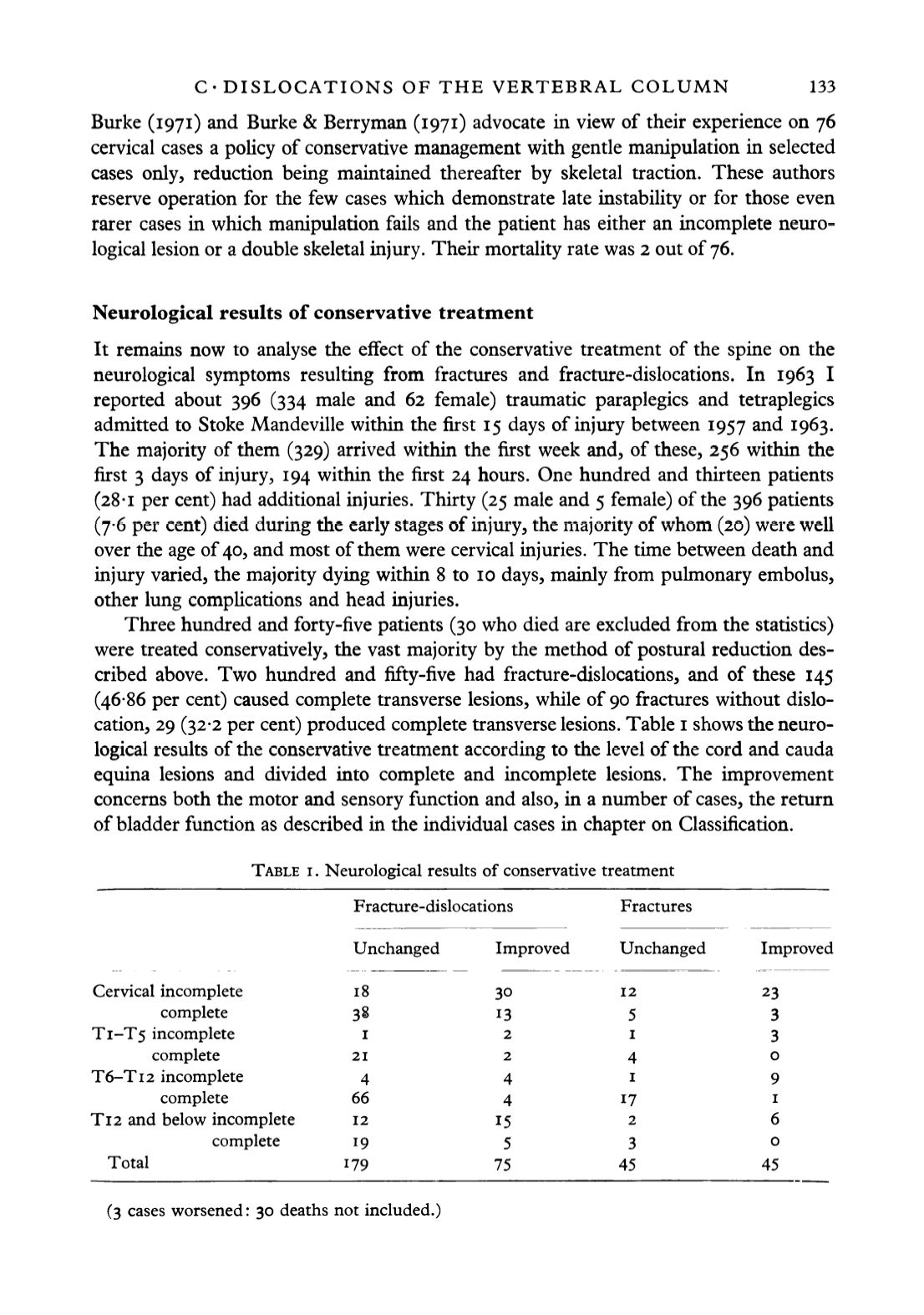
cation, 29 (32-2 per cent) produced complete transverse lesions. Table i shows the neuro
logical results of the conservative treatment according to the level of the cord and cauda
equina lesions and divided into complete and incomplete lesions. The improvement
concerns both the motor and sensory function and also, in a number of cases, the return
of bladder function as described in the individual cases in chapter on Classification.
TABLE i. Neurological results of conservative treatment
Fracture-dislocations
Cervical incomplete
complete
Ti-T5 incomplete
complete
T6-Ti2 incomplete
complete
Ti2 and below incomplete
complete
Total
Unchanged
18
38
i
21
4
66
12
19
179
Improved
30
13
2
2
4
4
15
5
75
Fractures
Unchanged
12
5
i
4
i
i?
2
3
45
Improved
23
3
3
o
9
i
6
0
45
(3 cases worsened: 30 deaths not included.)


