140
CHAPTER 12
6
.
2
55.
18-8-55.
18
2 -
58.
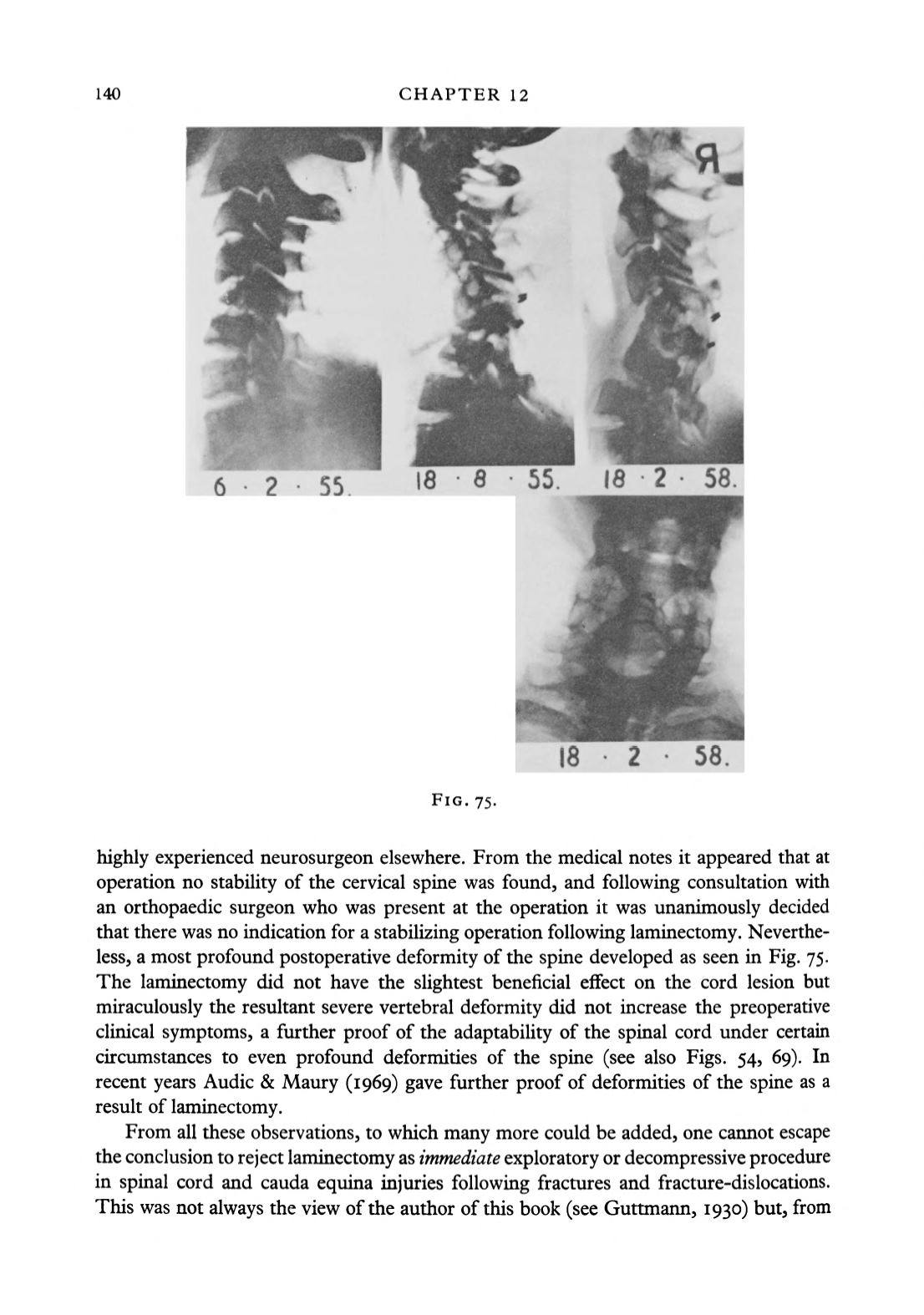
FIG. 75.
highly experienced neurosurgeon elsewhere. From the medical notes it appeared that at
operation no stability of the cervical spine was found, and following consultation with
an orthopaedic surgeon who was present at the operation it was unanimously decided
that there was no indication for a stabilizing operation following laminectomy. Neverthe
less, a most profound postoperative deformity of the spine developed as seen in Fig. 75.
The laminectomy did not have the slightest beneficial effect on the cord lesion but
miraculously the resultant severe vertebral deformity did not increase the preoperative
clinical symptoms, a further proof of the adaptability of the spinal cord under certain
circumstances to even profound deformities of the spine (see also Figs. 54, 69). In
recent years Audic & Maury (1969) gave further proof of deformities of the spine as a
result of laminectomy.
From all these observations, to which many more could be added, one cannot escape
the conclusion to reject laminectomy as
immediate
exploratory or decompressive procedure
in spinal cord and cauda equina injuries following fractures and fracture-dislocations.
This was not always the view of the author of this book (see Guttmann, 1930) but, from


