F- CLINICAL ASPECTS OF SPINAL CORD INJURIES
439
attached to a capsule manometer. Fig. 185 demonstrates motility record from a normal
subject.
Sigmoidoscopy itself showed certain effects in nearly all cases. In the cervicals, when
the sigmoidoscope reached 13 to 18 cm, there was reflex relaxation of the anus accompanied
by certain remote autonomic reflex responses such as tingling in the face and throbbing
headaches—symptoms which develop in these high lesions when their bowels are acting.
Actually many of the cervicals defaecated during sigmoidoscopy. These effects did not
occur in cervical patients who had had intrathecal alcohol block to abolish intractable
spasticity. In flaccid lesions, there was no change in the atonic anus during sigmoidoscopy
but the tone of the upper rectum and sigmoid colon was greater than in a normal subject
at level of 15 to 20 cm and the patients as well as the normal control complained of
periumbilical discomfort.
Fig. 186 illustrates motility records of patients with high cord lesion, low spastic
lesion and flaccid lesion of the lumbo-sacral cord, in comparison with the motility record
from a normal subject. High lesions showed, with one exception, concerning a patient
with a complete Cy lesion who at the time of the study had an active duodenal ulcer, less
colonic activity than the normal control and low cord lesions, and the amplitude of the
waves was diminished (Fig. 187). In contrast, the records from patients with distal cord
lesions showed increased colonic activity. There was difference in the percentage duration
of activity between distal spastic and flaccid lesions, although the latter showed more
irregular records (Fig. 188). Following intrathecal alcohol block resulting in destruction
of the sacral centre and its parasympathetic innervation, sigmoid motility was minimal
in every respect (Fig. 189). It would appear that, if the lesion affects mainly the lumbar
segments, the sacral centre shows hyperactivity resulting in increased colonic activity.
This indicates an inhibitory influence which the lumbar outflow exerts on colonic
activity. Actually, an inhibitory centre in the lumbo-sacral region of the cord was postu
lated by Garry (1933) as a result of experiments in cats.
The effect of food was an increase in both percentage duration of colonic activity
and in the amplitude of waves in 5 patients examined who had complete lesions of the
cervical, upper and distal thoracic and lumbar cord. The increase in activity varied
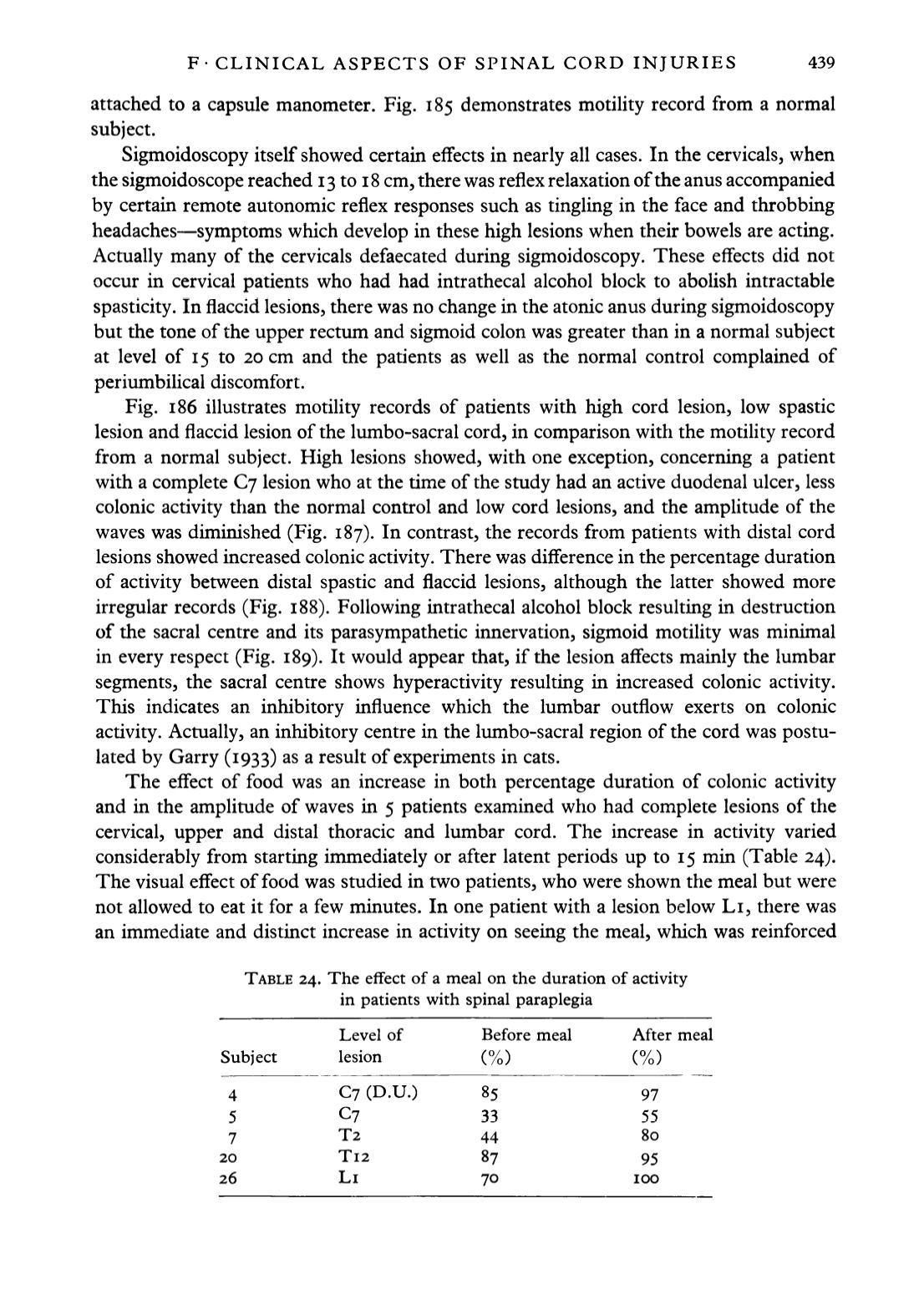
considerably from starting immediately or after latent periods up to 15 min (Table 24).
The visual effect of food was studied in two patients, who were shown the meal but were
not allowed to eat it for a few minutes. In one patient with a lesion below Li, there was
an immediate and distinct increase in activity on seeing the meal, which was reinforced
TABLE 24. The effect of a meal on the duration of activity
in patients with spinal paraplegia
Subject
4
5
7
20
26
Level of
lesion
C7 (D.U.)
C7
T2
Tl2
Li
Before meal
(%)
85
33
44
87
70
After meal
(°/
">
^
/o)
97
55
80
95
IOO


