432
CHAPTER 27
Their findings, that the external anal sphincter shows continuous electrical activity and
tonic contraction at rest, following transection of the cord above the level of the third
lumbar segment, confirmed Floyd & Walls' (1953) electromyographic results, which
showed conclusively that the human external sphincter ani is always in a state of tonic
contraction during waking and sleeping hours. Bors & Blinn (1958), using needle elec
trodes inserted into the external anal sphincter and pubo-rectalis, also found constant
muscle contraction at rest. These findings are not in accordance with Denny-Brown &
Robertson's conclusions that 'the external sphincter ani is not tonic although it contracts
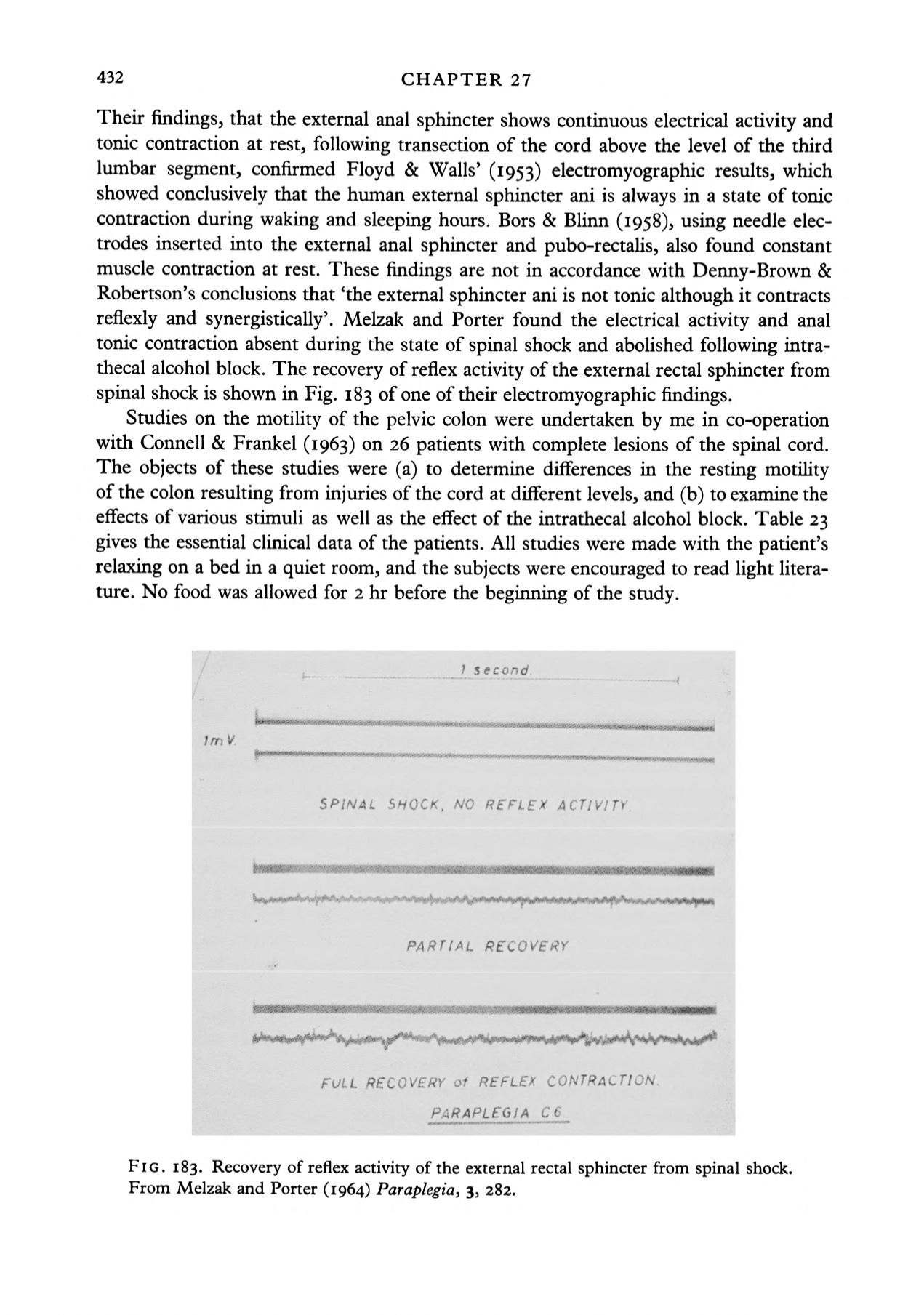
reflexly and synergistically'. Melzak and Porter found the electrical activity and anal
tonic contraction absent during the state of spinal shock and abolished following intra-
thecal alcohol block. The recovery of reflex activity of the external rectal sphincter from
spinal shock is shown in Fig. 183 of one of their electromyographic findings.
Studies on the motility of the pelvic colon were undertaken by me in co-operation
with Connell & Frankel (1963) on 26 patients with complete lesions of the spinal cord.
The objects of these studies were (a) to determine differences in the resting motility
of the colon resulting from injuries of the cord at different levels, and (b) to examine the
effects of various stimuli as well as the effect of the intrathecal alcohol block. Table 23
gives the essential clinical data of the patients. All studies were made with the patient's
relaxing on a bed in a quiet room, and the subjects were encouraged to read light litera
ture. No food was allowed for 2 hr before the beginning of the study.
1 second
SPINAL SHOCK, NO REPLBX ACTIVITY
PARTIAL RECOVERY
ruLL RECOVERY
o/
REFLEX CONTRACTION.
P^AJPLEG^A
_C6M
FIG. 183. Recovery of reflex activity of the external rectal sphincter from spinal shock.
From Melzak and Porter (1964)
Paraplegia,
3, 282.


