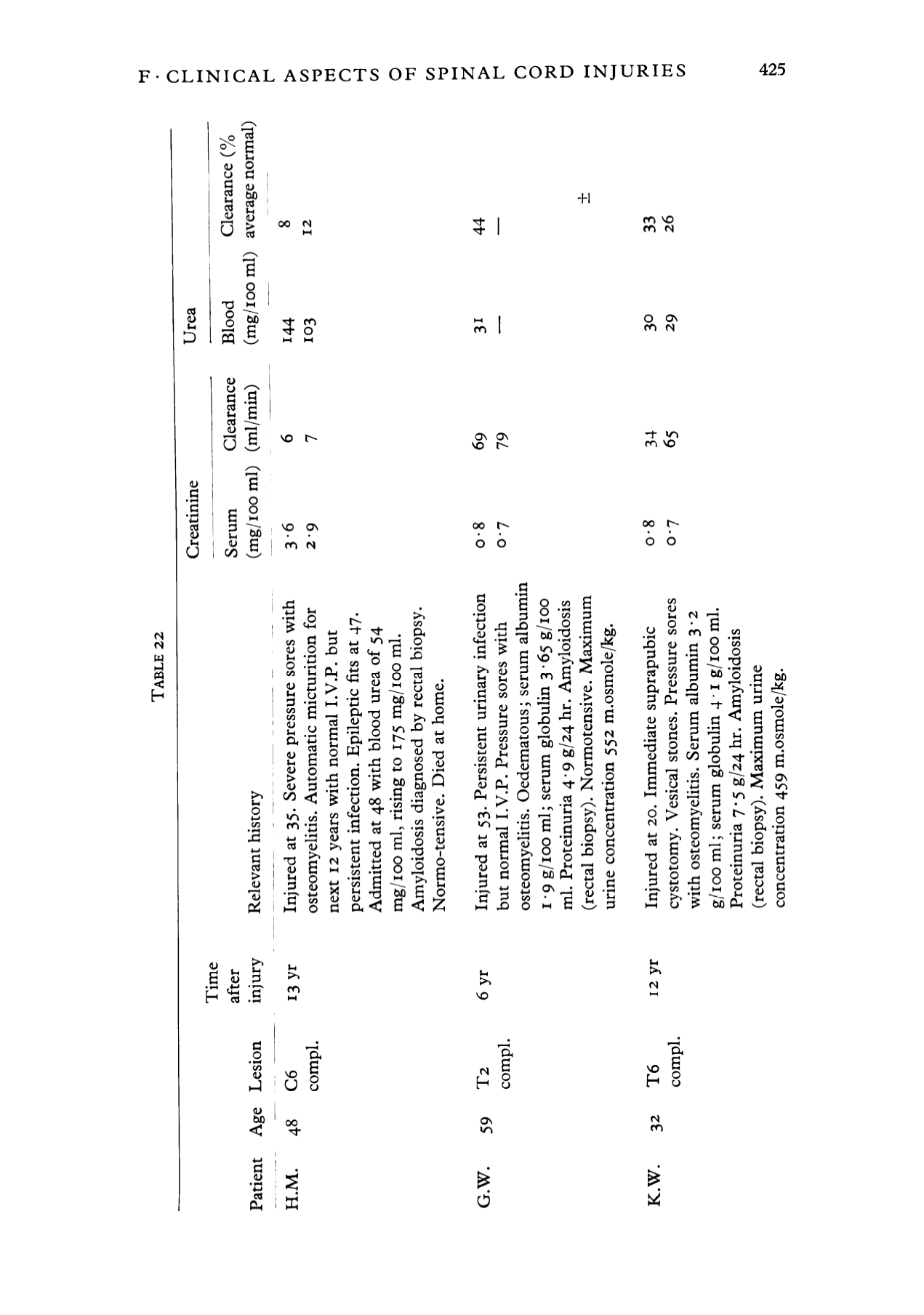
F- CLINICAL ASPECTS OF SPINAL CORD INJURIES
425
N
NW
H-l
W
<
h
<«
<u
JH
^
(U
fi
•<—i
g
'•S
ra
<u
i-i
ssf
^-^ M
<u
o
y c
B v
2 9
«
E
<u
u
0 S
's
o
0
T3 M
8~g
S vE
(U
S?
2 3
t-i
C
c«
-ii.
(U ^H
r^5 ^
U o
t
o
PI °
C M
2 "M
«
£
U
t/3 O
Relevant
history
00 N
M
Tj- CO
Tf O
M M
vo
t^
VO
ON
•
•
m N
Injured
at
35.
Severe
pr ssure
sores
with
osteomyelitis.
Aut
atic
micturition
f r
next
12
years
with
normal
I.V.P.
bu
Tt-
n-
M
ro
-1-1
m vo
m (S
O
ON
m M
ON ON
-1- v*
vo
r
^.
oo
r--
.
,
o o
persistent
infection.
Epileptic
fi s
at
47.
Admitted
at
48
with
blood
urea
of54 mg/ioo
ml,
rising
to
175
g/i o
l.
Amyloidosis
diagnosed
by
rectal
iop y.
Normo-tensive.
Di d
at
home.
d
Injured
at
53.
Persistent
urinary
i fectio
but
normal
I.V.P.
Pressure
sores
with
osteomyelitis.
Oedematous;
s rum
album
1-9
g/ioo
ml;
serum
globulin
3-65
/ioo
ml.
Proteinuria
4-9
g/24
hr
Amyloidosis
(rectal
biopsy).
Normotenive.
Maximum
urine
concentration
552
m.osmole/kg.
m vo
00
t^
•
•
0 0
Injured
at
20.
mmediate
suprapubic
cystotomy.
Vesical
stones.
Pr
sure
sor s
with
osteomyelitis.
Serum
albumin3
•2 g/ioo
ml;
serum
lobulin
4-1
/ oo
l.
Proteinuria
7
•5g/24
hr.
Amyloidosis
(rectal
biopsy).
Maximum
ur ne
concentration
459
m.osmole/kg.
flj
S3 S
VH
>>
vo
00
oo
a
«>
vo
15
H-l
U 8
a
e
o
o
ON
a
6
o
CJ
m
53
:>
•<
•i-i
^
t«
•
/?*
'
h-1
P^H
i
3-1
O


