F •
CLINICAL ASPECTS OF SPINAL CORD INJURIES
509
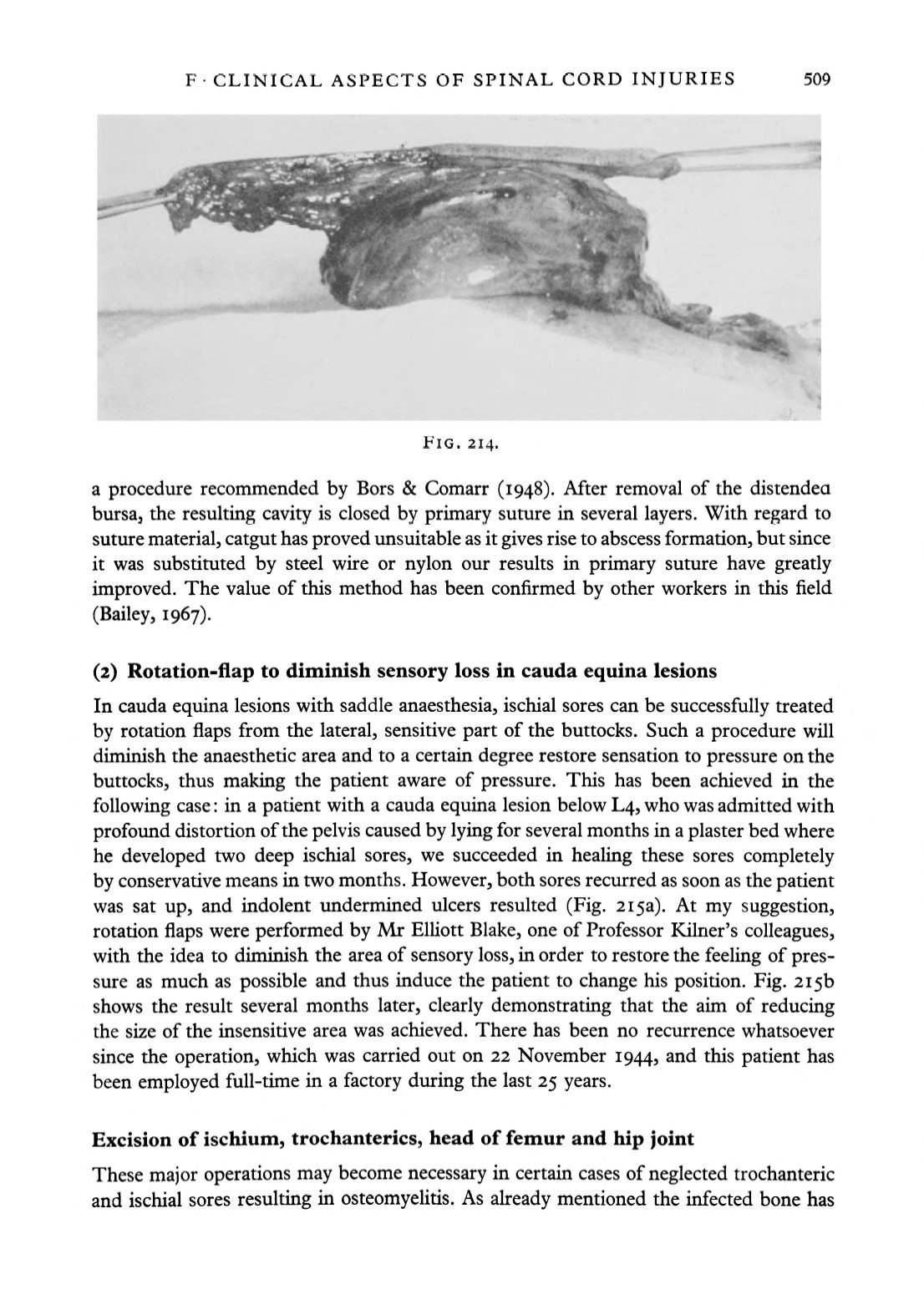
FIG. 214.
a procedure recommended by Bors & Comarr (1948). After removal of the distended
bursa, the resulting cavity is closed by primary suture in several layers. With regard to
suture material, catgut has proved unsuitable as it gives rise to abscess formation, but since
it was substituted by steel wire or nylon our results in primary suture have greatly
improved. The value of this method has been confirmed by other workers in this field
(Bailey, 1967).
(2) Rotation-flap to diminish sensory loss in cauda equina lesions
In cauda equina lesions with saddle anaesthesia, ischial sores can be successfully treated
by rotation flaps from the lateral, sensitive part of the buttocks. Such a procedure will
diminish the anaesthetic area and to a certain degree restore sensation to pressure on the
buttocks, thus making the patient aware of pressure. This has been achieved in the
following case: in a patient with a cauda equina lesion below L4, who was admitted with
profound distortion of the pelvis caused by lying for several months in a plaster bed where
he developed two deep ischial sores, we succeeded in healing these sores completely
by conservative means in two months. However, both sores recurred as soon as the patient
was sat up, and indolent undermined ulcers resulted (Fig. 2153). At my suggestion,
rotation flaps were performed by Mr Elliott Blake, one of Professor Kilner Js colleagues,
with the idea to diminish the area of sensory loss, in order to restore the feeling of pres
sure as much as possible and thus induce the patient to change his position. Fig.
21 $b
shows the result several months later, clearly demonstrating that the aim of reducing
the size of the insensitive area was achieved. There has been no recurrence whatsoever
since the operation, which was carried out on 22 November 1944, and this patient has
been employed full-time in a factory during the last 25 years.
Excision of ischium, trochanterics, head of femur and hip joint
These major operations may become necessary in certain cases of neglected trochanteric
and ischial sores resulting in osteomyelitis. As already mentioned the infected bone has


