F • CLINICAL ASPECTS OF SPINAL CORD INJURIES
233
greatly increased and ankle and knee jerks as well as ipsilateral flexion reflex are well
established. They occur in both complete and incomplete transverse lesions. The most
common crossed reflex resulting from plantar stimulation of the foot is the extensor
thrust of the contralateral leg, consisting of contraction of contralateral extensors of the
hip, adductors, quadriceps and plantar flexion of the foot and toes. Fig. 107 demon
strates the crossed reflex-response of the feet and toes following plantar stimulation of the
right foot. In cases with high degree of spasticity, alternating withdrawal contractions
on one side and extensor thrust on the other may occur spontaneously or with only slight
extrinsic stimulation and may become most disturbing to the patient, especially at
night. On the other hand, the crossed extensor contractions of the legs associated with
adductor contractions to unilateral stimulation may be the earliest true crossed reflex-
response (Fig. 108). It has already been mentioned that in tetraplegics below C6/7,
once the receptive field is extended over the whole area below the level of the lesion,
strong unilateral plantar stimulation of the foot may result in ipsilateral and contralateral
contraction of the paralysed extensors of the ringers (Fig. 106).
4.
Alternating and synchronous rhythmic contractions
Rhythmic, alternating flexor and extensor contractions of the paralysed lower limbs
have been previously described by Riddoch (1917) and Foerster (1936), and special
mention may be made of the coitus reflex described by Riddoch as an example of rhythmic
alternating flexion and extension synergies of the hips.
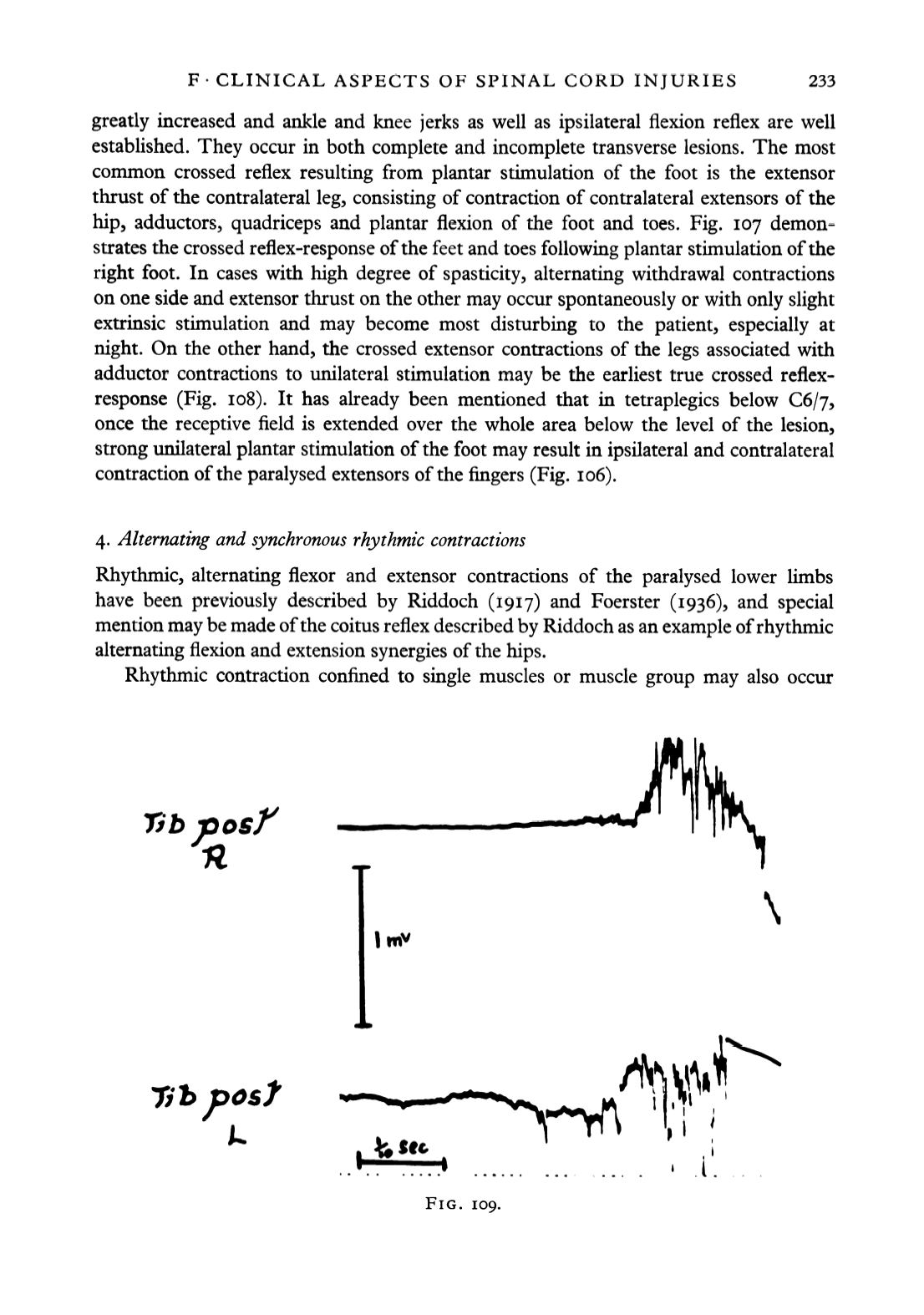
Rhythmic contraction confined to single muscles or muscle group may also occur
Tib posf
\
FIG. 109.


