238
CHAPTER 23
are also paralysed, this respiratory paralysis will lead to death within the shortest time,
unless tracheostomy and artificial respiration are carried out immediately. However, in
transverse lesions confined to €4—for instance, following stab wounds—the segmental
innervation of the phrenic nerve by €3 may be sufficient to ensure good function of the
diaphragm, once the post-traumatic oedema of the cervical cord above the transection
has subsided.
Below the transection, all voluntary movements in both upper and lower limbs as well
as trunk are abolished and, as soon as the stage of spinal shock is over, spasticity
and rigidity of these muscles develops. The spastic paralysis of the arms is one in exten
sion. Furthermore, all forms of sensibility, control of bladder, bowels and sexual function
as well as vasomotor control and heat regulation are abolished.
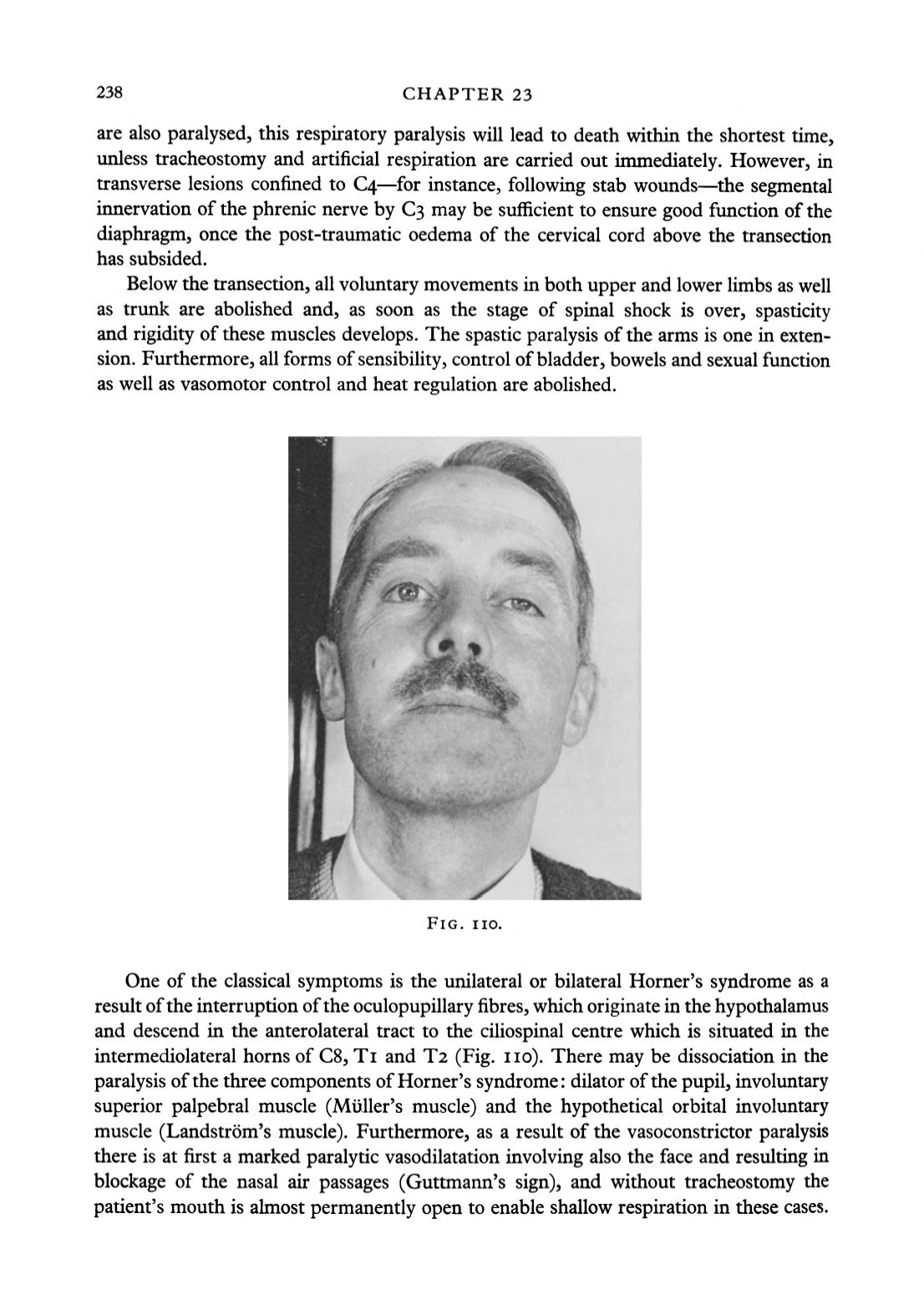
FIG. no.
One of the classical symptoms is the unilateral or bilateral Horner's syndrome as a
result of the interruption of the oculopupillary fibres, which originate in the hypothalamus
and descend in the anterolateral tract to the ciliospinal centre which is situated in the
intermediolateral horns of C8, Ti and T2 (Fig. no). There may be dissociation in the
paralysis of the three components of Horner's syndrome: dilator of the pupil, involuntary
superior palpebral muscle (Muller's muscle) and the hypothetical orbital involuntary
muscle (Landstrom's muscle). Furthermore, as a result of the vasoconstrictor paralysis
there is at first a marked paralytic vasodilatation involving also the face and resulting in
blockage of the nasal air passages (Guttmann's sign), and without tracheostomy the
patient's mouth is almost permanently open to enable shallow respiration in these cases.


