254
CHAPTER 23
Anaesthesia
are common amongst the coloured popula-
L.M.N. paralysis
&
.
.
* *
( ..
K , Nl
,
.
tion. More commonly, a stab injury of the
JU.M.N. paralysis
Jy
'
J
I LOSS of post. col. sensibility
cord may not only sever one half of the cord
LOSS of spino-thai.tr sensibility
but may somewhat encroach on the other
half, thus producing bilateral symptoms.
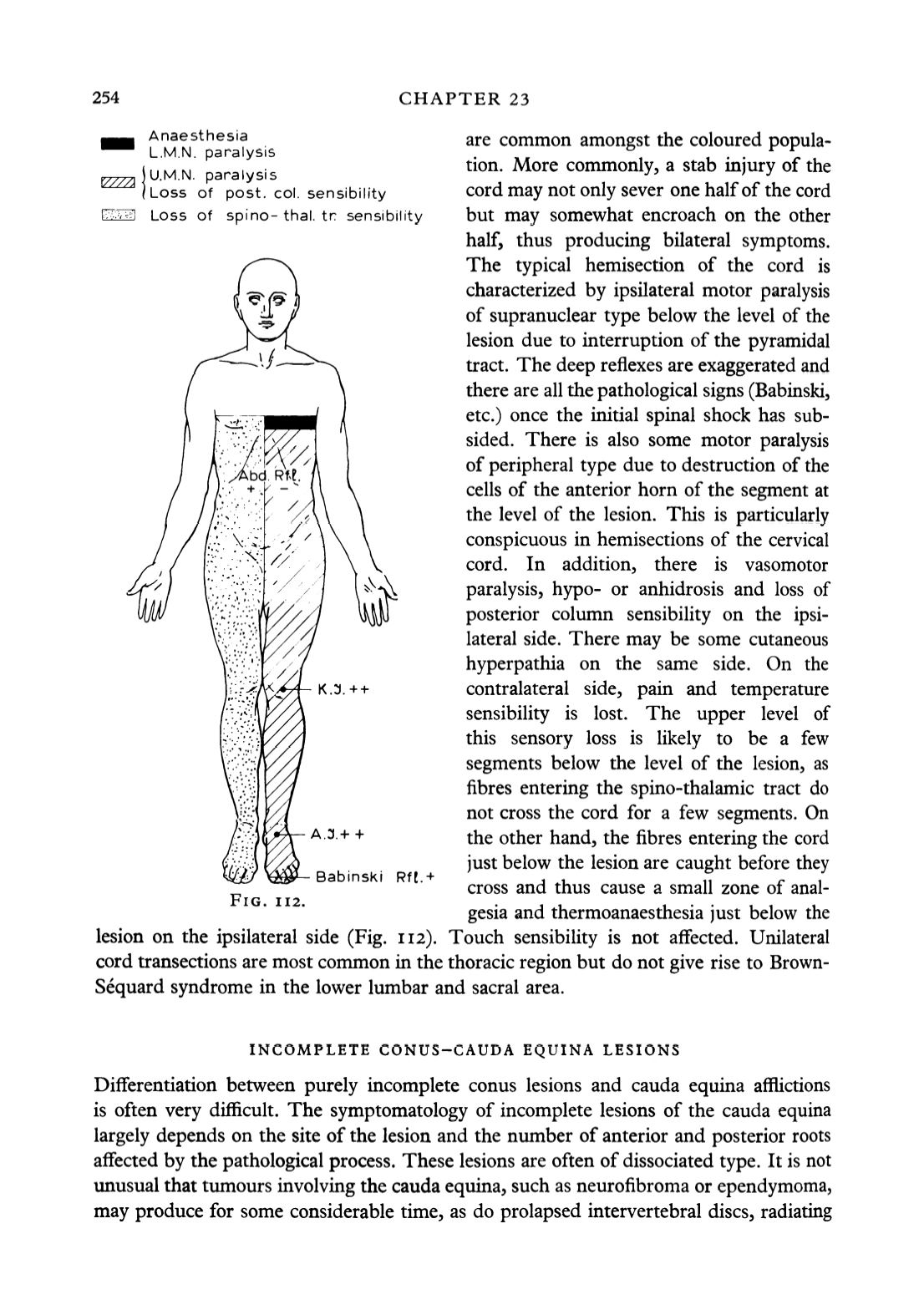
The typical hemisection of the cord is
characterized by ipsilateral motor paralysis
of supranuclear type below the level of the
lesion due to interruption of the pyramidal
tract. The deep reflexes are exaggerated and
there are all the pathological signs (Babinski,
etc.) once the initial spinal shock has sub
sided. There is also some motor paralysis
of peripheral type due to destruction of the
cells of the anterior horn of the segment at
the level of the lesion. This is particularly
conspicuous in hemisections of the cervical
cord.
In addition,
there
is vasomotor
paralysis, hypo- or anhidrosis and loss of
posterior column sensibility on the ipsi
lateral side. There may be some cutaneous
hyperpathia on the same side. On the
contralateral side, pain and temperature
sensibility
is
lost. The upper
level of
this sensory loss is
likely to be a few
segments below the level of the lesion, as
fibres entering the spino-thalamic tract do
not cross the cord for a few segments. On
the other hand, the fibres entering the cord
just below the lesion are caught before they
cross and thus cause a small zone of anal
gesia and thermoanaesthesia just below the
lesion on the ipsilateral side (Fig. 112). Touch sensibility is not affected. Unilateral
cord transections are most common in the thoracic region but do not give rise to Brown-
Sequard syndrome in the lower lumbar and sacral area.
Babinski RfJ.+
FIG. 112.
INCOMPLETE CONUS-CAUDA EQUINA LESIONS
Differentiation between purely incomplete conus lesions and cauda equina afflictions
is often very difficult. The symptomatology of incomplete lesions of the cauda equina
largely depends on the site of the lesion and the number of anterior and posterior roots
affected by the pathological process. These lesions are often of dissociated type. It is not
unusual that tumours involving the cauda equina, such as neurofibroma or ependymoma,
may produce for some considerable time, as do prolapsed intervertebral discs, radiating


