F- CLINICAL ASPECTS OF SPINAL CORD INJURIES
263
Disturbances of sensibility in incomplete lesions
Although an anatomically incomplete cord or cauda equina lesion may initially reveal a
complete sensory loss below the level of the lesion, sooner or later certain if not all
modalities of sensibility may recover in accordance with the functional return of the
posterior column or spinothalamic tracts. It is well known that the various modalities
of sensibility have separate representations in both the posterior column and spino
thalamic tract. Moreover, there exists a lamelliform arrangement of a somatotopic
division of the various areas of the body within these tracts which is particularly con
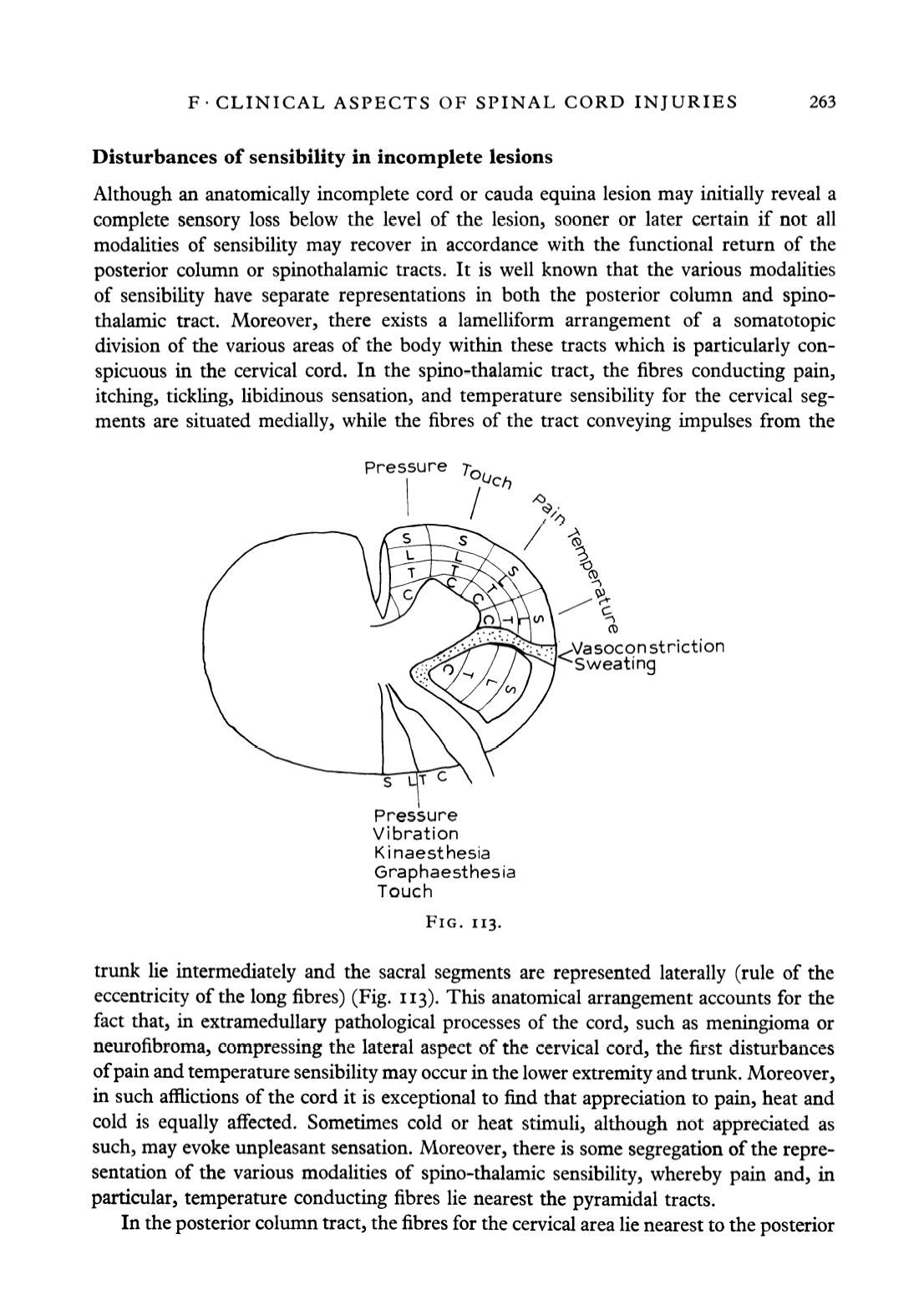
spicuous in the cervical cord. In the spino-thalamic tract, the fibres conducting pain,
itching, tickling, libidinous sensation, and temperature sensibility for the cervical seg
ments are situated medially, while the fibres of the tract conveying impulses from the
Pressure 7-
C/7
Vasocqnstriction
Sweating
Pressure
Vibration
Kinaesthesia
Graphaesthesia
Touch
FIG. 113.
trunk lie intermediately and the sacral segments are represented laterally (rule of the
eccentricity of the long fibres) (Fig. 113). This anatomical arrangement accounts for the
fact that, in extramedullary pathological processes of the cord, such as meningioma or
neurofibroma, compressing the lateral aspect of the cervical cord, the first disturbances
ofpain and temperature sensibility may occur in the lower extremity and trunk. Moreover,
in such afflictions of the cord it is exceptional to find that appreciation to pain, heat and
cold is equally affected. Sometimes cold or heat stimuli, although not appreciated as
such, may evoke unpleasant sensation. Moreover, there is some segregation of the repre
sentation of the various modalities of spino-thalamic sensibility, whereby pain and, in
particular, temperature conducting fibres lie nearest the pyramidal tracts.
In the posterior column tract, the fibres for the cervical area lie nearest to the posterior


