F- CLINICAL ASPECTS OF SPINAL CORD INJURIES
265
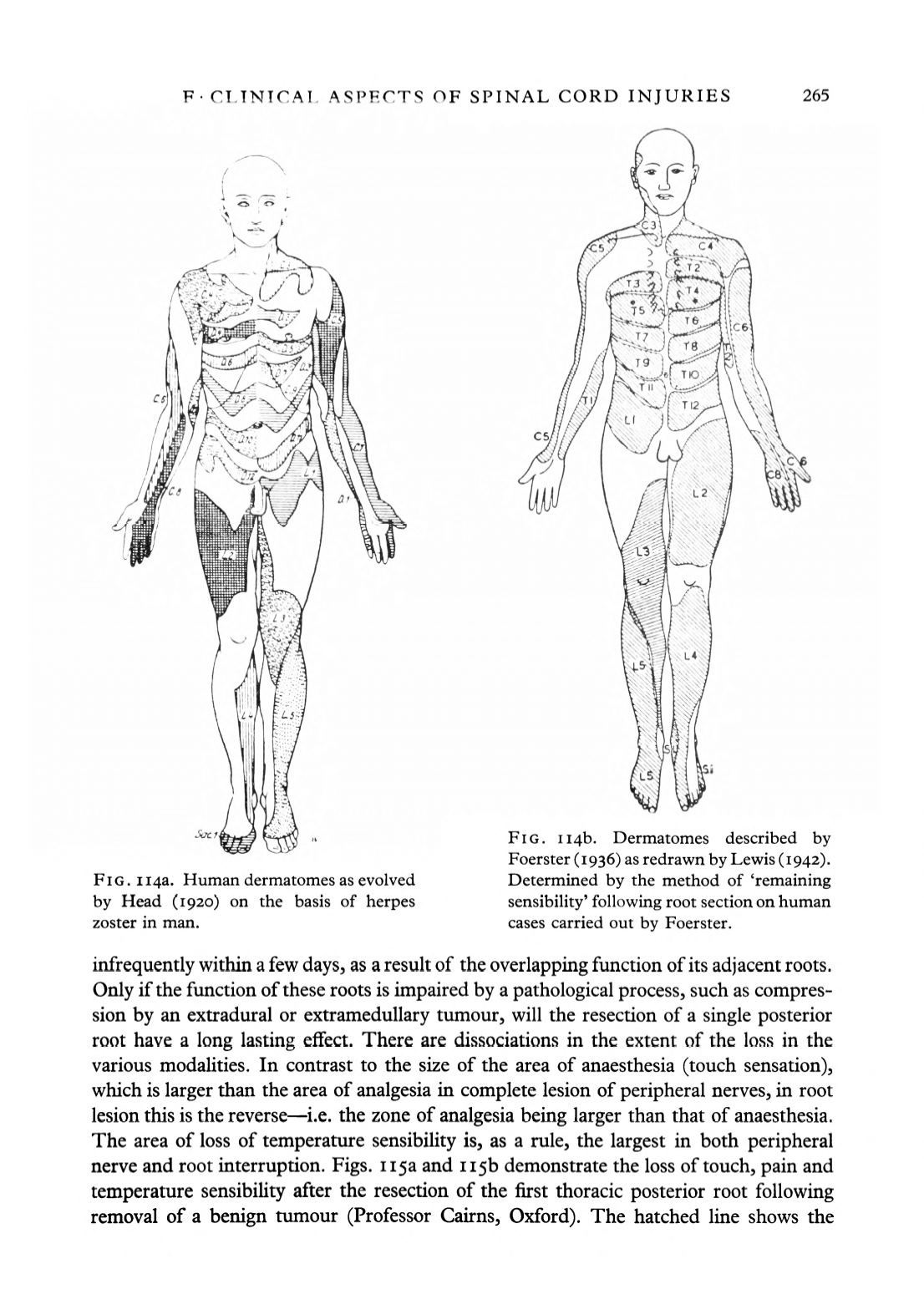
FIG. 1143. Human dermatomes as evolved
by Head (1920) on the basis of herpes
zoster in man.
FIG. H4b. Dermatomes described by
Foerster (1936) as redrawn by Lewis (1942).
Determined by the method of 'remaining
sensibility' following root section on human
cases carried out by Foerster.
infrequently within a few days, as a result of the overlapping function of its adjacent roots.
Only if the function of these roots is impaired by a pathological process, such as compres
sion by an extradural or extramedullary tumour, will the resection of a single posterior
root have a long lasting effect. There are dissociations in the extent of the loss in the
various modalities. In contrast to the size of the area of anaesthesia (touch sensation),
which is larger than the area of analgesia in complete lesion of peripheral nerves, in root
lesion this is the reverse—i.e. the zone of analgesia being larger than that of anaesthesia.
The area of loss of temperature sensibility is, as a rule, the largest in both peripheral
nerve and root interruption. Figs. 1153 and H5b demonstrate the loss of touch, pain and
temperature sensibility after the resection of the first thoracic posterior root following
removal of a benign tumour (Professor Cairns, Oxford). The hatched line shows the


