F •
CLINICAL ASPECTS OF SPINAL CORD INJURIES
389
urethral fistulae whilst at Stoke Mandeville, although the majority of the 2,060 at some
time had been treated by an indwelling catheter which, however, was invariably changed
three times a week by a skilled medical officer. Moreover, in this connection, it may be
again referred to our report (Guttmann & Frankel, 1966) on 476 acute traumatic para
plegics and tetraplegics who were treated over an eleven-year period by intermittent
catheterization using the non-touch technique. Not a single urethral, peno-scrotal or
vesico-vaginal fistula occurred in spite of the many thousand intermittent catheterizations
which were carried out during that long period.
The incidence of peno-scrotal fistulae has been frequently reported in the literature
of other authors. Comarr & Bors (1951) found 43 (7 per cent) fistulae among 619 patients
and recently (1971) 445 (21 per cent) peno-scrotal lesions among 2,074 patients, Bunts
(1958) found 10-6 per cent fistulae in 1,000 patients. One of the reasons for the high
percentage of peno-scrotal fistulae found in certain Spinal Units is most probably the
fact that they receive their spinal cord injuries mainly, if not entirely, at later stages follow
ing injury after inadequate management elsewhere, where catheterization in the acute
and early stages had been left to unskilled medical and, in particular, paramedical staff.
In one patient a vesico-urethral fistula occurred following extensive transurethral
resection which healed by urinary diversion through an indwelling urethral catheter.
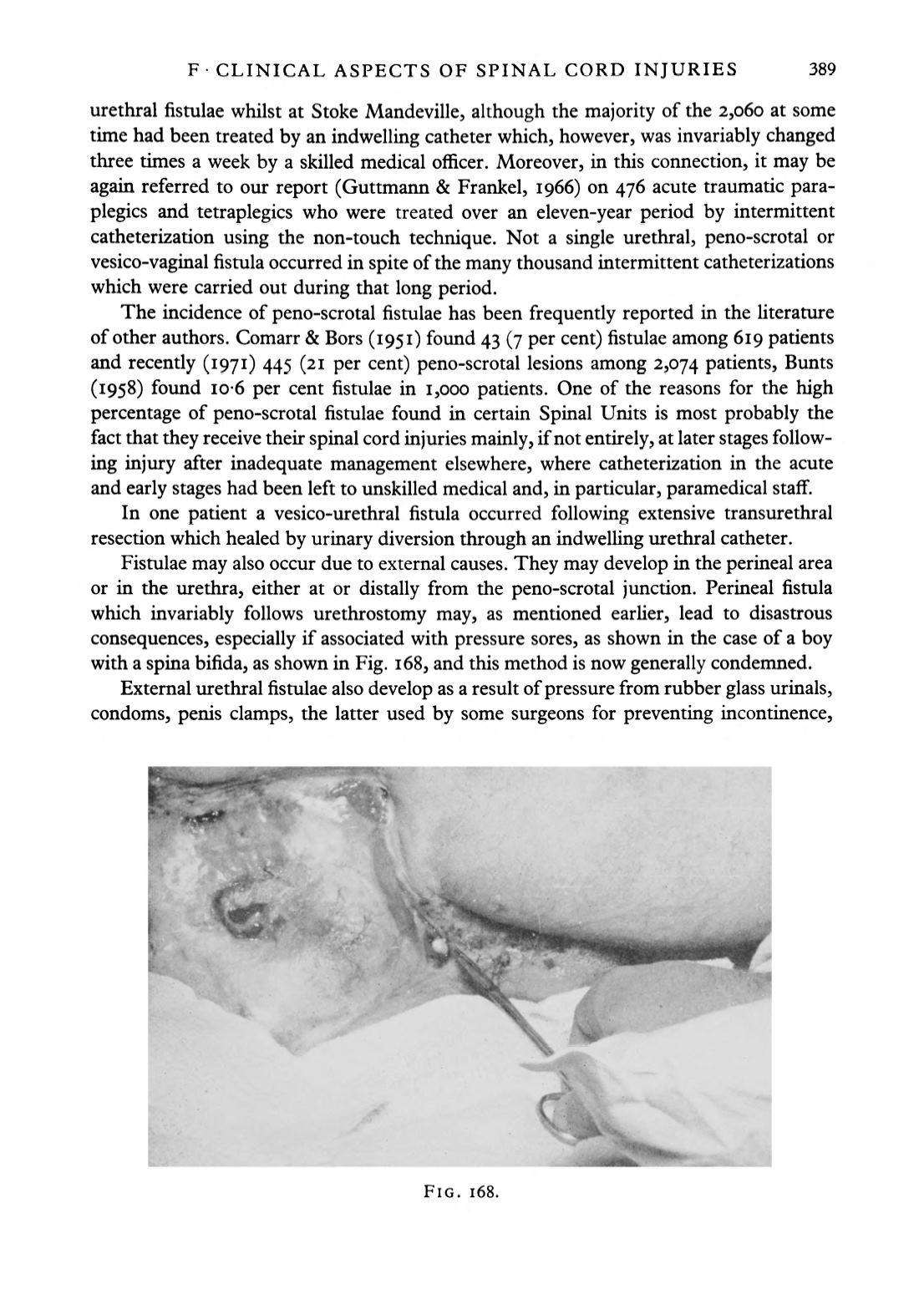
Fistulae may also occur due to external causes. They may develop in the perineal area
or in the urethra, either at or distally from the peno-scrotal junction. Perineal fistula
which invariably follows urethrostomy may, as mentioned earlier, lead to disastrous
consequences, especially if associated with pressure sores, as shown in the case of a boy
with a spina bifida, as shown in Fig. 168, and this method is now generally condemned.
External urethral fistulae also develop as a result of pressure from rubber glass urinals,
condoms, penis clamps, the latter used by some surgeons for preventing incontinence,
FIG. 168.


