F • CLINICAL ASPECTS OF SPINAL CORD INJURIES
399
cystography in detecting reflux. The advantage of cineradiology in the evaluation of
reflux is the demonstration of the flow rate and antiperistaltic waves which may affect
either part or the whole length of the ureter up to the renal pelvis and calyces. Moreover,
this method can be combined with recordings of volume and intravesical pressure.
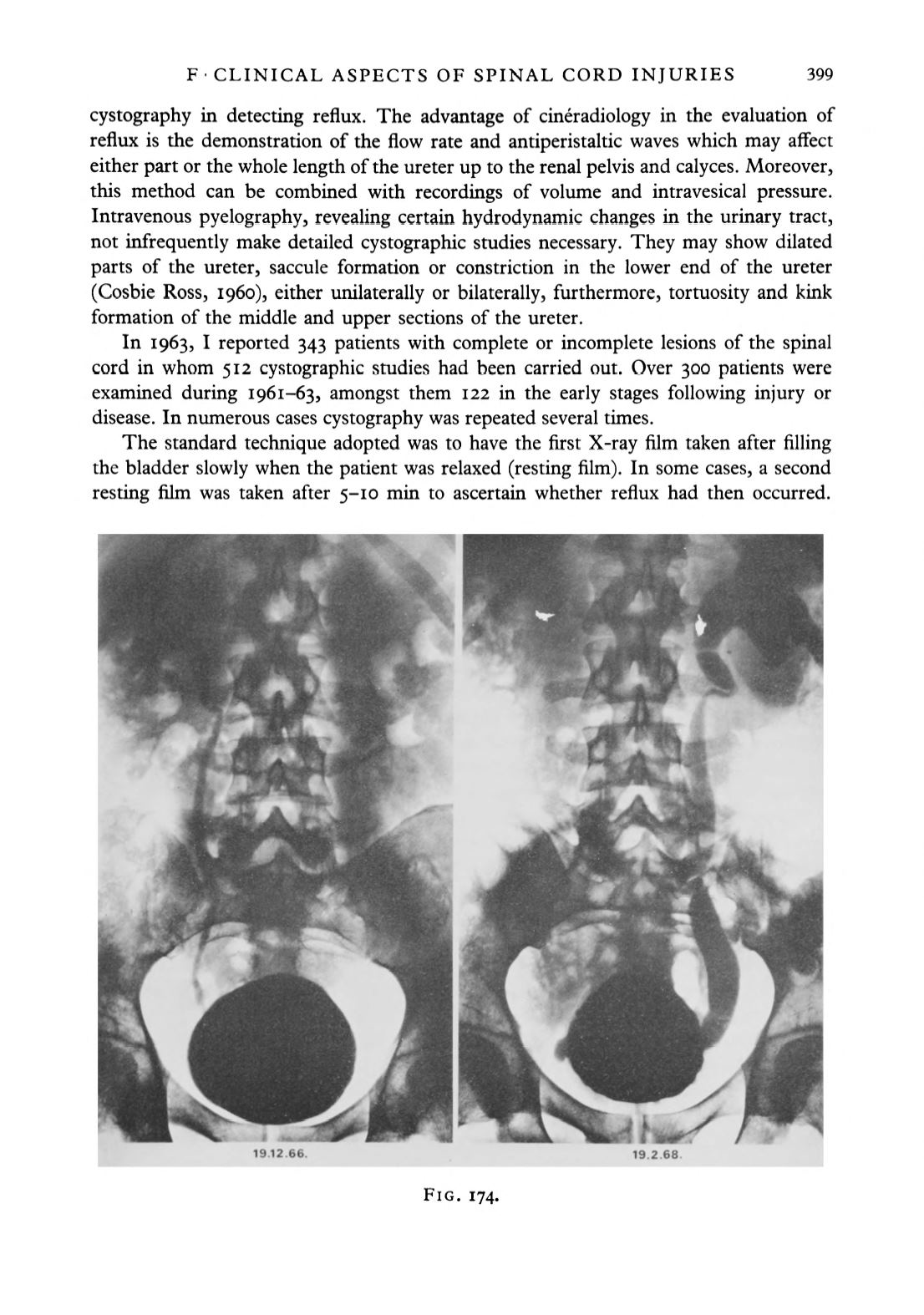
Intravenous pyelography, revealing certain hydrodynamic changes in the urinary tract,
not infrequently make detailed cystographic studies necessary. They may show dilated
parts of the ureter, saccule formation or constriction in the lower end of the ureter
(Cosbie Ross, 1960), either unilaterally or bilaterally, furthermore, tortuosity and kink
formation of the middle and upper sections of the ureter.
In 1963, I reported 343 patients with complete or incomplete lesions of the spinal
cord in whom 512 cystographic studies had been carried out. Over 300 patients were
examined during 1961-63, amongst them
122 in.
the early stages following injury or
disease. In numerous cases cystography was repeated several times.
The standard technique adopted was to have the first X-ray film taken after filling
the bladder slowly when the patient was relaxed (resting film). In some cases, a second
resting film was taken after 5-10 min to ascertain whether reflux had then occurred.
19.12.66.
19.2.68
FIG. 174.


