F- CLINICAL ASPECTS OF SPINAL CORD INJURIES
405
10.9.53.
21.8.62.
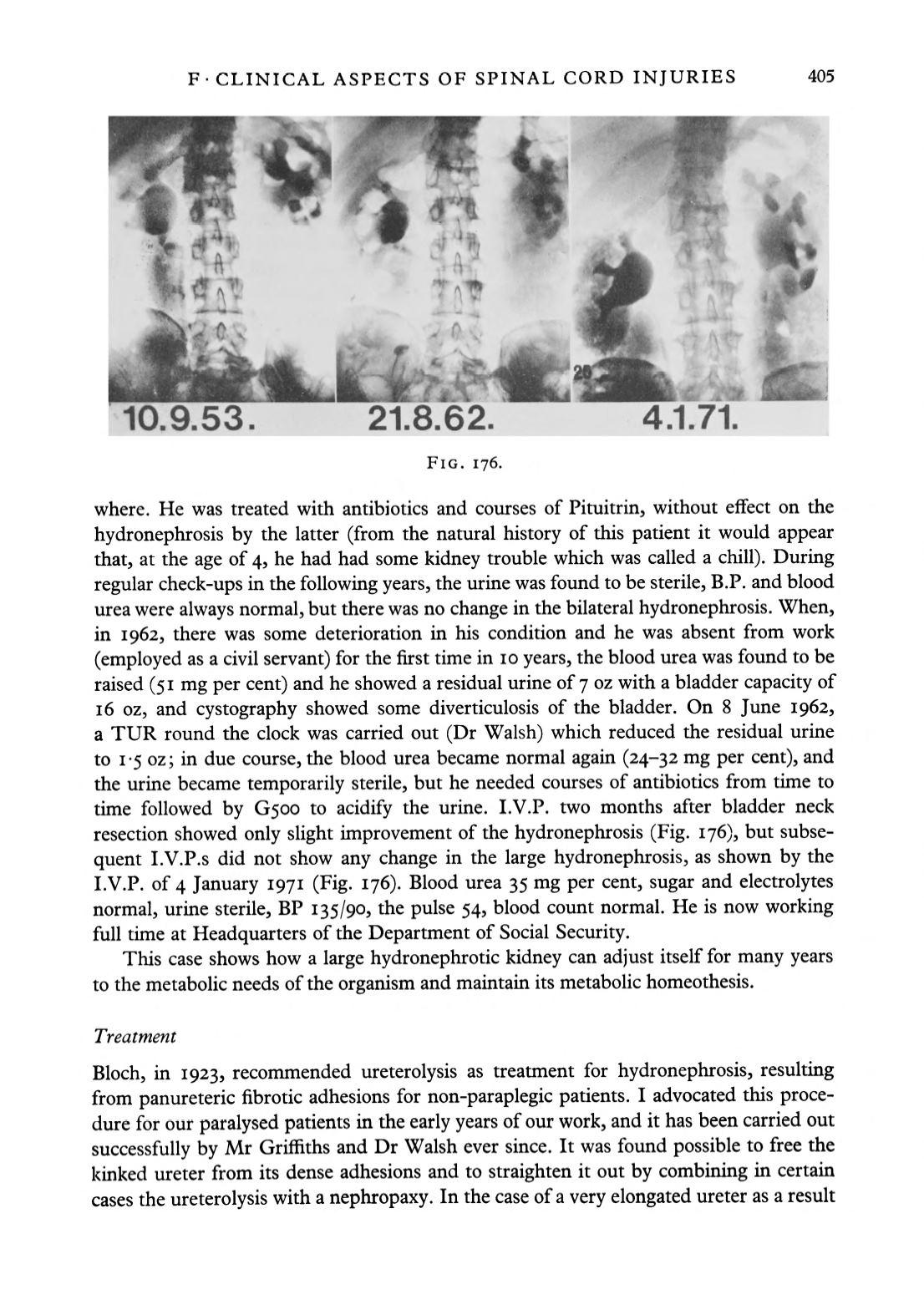
FIG. 176.
4.1.71.
where. He was treated with antibiotics and courses of Pituitrin, without effect on the
hydronephrosis by the latter (from the natural history of this patient it would appear
that, at the age of 4, he had had some kidney trouble which was called a chill). During
regular check-ups in the following years, the urine was found to be sterile, B.P. and blood
urea were always normal, but there was no change in the bilateral hydronephrosis. When,
in 1962, there was some deterioration in his condition and he was absent from work
(employed as a civil servant) for the first time in 10 years, the blood urea was found to be
raised (51 mg per cent) and he showed a residual urine of 7 oz with a bladder capacity of
16 oz, and cystography showed some diverticulosis of the bladder. On 8 June 1962,
a TUR round the clock was carried out (Dr Walsh) which reduced the residual urine
to 1-5 oz; in due course, the blood urea became normal again (24-32 mg per cent), and
the urine became temporarily sterile, but he needed courses of antibiotics from time to
time followed by 0500 to acidify the urine. I.V.P. two months after bladder neck
resection showed only slight improvement of the hydronephrosis (Fig. 176), but subse
quent I.V.P.s did not show any change in the large hydronephrosis, as shown by the
I.V.P. of 4 January 1971 (Fig. 176). Blood urea 35 mg per cent, sugar and electrolytes
normal, urine sterile, BP 135/90, the pulse 54, blood count normal. He is now working
full time at Headquarters of the Department of Social Security.
This case shows how a large hydronephrotic kidney can adjust itself for many years
to the metabolic needs of the organism and maintain its metabolic homeothesis.
Treatment
Bloch, in 1923, recommended ureterolysis as treatment for hydronephrosis, resulting
from panureteric fibretic adhesions for non-paraplegic patients. I advocated this proce
dure for our paralysed patients in the early years of our work, and it has been carried out
successfully by Mr Griffiths and Dr Walsh ever since. It was found possible to free the
kinked ureter from its dense adhesions and to straighten it out by combining in certain
cases the ureterolysis with a nephropaxy. In the case of a very elongated ureter as a result


