406
CHAPTER 26
of kink formations, it may be necessary to alter the course of the ureter by fixing it to the
psoas fascia outside the peritoneum.
In cases with non-obstructive type of hydronephrosis, Yates-Bell (1949, 1953)
recommended a course of fresh Pituitrin consisting of 0-5 cc intramuscularly every day
for 2 weeks, 0-5 cc on alternative days for 2 weeks and a maintenance dose of 0-5 cc once
a week for 6 weeks. This treatment is based on the stimulating effect of Pituitrin on the
ureter eliciting rhythmic contractions, as described by Tona (1928, 1936). We have
confirmed the beneficial effect of this treatment in a few selected cases of unilateral
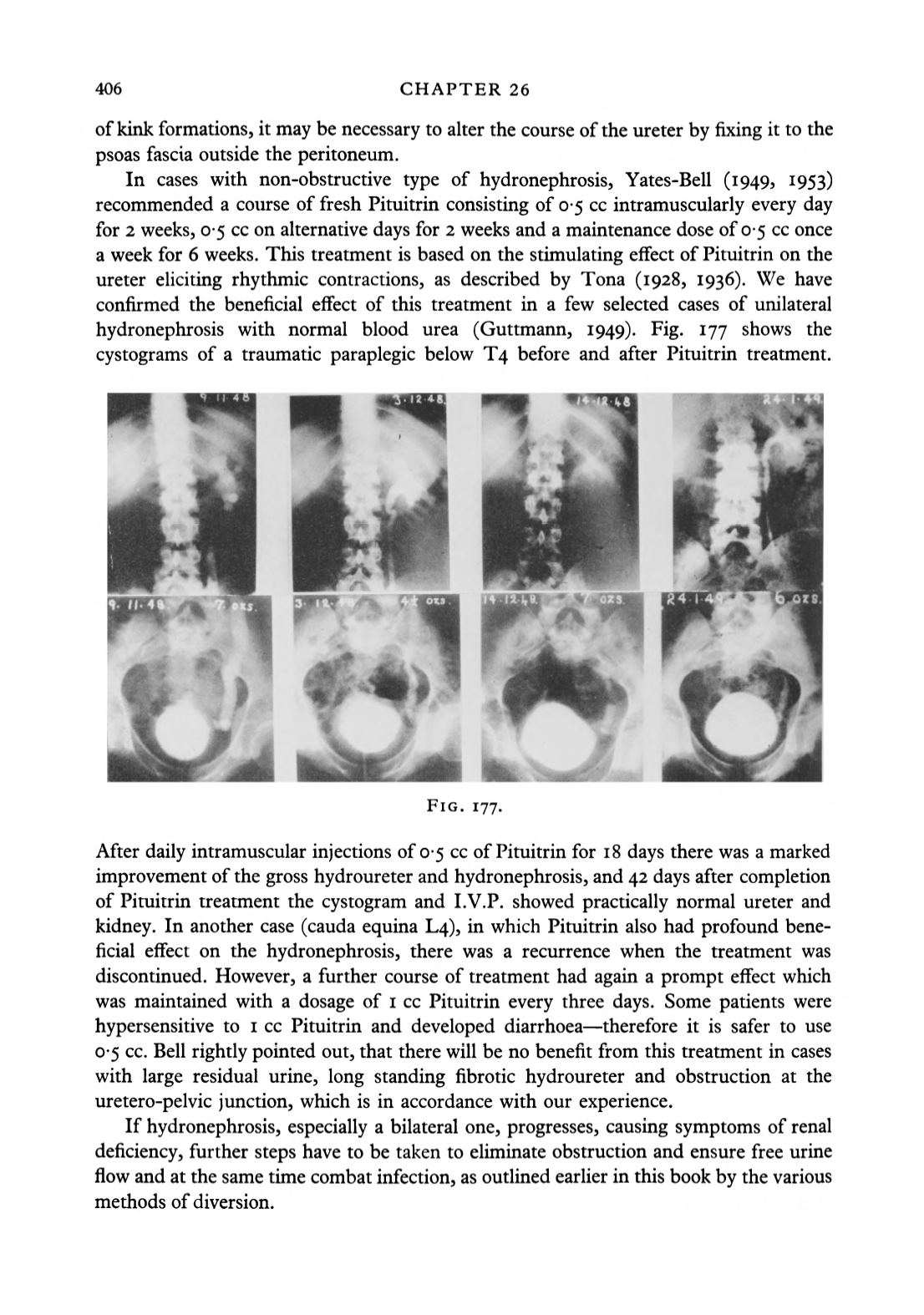
hydronephrosis with normal blood urea (Guttmann, 1949). Fig. 177 shows the
cystograms of a traumatic paraplegic below T4 before and after Pituitrin treatment.
FIG. 177.
After daily intramuscular injections of 0-5 cc of Pituitrin for 18 days there was a marked
improvement of the gross hydroureter and hydronephrosis, and 42 days after completion
of Pituitrin treatment the cystogram and I.V.P. showed practically normal ureter and
kidney. In another case (cauda equina L4), in which Pituitrin also had profound bene
ficial effect on the hydronephrosis, there was a recurrence when the treatment was
discontinued. However, a further course of treatment had again a prompt effect which
was maintained with a dosage of i cc Pituitrin every three days. Some patients were
hypersensitive to i cc Pituitrin and developed diarrhoea—therefore it is safer to use
0-5 cc. Bell rightly pointed out, that there will be no benefit from this treatment in cases
with large residual urine, long standing fibrotic hydroureter and obstruction at the
uretero-pelvic junction, which is in accordance with our experience.
If hydronephrosis, especially a bilateral one, progresses, causing symptoms of renal
deficiency, further steps have to be taken to eliminate obstruction and ensure free urine
flow and at the same time combat infection, as outlined earlier in this book by the various
methods of diversion.


