474
CHAPTER 28
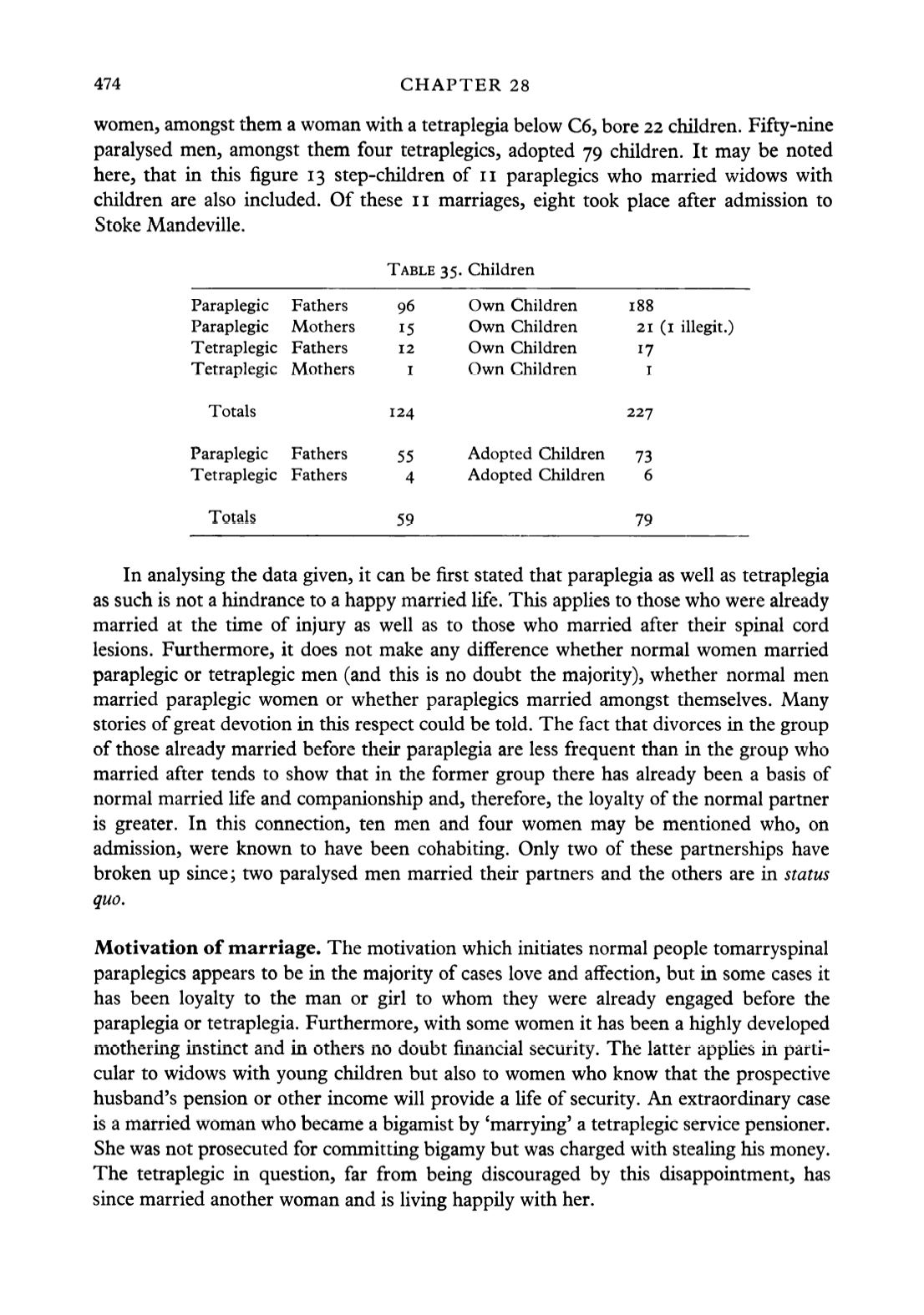
women, amongst them a woman with a tetraplegia below C6, bore 22 children. Fifty-nine
paralysed men, amongst them four tetraplegics, adopted 79 children. It may be noted
here, that in this figure 13 step-children of n paraplegics who married widows with
children are also included. Of these 11 marriages, eight took place after admission to
Stoke Mandeville.
TABLE 35. Children
Paraplegic
Paraplegic
Tetraplegic
Tetraplegic
Fathers
Mothers
Fathers
Mothers
96
15
12
I
Own
Own
Own
Own
Children
Children
Children
Children
188
21 (l
17
i
illegit.)
Totals
124
Paraplegic
Fathers
55
Tetraplegic Fathers
4
Totals
59
227
Adopted Children
73
Adopted Children
6
79
In analysing the data given, it can be first stated that paraplegia as well as tetraplegia
as such is not a hindrance to a happy married life. This applies to those who were already
married at the time of injury as well as to those who married after their spinal cord
lesions. Furthermore, it does not make any difference whether normal women married
paraplegic or tetraplegic men (and this is no doubt the majority), whether normal men
married paraplegic women or whether paraplegics married amongst themselves. Many
stories of great devotion in this respect could be told. The fact that divorces in the group
of those already married before their paraplegia are less frequent than in the group who
married after tends to show that in the former group there has already been a basis of
normal married life and companionship and, therefore, the loyalty of the normal partner
is greater. In this connection, ten men and four women may be mentioned who, on
admission, were known to have been cohabiting. Only two of these partnerships have
broken up since; two paralysed men married their partners and the others are in
status
quo.
Motivation of marriage.
The motivation which initiates normal people tomarryspinal
paraplegics appears to be in the majority of cases love and affection, but in some cases it
has been loyalty to the man or girl to whom they were already engaged before the
paraplegia or tetraplegia. Furthermore, with some women it has been a highly developed
mothering instinct and in others no doubt financial security. The latter applies in parti
cular to widows with young children but also to women who know that the prospective
husband's pension or other income will provide a life of security. An extraordinary case
is a married woman who became a bigamist by 'marrying5 a tetraplegic service pensioner.
She was not prosecuted for committing bigamy but was charged with stealing his money.
The tetraplegic in question, far from being discouraged by this disappointment, has
since married another woman and is living happily with her.


