F- CLINICAL ASPECTS OF SPINAL CORD INJURIES
587
2
for a disabled parent, able to drive, who for a substantial part of the day is in sole
charge of his/her young child;
3
for a disabled person able to drive, who lives with a blind relative;
4
for an eligible disabled person suffering from severe haemophilia.
The cars supplied are taxed and insured by the Department and are replaced free of
charge when required unless the replacement is necessitated by the user's negligence.
The user is responsible for maintenance and repairs but an annual allowance is paid
towards this.
There are various types of conversion to hand-control, both mechanical and servo-
assisted. In Great Britain, Reselco-Invalid Carriages Ltd (London, W.6) have done
pioneer work in the development of hand-controls, and their design has been accepted by
the Ministry for cars which have adequately wide doors to allow easy access for the
paraplegic. The lay-out of the Reselco Conversion control is one of great simplicity.
The clutch and accelerator controls have the form of two 'L'-shaped levers, back to
back forming a T' fitted at about 3 in. below the rim of the steering wheel in the 'three
o'clock' position. The brake has the form of a push-on, spring-off lever at the driver's
left hand.
Getting into and out of the car may present problems to the paraplegic, and training
given in this respect by the physiotherapist should already start, whenever possible,
during the later stages of rehabilitation at the Spinal Centre. Some paraplegics prefer
to slide along a board from their wheelchair to the car seat. Although this has the dis
advantage of being somewhat time consuming, it obviates the necessity for swinging the
whole body weight into the car. However, the majority of paraplegics learn to enter the
car by lifting themselves from their chair on to their car seat, using a handle fitted just
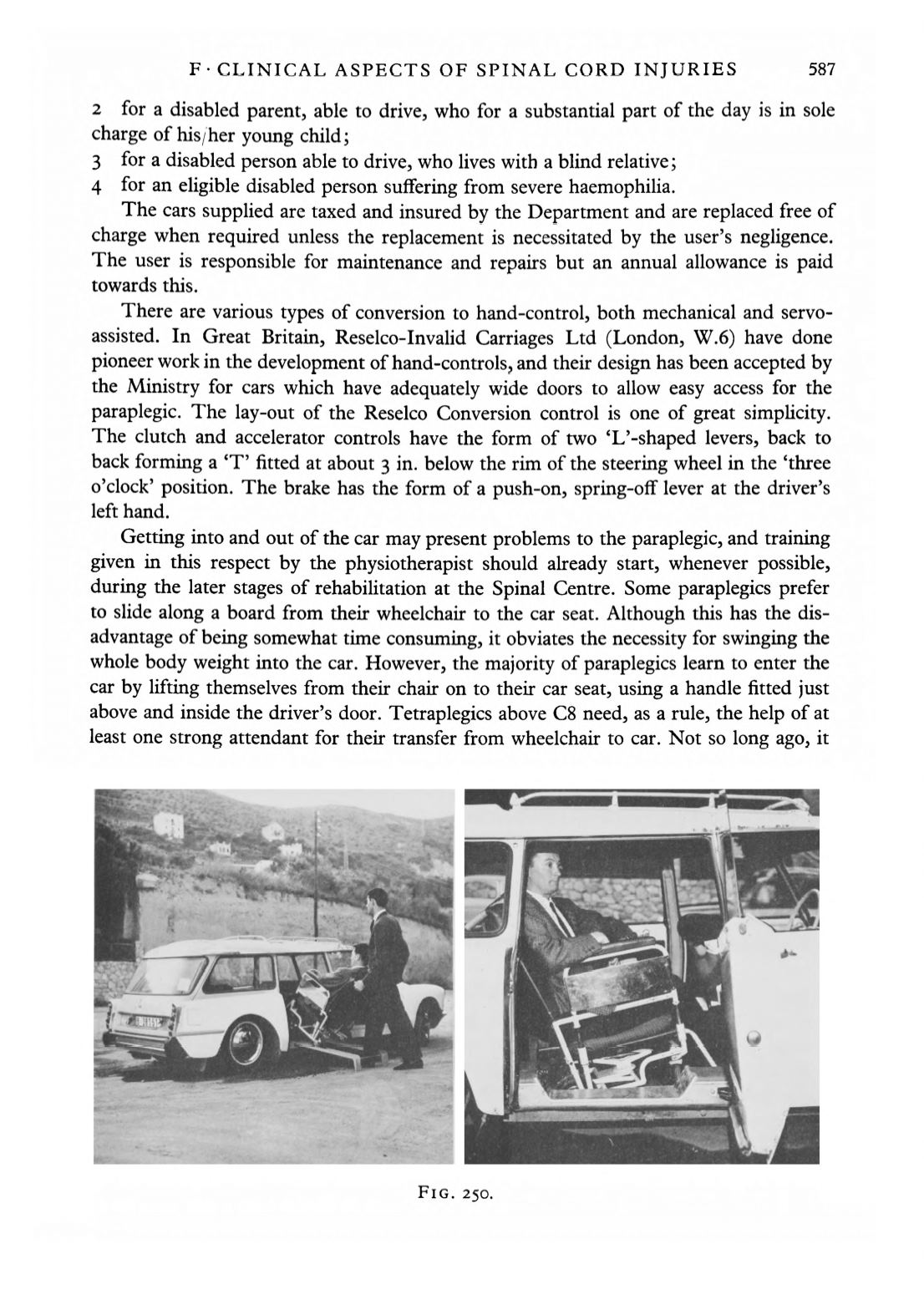
above and inside the driver's door. Tetraplegics above C8 need, as a rule, the help of at
least one strong attendant for their transfer from wheelchair to car. Not so long ago, it
FIG. 250.


