F- CLINICAL ASPECTS OF SPINAL CORD INJURIES
595
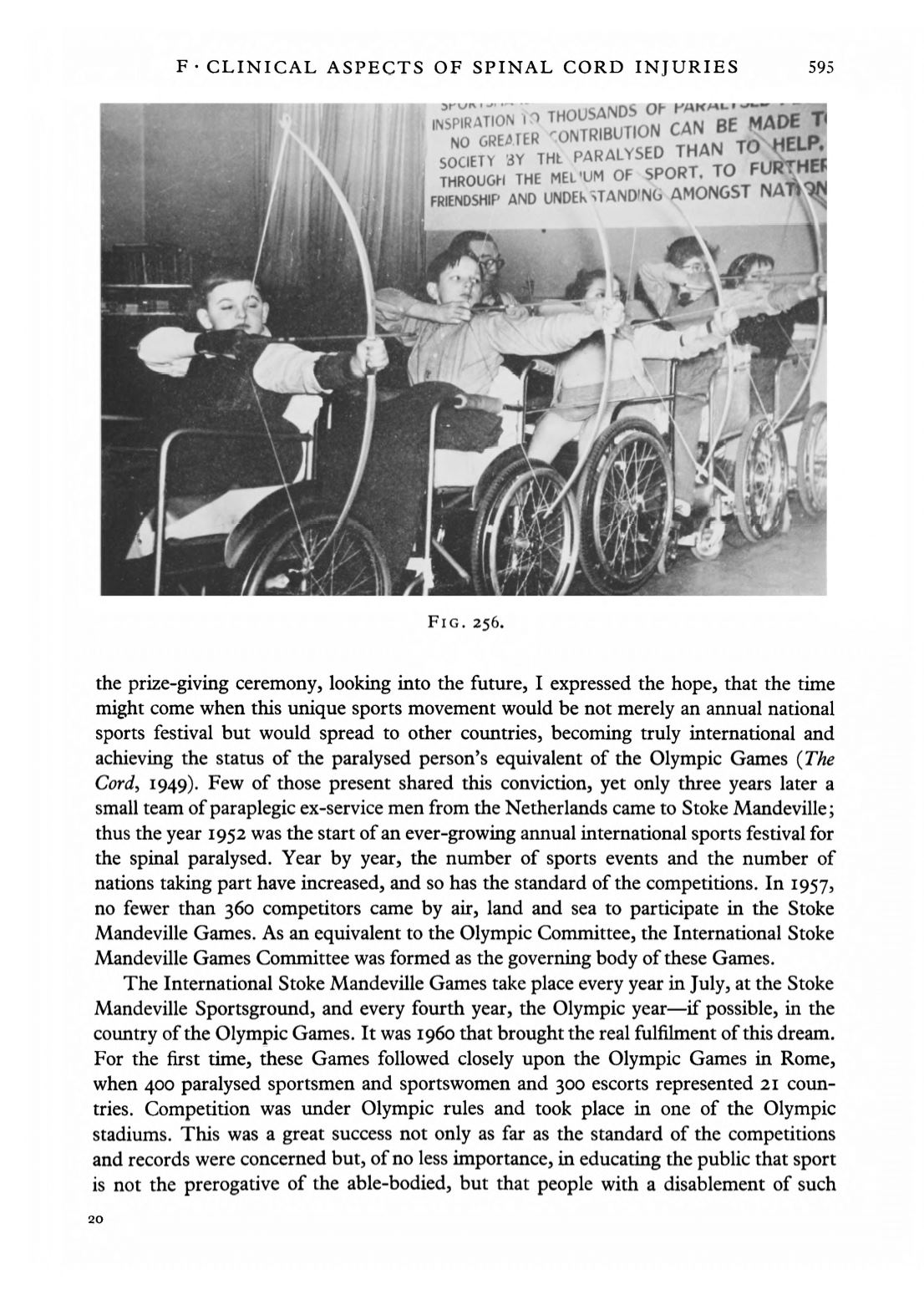
FRIENDSHIP AND UNDEK VTAND'NG AMONGST
«*W"
FIG. 256.
the prize-giving ceremony, looking into the future, I expressed the hope, that the time
might come when this unique sports movement would be not merely an annual national
sports festival but would spread to other countries, becoming truly international and
achieving the status of the paralysed person's equivalent of the Olympic Games
(The
Cord,
1949). Few of those present shared this conviction, yet only three years later a
small team of paraplegic ex-service men from the Netherlands came to Stoke Mandeville;
thus the year 1952 was the start of an ever-growing annual international sports festival for
the spinal paralysed. Year by year, the number of sports events and the number of
nations taking part have increased, and so has the standard of the competitions. In 1957,
no fewer than 360 competitors came by air, land and sea to participate in the Stoke
Mandeville Games. As an equivalent to the Olympic Committee, the International Stoke
Mandeville Games Committee was formed as the governing body of these Games.
The International Stoke Mandeville Games take place every year in July, at the Stoke
Mandeville Sportsground, and every fourth year, the Olympic year—if possible, in the
country of the Olympic Games. It was 1960 that brought the real fulfilment of this dream.
For the first time, these Games followed closely upon the Olympic Games in Rome,
when 400 paralysed sportsmen and sportswomen and 300 escorts represented 21 coun
tries. Competition was under Olympic rules and took place in one of the Olympic
stadiums. This was a great success not only as far as the standard of the competitions
and records were concerned but, of no less importance, in educating the public that sport
is not the prerogative of the able-bodied, but that people with a disablement of such
20


