598
CHAPTER 35
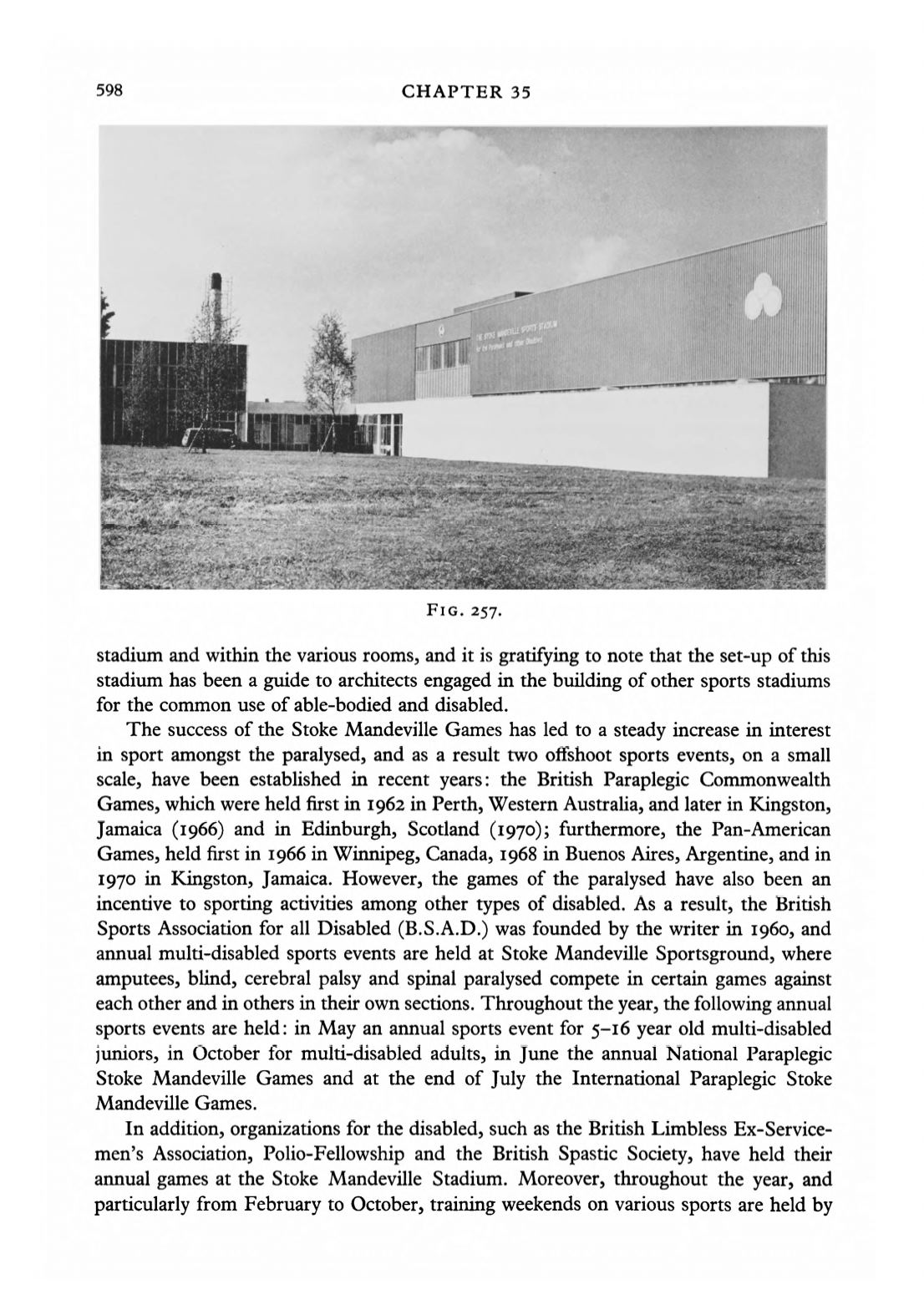
FIG. 257.
stadium and within the various rooms, and it is gratifying to note that the set-up of this
stadium has been a guide to architects engaged in the building of other sports stadiums
for the common use of able-bodied and disabled.
The success of the Stoke Mandeville Games has led to a steady increase in interest
in sport amongst the paralysed, and as a result two offshoot sports events, on a small
scale, have been established in recent years: the British Paraplegic Commonwealth
Games, which were held first in 1962 in Perth, Western Australia, and later in Kingston,
Jamaica (1966) and in Edinburgh, Scotland (1970); furthermore, the Pan-American
Games, held first in 1966 in Winnipeg, Canada, 1968 in Buenos Aires, Argentine, and in
1970 in Kingston, Jamaica. However, the games of the paralysed have also been an
incentive to sporting activities among other types of disabled. As a result, the British
Sports Association for all Disabled (B.S.A.D.) was founded by the writer in 1960, and
annual multi-disabled sports events are held at Stoke Mandeville Sportsground, where
amputees, blind, cerebral palsy and spinal paralysed compete in certain games against
each other and in others in their own sections. Throughout the year, the following annual
sports events are held: in May an annual sports event for 5-16 year old multi-disabled
juniors, in October for multi-disabled adults, in June the annual National Paraplegic
Stoke Mandeville Games and at the end of July the International Paraplegic Stoke
Mandeville Games.
In addition, organizations for the disabled, such as the British Limbless Ex-Service
men's Association, Polio-Fellowship and the British Spastic Society, have held their
annual games at the Stoke Mandeville Stadium. Moreover, throughout the year, and
particularly from February to October, training weekends on various sports are held by


