C DISLOCATIONS OF THE VERTEBRAL COLUMN
95
(B) FRACTURES OF VERTEBRAL BODIES AND THEIR
ARTICULATIONS
(i) Cervical spine
The cervical spine is the most movable part of the vertebral column and, although the
vertebrae are locked together to form a very stable column, extensive movements in
extension, flexion, rotation and sideways tilting are possible.
(a) FRACTURES AND DISLOCATIONS OF THE ATLAS
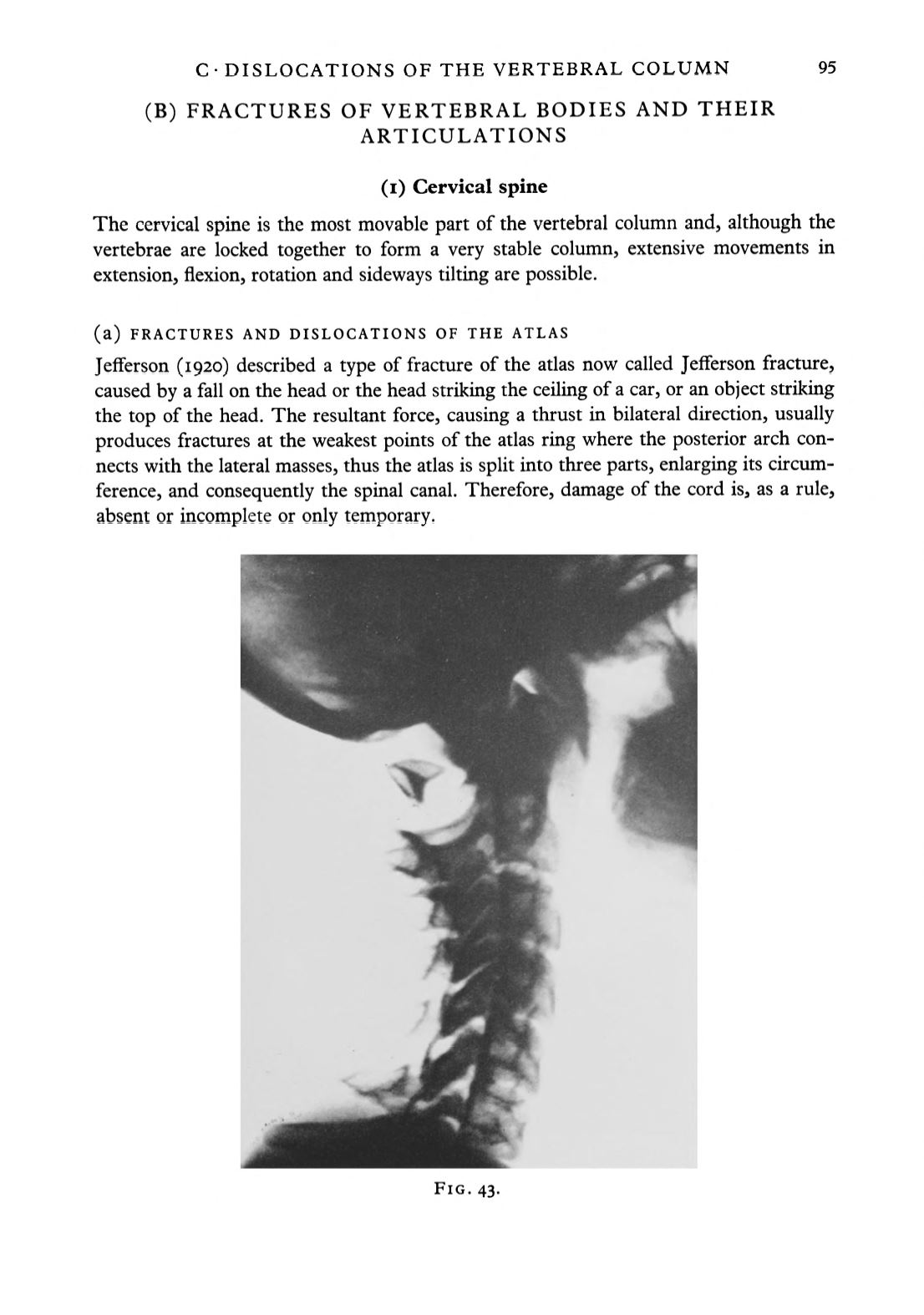
Jefferson (1920) described a type of fracture of the atlas now called Jefferson fracture,
caused by a fall on the head or the head striking the ceiling of a car, or an object striking
the top of the head. The resultant force, causing a thrust in bilateral direction, usually
produces fractures at the weakest points of the atlas ring where the posterior arch con–
nects with the lateral masses, thus the atlas is split into three parts, enlarging its circum–
ference, and consequently the spinal canal. Therefore, damage of the cord isa as a rule,
absent or incomplete or only temporary.
FIG. 43.


