102
CHAPTER 11
27-12
-
58.
26-12 -58.
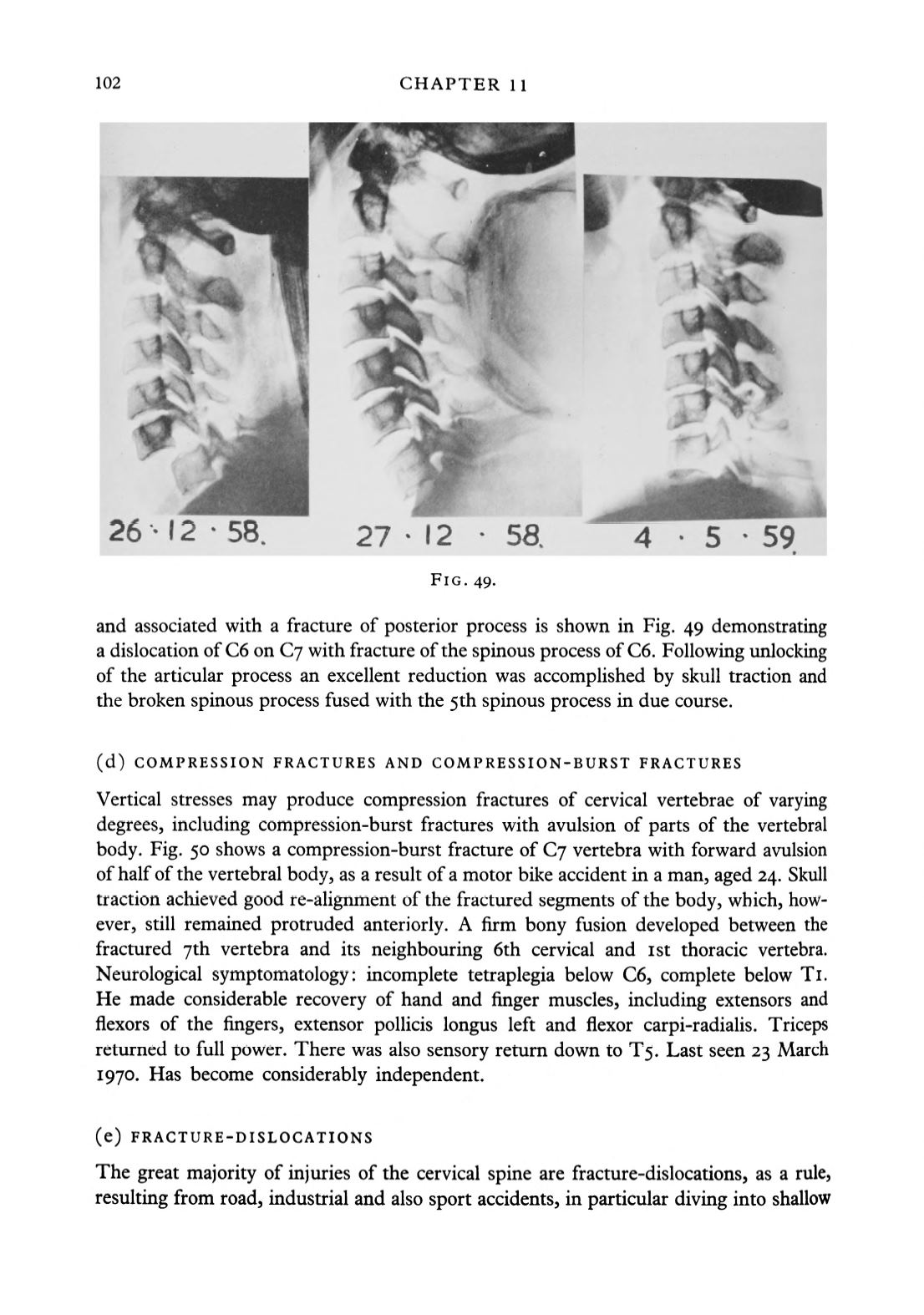
and associated with a fracture of posterior process is shown in Fig. 49 demonstrating
a dislocation of C6 on Cy with fracture of the spinous process of C6. Following unlocking
of the articular process an excellent reduction was accomplished by skull traction and
the broken spinous process fused with the 5th spinous process in due course.
(d) COMPRESSION FRACTURES AND COMPRESSION-BURST FRACTURES
Vertical stresses may produce compression fractures of cervical vertebrae of varying
degrees, including compression-burst fractures with avulsion of parts of the vertebral
body. Fig. 50 shows a compression-burst fracture of Cy vertebra with forward avulsion
of half of the vertebral body, as a result of a motor bike accident in a man, aged 24. Skull
traction achieved good re-alignment of the fractured segments of the body, which, how
ever, still remained protruded anteriorly. A firm bony fusion developed between the
fractured yth vertebra and its neighbouring 6th cervical and ist thoracic vertebra.
Neurological symptomatology: incomplete tetraplegia below C6, complete below Ti.
He made considerable recovery of hand and finger muscles, including extensors and
flexors of the fingers, extensor pollicis longus left and flexor carpi-radialis. Triceps
returned to full power. There was also sensory return down to T5. Last seen 23 March
1970. Has become considerably independent.
(e) FRACTURE-DISLOCATIONS
The great majority of injuries of the cervical spine are fracture-dislocations, as a rule,
resulting from road, industrial and also sport accidents, in particular diving into shallow


