C-DISLOCATIONS OF THE VERTEBRAL COLUMN
111
COMPRESSION FRACTURES
There are great varieties of compression fractures ranging from slight or moderate com
pression of the superior and/or inferior plates of the vertebral body as shown in Fig. 60
of a case with compression of the superior plate. Moreover, there may be more or less
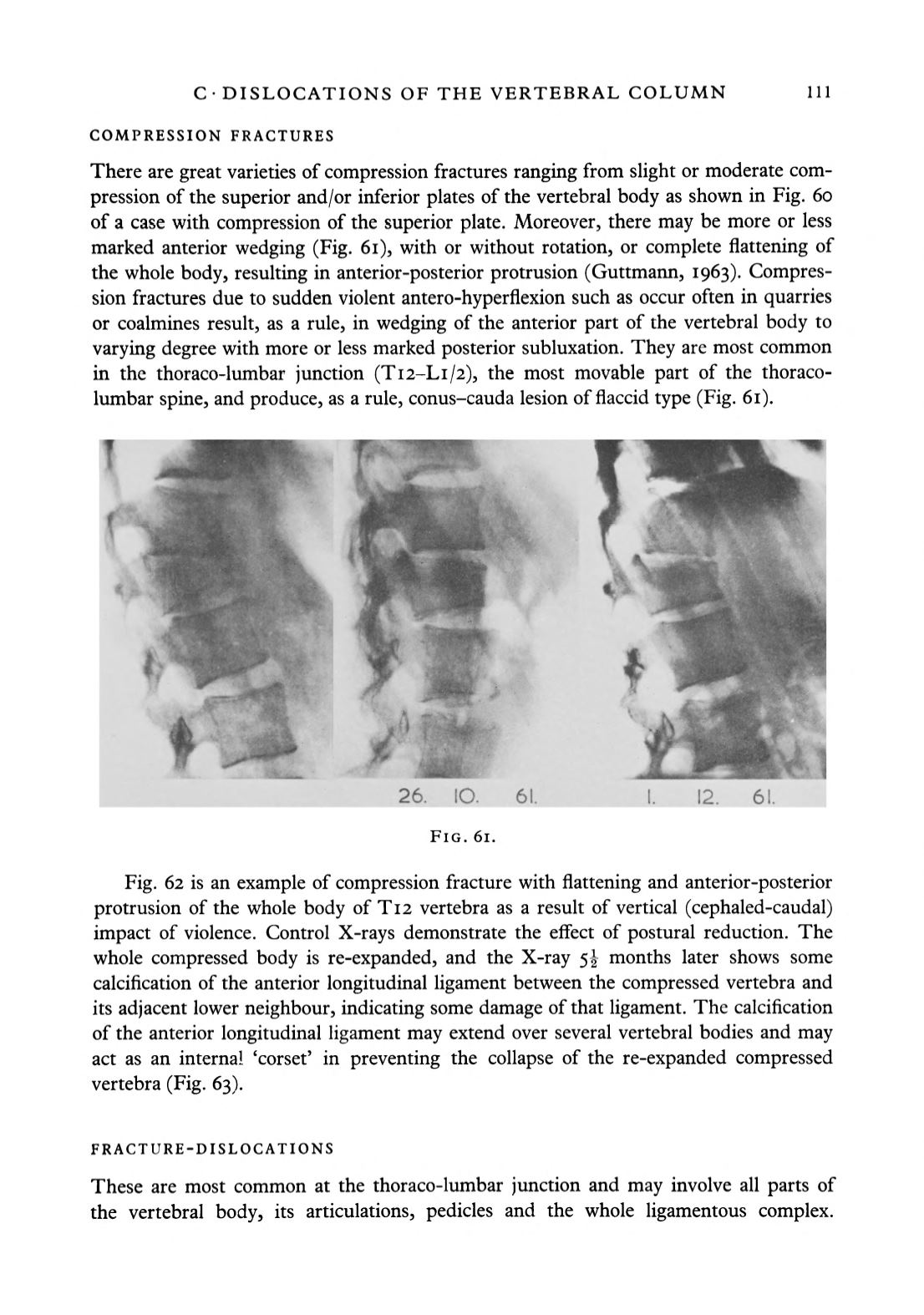
marked anterior wedging (Fig. 61), with or without rotation, or complete flattening of
the whole body, resulting in anterior-posterior protrusion (Guttmann, 1963). Compres
sion fractures due to sudden violent antero-hyperflexion such as occur often in quarries
or coalmines result, as a rule, in wedging of the anterior part of the vertebral body to
varying degree with more or less marked posterior subluxation. They are most common
in the thoraco-lumbar junction (Ti2-Li/2), the most movable part of the thoraco-
lumbar spine, and produce, as a rule, conus-cauda lesion of flaccid type (Fig. 61).
12.
61.
Fig. 62 is an example of compression fracture with flattening and anterior-posterior
protrusion of the whole body of Ti2 vertebra as a result of vertical (cephaled-caudal)
impact of violence. Control X-rays demonstrate the effect of postural reduction. The
whole compressed body is re-expanded, and the X-ray 5^ months later shows some
calcification of the anterior longitudinal ligament between the compressed vertebra and
its adjacent lower neighbour, indicating some damage of that ligament. The calcification
of the anterior longitudinal ligament may extend over several vertebral bodies and may
act as an internal 'corset' in preventing the collapse of the re-expanded compressed
vertebra (Fig. 63).
FRACTURE-DISLOCATIONS
These are most common at the thoraco-lumbar junction and may involve all parts of
the vertebral body, its articulations, pedicles and the whole ligamentous complex.


