106
CHAPTER 11
piece rejoined the body forming in due course a firm bony fusion with the adjacent C5
vertebra. The initially blocked spinal canal was freed. In another case of this type of
burst fracture-dislocation, a piece of the anterior-inferior part of the fractured €5
vertebra was chipped off upward and rejoined later the upper margin of the anterior
part of the vertebra forming a firm bony junction with the adjacent €4 vertebra (Fig. 53).
The initially almost complete tetraplegia recovered with mild residual spasticity in the
legs. The patient is full-time employed.
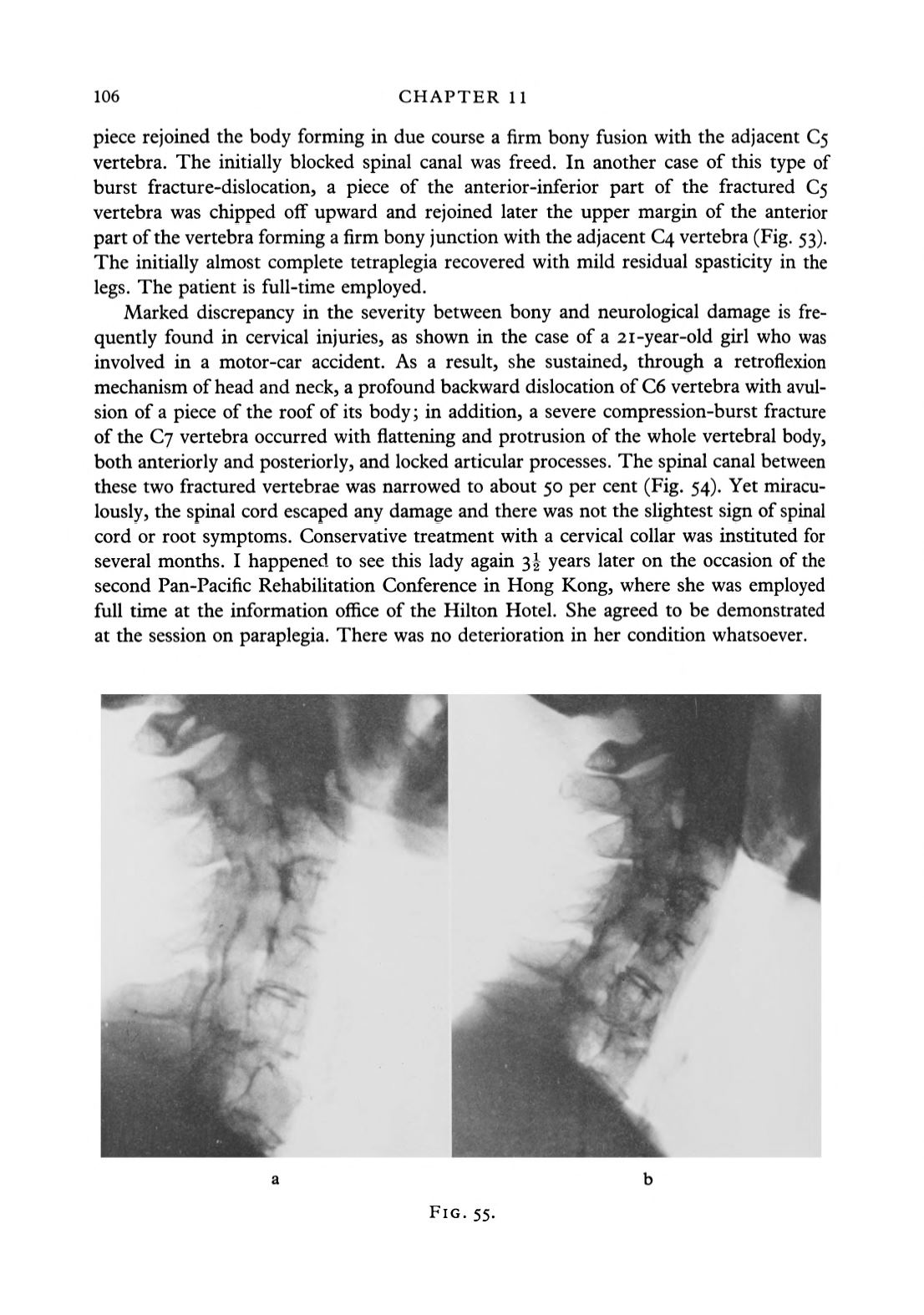
Marked discrepancy in the severity between bony and neurological damage is fre
quently found in cervical injuries, as shown in the case of a 21-year-old girl who was
involved in a motor-car accident. As a result, she sustained, through a retroflexion
mechanism of head and neck, a profound backward dislocation of C6 vertebra with avul
sion of a piece of the roof of its body; in addition, a severe compression-burst fracture
of the
Cj
vertebra occurred with flattening and protrusion of the whole vertebral body,
both anteriorly and posteriorly, and locked articular processes. The spinal canal between
these two fractured vertebrae was narrowed to about 50 per cent (Fig. 54). Yet miracu
lously, the spinal cord escaped any damage and there was not the slightest sign of spinal
cord or root symptoms. Conservative treatment with a cervical collar was instituted for
several months. I happened to see this lady again 3 J years later on the occasion of the
second Pan-Pacific Rehabilitation Conference in Hong Kong, where she was employed
full time at the information office of the Hilton Hotel. She agreed to be demonstrated
at the session on paraplegia. There was no deterioration in her condition whatsoever.
FIG. 55.


