C • DISLOCATIONS OF THE VERTEBRAL COLUMN
101
following a fall down from the top of a flight of stairs while under the influence of alcohol.
The X-ray also shows a congenital fusion of the 2nd and 3rd cervical vertebrae. The neuro
logical symptomatology was that of a traction lesion of the 5th cervical roots on the right
side only with paralysis of the deltoid and partial paralysis of the biceps and sensory
loss over the 5th cervical root distribution. Full anatomical reduction and complete
recovery of the root lesion occurred without skull traction following bed rest with retro-
flexion of the cervical spine produced by a supporting small semi-hard cushion under
neath the neck, followed by the application of a cervical collar.
(ii)
Dislocations
In this type of injury of the whole vertebral body, caused, as a rule, by retro-hyperflexion
of head and cervical spine, the interspinous, anterior and posterior ligaments may be
ruptured, the lateral articular capsules torn and the intervertebral disc more or less
disrupted. As a result, instability of the spine occurs, unless the articular facets are locked
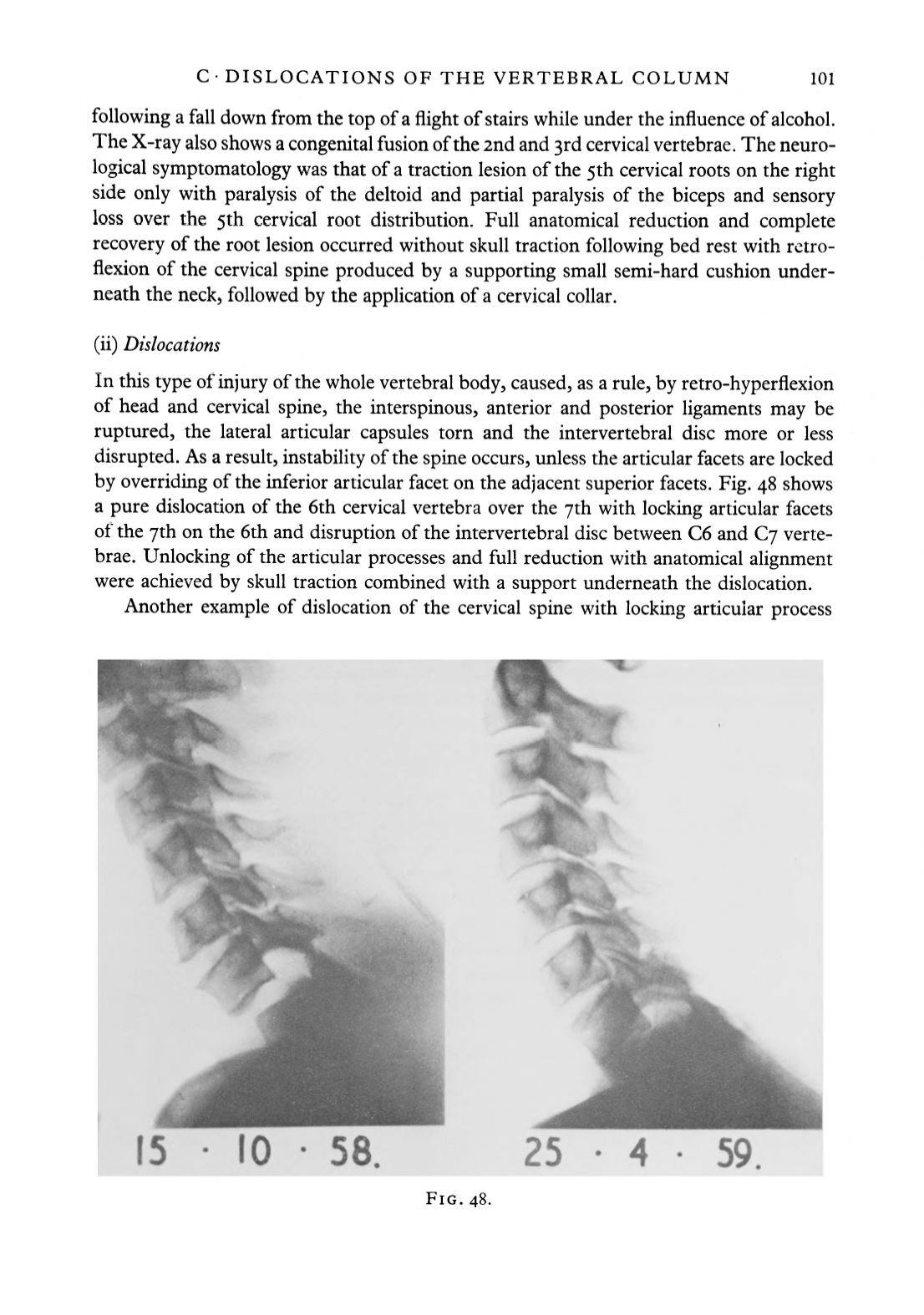
by overriding of the inferior articular facet on the adjacent superior facets. Fig. 48 shows
a pure dislocation of the 6th cervical vertebra over the yth with locking articular facets
of the yth on the 6th and disruption of the intervertebral disc between C6 and Cy verte
brae. Unlocking of the articular processes and full reduction with anatomical alignment
were achieved by skull traction combined with a support underneath the dislocation.
Another example of dislocation of the cervical spine with locking articular process
15
FIG. 48.


