118
CHAPTER 11
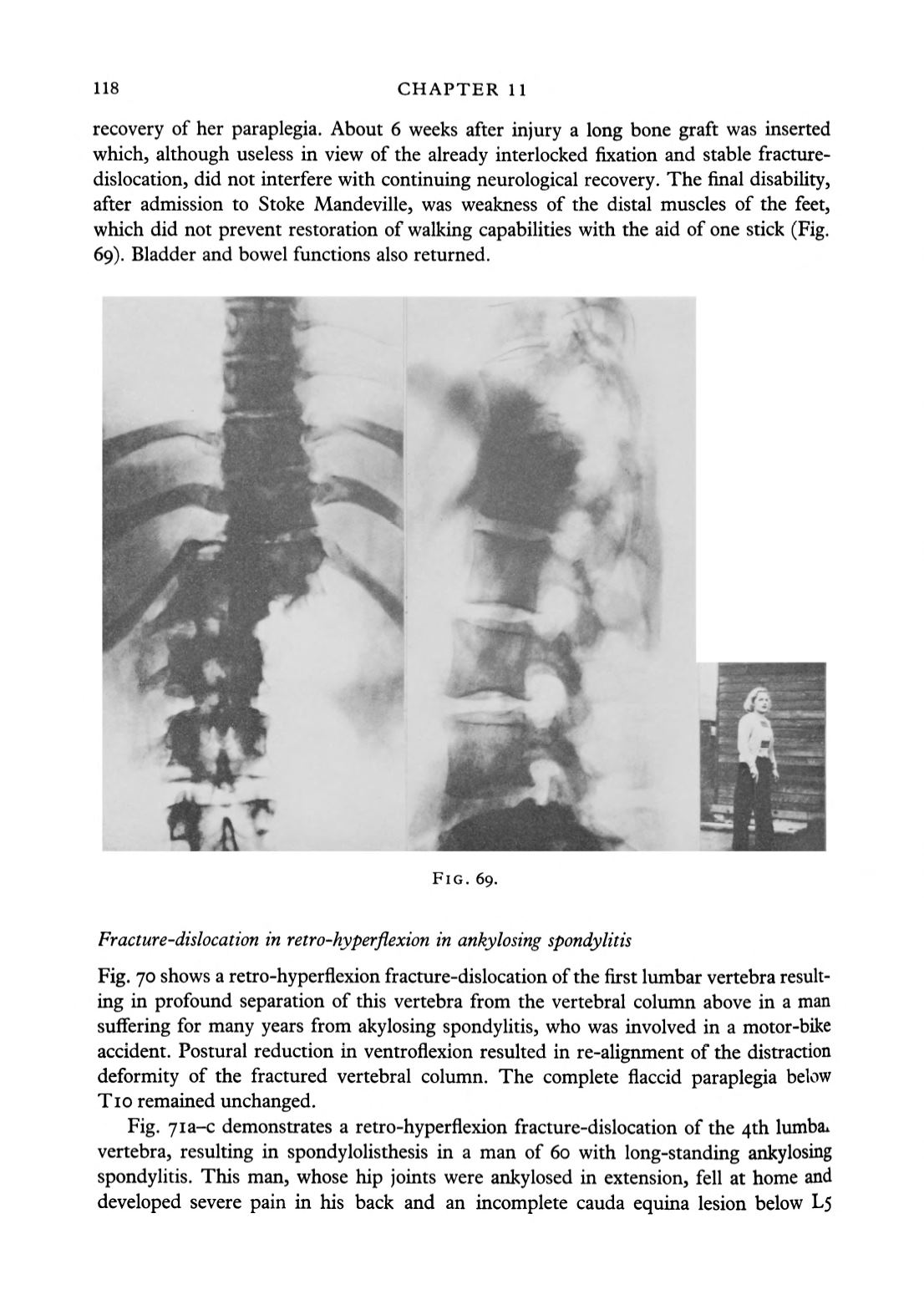
recovery of her paraplegia. About 6 weeks after injury a long bone graft was inserted
which, although useless in view of the already interlocked fixation and stable fracture-
dislocation, did not interfere with continuing neurological recovery. The final disability,
after admission to Stoke Mandeville, was weakness of the distal muscles of the feet,
which did not prevent restoration of walking capabilities with the aid of one stick (Fig.
69). Bladder and bowel functions also returned.
FIG. 69.
Fracture-dislocation in retro-hyperflexion in ankylosing spondylitis
Fig. 70 shows a retro-hyperflexion fracture-dislocation of the first lumbar vertebra result
ing in profound separation of this vertebra from the vertebral column above in a man
suffering for many years from akylosing spondylitis, who was involved in a motor-bike
accident. Postural reduction in ventroflexion resulted in re-alignment of the distraction
deformity of the fractured vertebral column. The complete flaccid paraplegia below
Tio remained unchanged.
Fig. yia-c demonstrates a retro-hyperflexion fracture-dislocation of the 4th lumba*
vertebra, resulting in spondylolisthesis in a man of 60 with long-standing ankylosing
spondylitis. This man, whose hip joints were ankylosed in extension, fell at home and
developed severe pain in his back and an incomplete cauda equina lesion below L5


