D - GUNSHOT INJURIES AND STAB WOUNDS
171
and economic conditions and, moreover, the shortage of more sophisticated weapons
amongst these people, accounts for this very large material of stab wounds. In contrast,
there are only 4 cases of stab wounds in our own material over a period of 27 years—
three women and one man. The latter was admitted during the war with a bayonet wound
of the neck resulting in an incomplete cervical lesion from which he almost completely
recovered by conservative treatment. When I visited Lipschitz's spinal unit in 1957
almost every second or third patient had a stab wound of the spinal cord but at the time
of my second visit in 1970 the percentage was infinitely lower as a result of improved
social and economic conditions amongst Africans. Seventy-three per cent of stab wounds
affected the thoracic, 15 per cent the cervical and 8 per cent the lumbar regions. There
was a discrepancy between the level of the external wound and the level of the cord injury.
In only 4 per cent was there a leakage of C.S.F. through the wound. Key & Retief (1971)
of the spinal unit, Cape Town, reported about 70 stab wounds amongst 300 new lesions
admitted between November 1963 and January 1967 to the Spinal Unit at Conradie
Hospital in Cape Town, which also reveals a high percentage of stab wounds of spinal
cord injuries.
The vast majority of victims of stab wounds amongst the coloured people in South
Africa are men, the age varying between 15 and 50 years. Various types of knives are
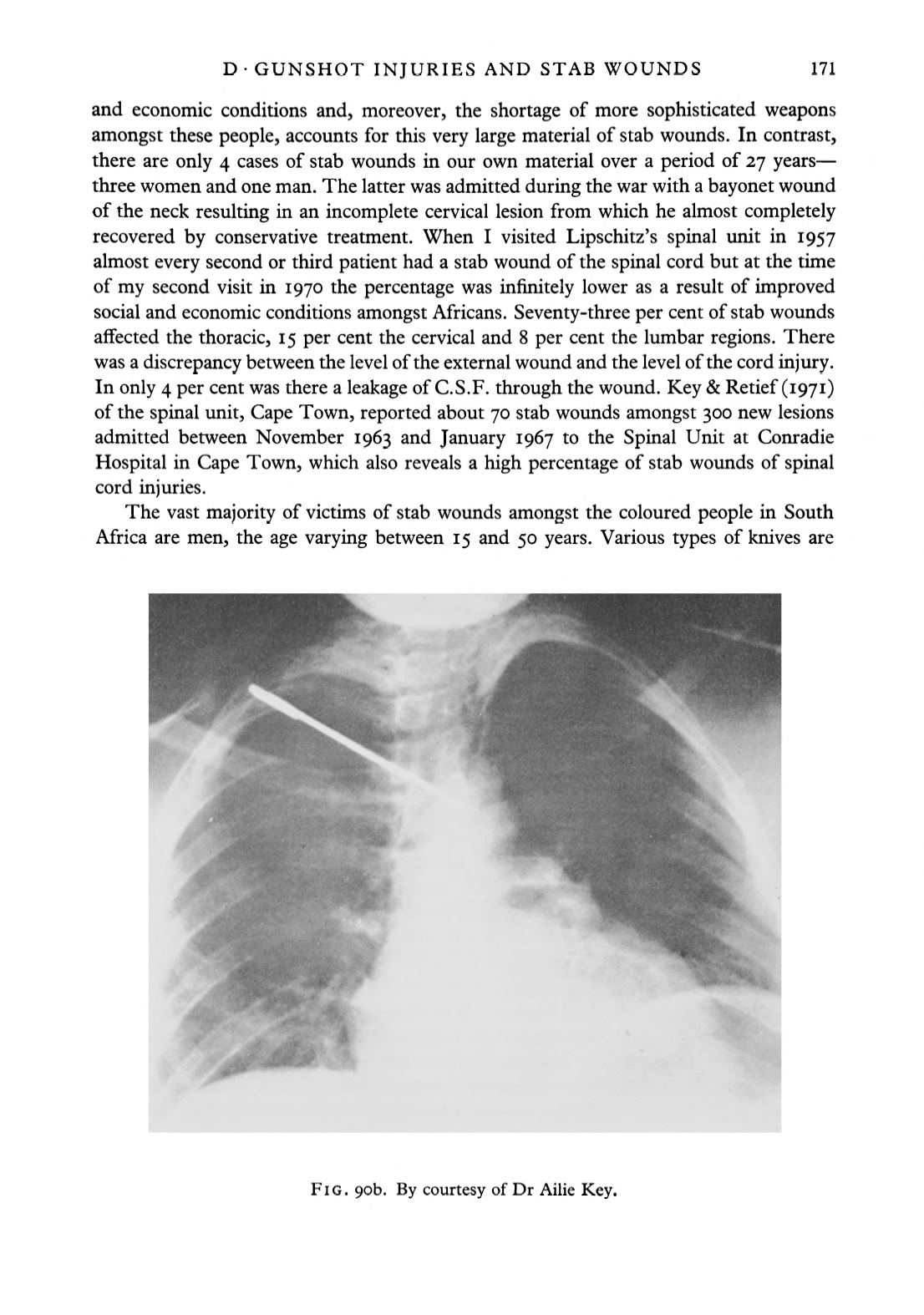
FIG. 9ob. By courtesy of Dr Ailie Key.


