D • GUNSHOT INJURIES AND STAB WOUNDS
163
sustained a complete transection of the cord below T8. He was admitted several months
after injury in a pitiful condition due to sepsis from a huge sacral bedsore which was
healed at Stoke Mandeville (Fig. 86). The man made a good rehabilitation but died
10 years later from renal deficiency resulting from ascending infection following supra-
pubic cystotomy.
(3)
Missile lodged extramedullary but intradurally
In this group there is a greater possibility of incomplete cord lesions and immediate
removal of the missile may result in more or less improvement of the neurological symp
toms (Jourdan, 1915; Marburg & Ranzi, 1917; Foerster, 1929). However, the immediate
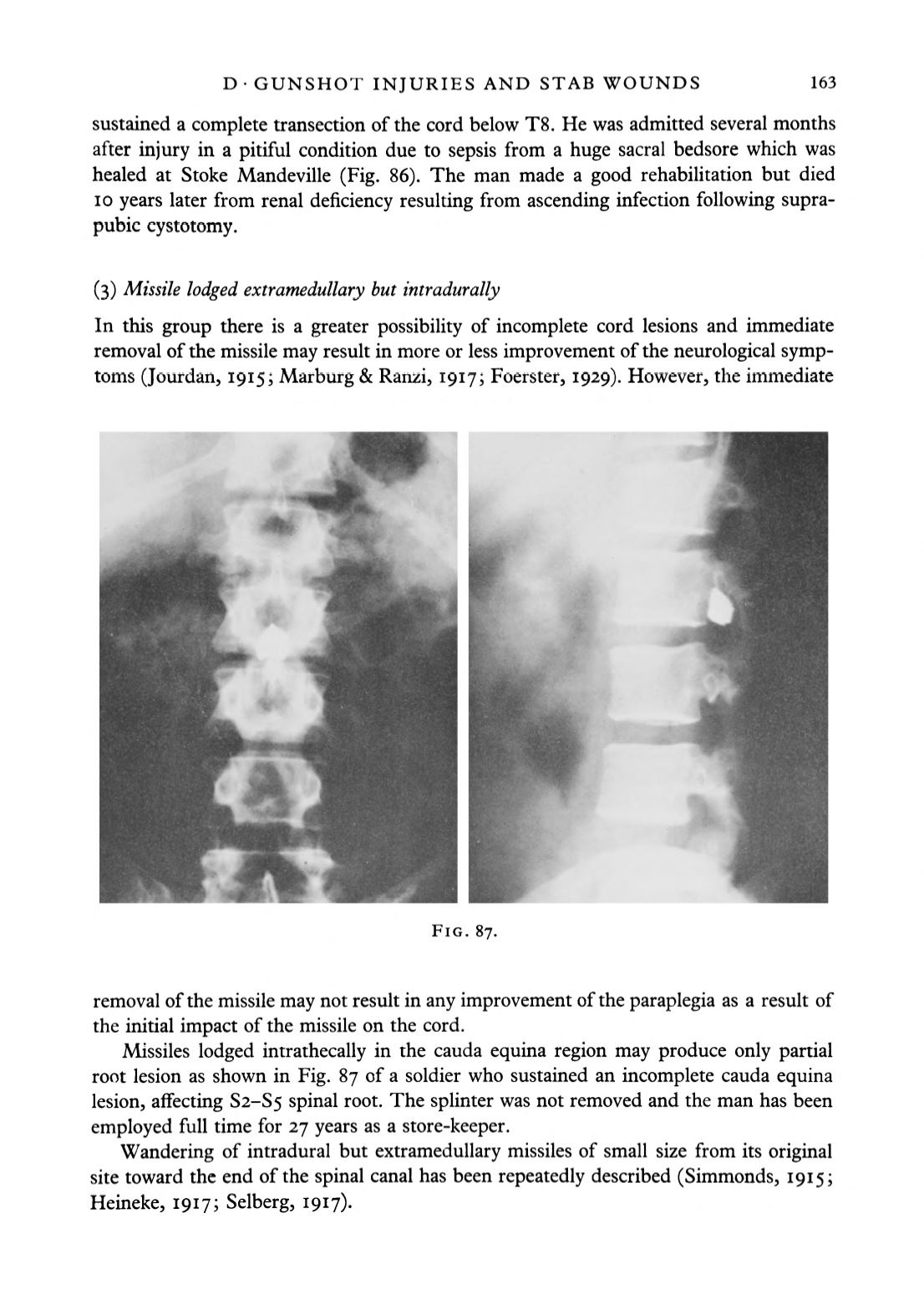
FIG. 87.
removal of the missile may not result in any improvement of the paraplegia as a result of
the initial impact of the missile on the cord.
Missiles lodged intrathecally in the cauda equina region may produce only partial
root lesion as shown in Fig. 87 of a soldier who sustained an incomplete cauda equina
lesion, affecting 82-85 spinal root. The splinter was not removed and the man has been
employed full time for 27 years as a store-keeper.
Wandering of intradural but extramedullary missiles of small size from its original
site toward the end of the spinal canal has been repeatedly described (Simmonds, 1915;
Heineke, 1917; Selberg, 1917).


