172
CHAPTER 14
used as weapons for attack or defence but other sharp instruments are also employed
such as screwdrivers and bicycle spokes. While most of the stab wounds in Lipschitz's
material are the result of generalized stabbing, in some instances they have been deliber
ately inflicted with great skill to the spine to produce paraplegia or tetraplegia, particu
larly when a gang of young detribalized Bantus, called 'zossies', the equivalent of our
'rockers' or 'greasers', wish to take revenge on an opponent (Figs. 903 and b). Stab
wounds are often not confined to the spine but may injure other organs in transit, such as
major vessels, the brachial plexus, trachea or oesophagus, the lung, heart, diaphragm and
abdominal organs which on admission to the hospital need priority treatment to save the
life of the victim. Lipschitz found 86 associated injuries in 252 stab wounds of the spinal
cord.
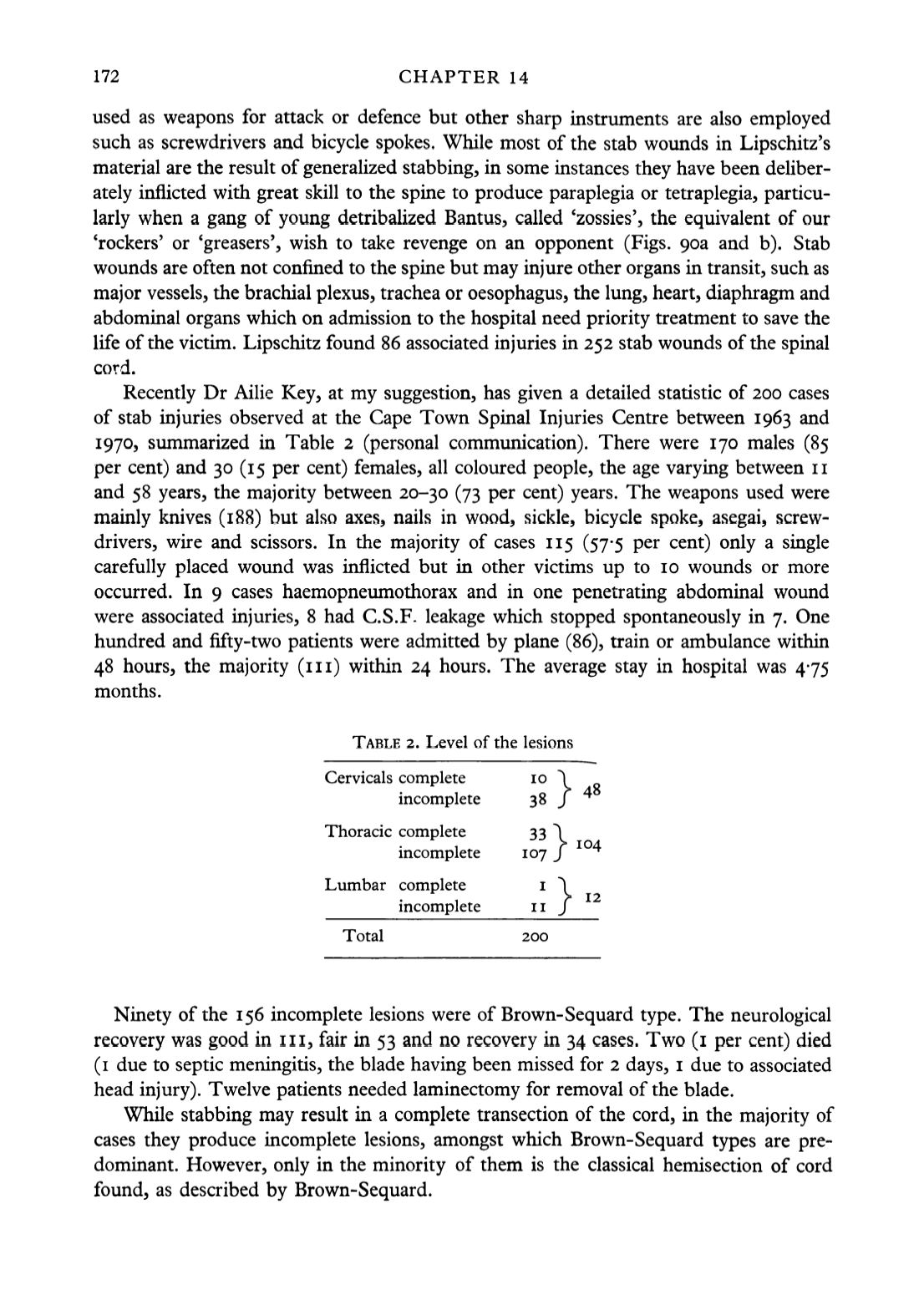
Recently Dr Ailie Key, at my suggestion, has given a detailed statistic of 200 cases
of stab injuries observed at the Cape Town Spinal Injuries Centre between 1963 and
1970, summarized in Table 2 (personal communication). There were 170 males (85
per cent) and 30 (15 per cent) females, all coloured people, the age varying between n
and 58 years, the majority between 20-30 (73 per cent) years. The weapons used were
mainly knives (188) but also axes, nails in wood, sickle, bicycle spoke, asegai, screw
drivers, wire and scissors. In the majority of cases 115 (57-5 per cent) only a single
carefully placed wound was inflicted but in other victims up to 10 wounds or more
occurred. In 9 cases haemopneumothorax and in one penetrating abdominal wound
were associated injuries, 8 had C.S.F. leakage which stopped spontaneously in 7. One
hundred and fifty-two patients were admitted by plane (86), train or ambulance within
48 hours, the majority (HI) within 24 hours. The average stay in hospital was 475
months.
TABLE 2. Level of the lesions
Cervicals complete
10
incomplete
38
Thoracic complete
33
i
r
104
incomplete
107 J
Lumbar complete
i
incomplete
11
Total
200
Ninety of the 156 incomplete lesions were of Brown-Sequard type. The neurological
recovery was good in HI, fair in 53 and no recovery in 34 cases. Two (i per cent) died
(i due to septic meningitis, the blade having been missed for 2 days, i due to associated
head injury). Twelve patients needed laminectomy for removal of the blade.
While stabbing may result in a complete transection of the cord, in the majority of
cases they produce incomplete lesions, amongst which Brown-Sequard types are pre
dominant. However, only in the minority of them is the classical hemisection of cord
found, as described by Brown-Sequard.


