160
CHAPTER 13
According to Matson (1948) the overall mortality rate over a 9 months period of 482
patients of the U.S. First Army who reached field and evacuation hospitals was 14-5 per
cent. The mortality rate of 93 cases in one individual evacuation hospital was 16-1 per
cent and of 85 cases in another was 14-1 per cent.
How greatly the immediate and early mortality rate following injuries of the spinal
cord during the later stages of the Second World War decreased as a result of the intro
duction of a new system of treatment at the Stoke Mandeville Spinal Injuries Centre
is shown by a statistic of 351 gunshot injuries admitted during the beginning of February
1944 to 1950 (Guttmann, 1953); 33 patients (9-3 per cent) died and this figure includes
patients who died after discharge from the Centre, including 7 patients who died from
causes unrelated to their spinal cord lesions, such as tuberculosis, empyema, cerebral
haemorrhage and road accident. The corrected figure is, therefore, only 7-4 per cent.
The mortality rate of an earlier statistic of 177 patients was 7-3 per cent, the corrected
figure 5-6 per cent.
MECHANISM AND CLASSIFICATIONS
It must first be stressed that spinal cord lesions may not be the direct result of a gunshot
injury to the cord but may occur as a result of a fall or sudden strong contraction of the
back—or neck muscles. Schlagwitz (1920) reported a soldier with a gunshot injury
through the heart who by violent retroflexion of head and neck at the moment of injury
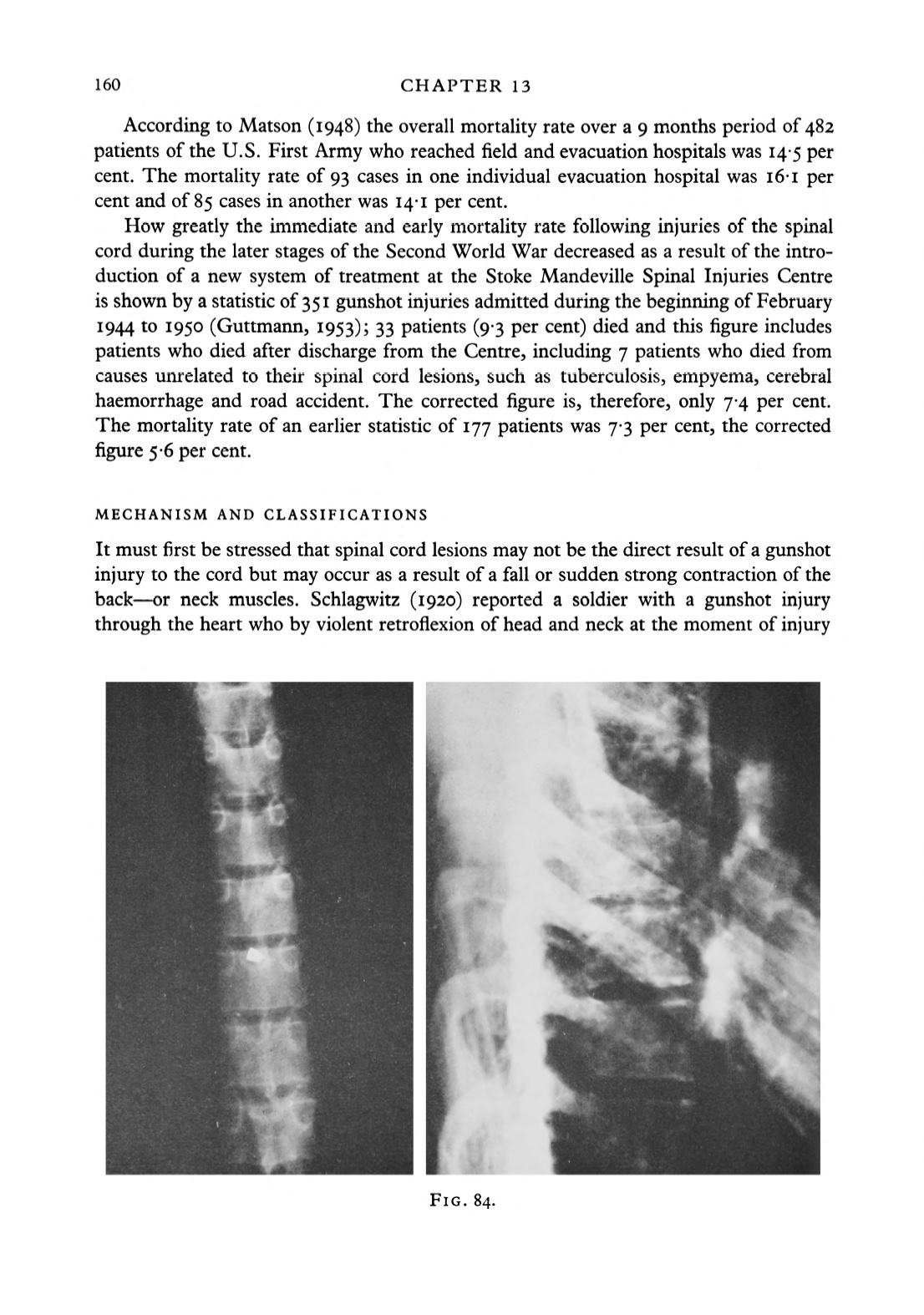
FIG. 84.


