152
CHAPTER 12
21-1O-64
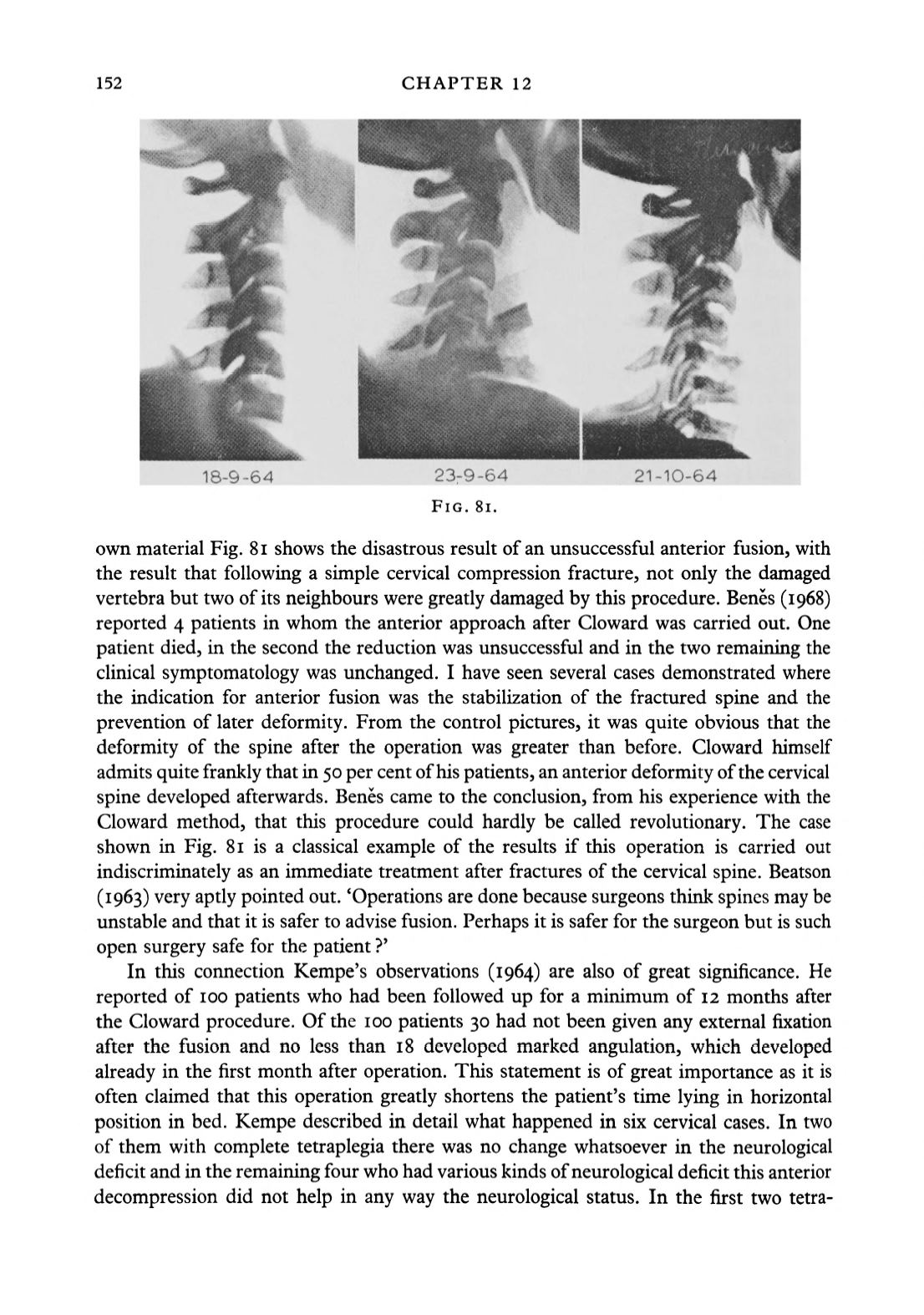
own material Fig. 81 shows the disastrous result of an unsuccessful anterior fusion, with
the result that following a simple cervical compression fracture, not only the damaged
vertebra but two of its neighbours were greatly damaged by this procedure. Benes (1968)
reported 4 patients in whom the anterior approach after Cloward was carried out. One
patient died, in the second the reduction was unsuccessful and in the two remaining the
clinical symptomatology was unchanged. I have seen several cases demonstrated where
the indication for anterior fusion was the stabilization of the fractured spine and the
prevention of later deformity. From the control pictures, it was quite obvious that the
deformity of the spine after the operation was greater than before. Cloward himself
admits quite frankly that in 50 per cent of his patients, an anterior deformity of the cervical
spine developed afterwards. Benes came to the conclusion, from his experience with the
Cloward method, that this procedure could hardly be called revolutionary. The case
shown in Fig. 81 is a classical example of the results if this operation is carried out
indiscriminately as an immediate treatment after fractures of the cervical spine. Beatson
(1963) very aptly pointed out. 'Operations are done because surgeons think spines may be
unstable and that it is safer to advise fusion. Perhaps it is safer for the surgeon but is such
open surgery safe for the patient ?'
In this connection Kempe's observations (1964) are also of great significance. He
reported of 100 patients who had been followed up for a minimum of 12 months after
the Cloward procedure. Of the 100 patients 30 had not been given any external fixation
after the fusion and no less than 18 developed marked angulation, which developed
already in the first month after operation. This statement is of great importance as it is
often claimed that this operation greatly shortens the patient's time lying in horizontal
position in bed. Kempe described in detail what happened in six cervical cases. In two
of them with complete tetraplegia there was no change whatsoever in the neurological
deficit and in the remaining four who had various kinds of neurological deficit this anterior
decompression did not help in any way the neurological status. In the first two tetra-


