F- CLINICAL ASPECTS OF SPINAL CORD INJURIES
325
individually by special investigations, as mentioned previously. The causes of these
disturbances may lie primarily in dysfunction of the afferent or efferent components of
the vesical reflex arc and its synaptic connections, resulting in hypo- or hyperreflexia
of the bladder. Furthermore, flexor or extensor spasms of skeletal muscles resulting
from the heightened reflex activity of the isolated cord itself may also influence the reflex
activity of the bladder. For instance, flexor spasms of the legs may interrupt reflex
micturition in progress. Moreover, any irritative process elsewhere in the organism, such
as an ingrowing toe nail, may greatly increase the spasticity. On the other hand, structural
changes in the various compartments of the urinary tract itself, such as diverticulosis,
hypertrophy of the bladder neck, changes of the external urethral sphincter, and above
all, those produced by active infection, may be responsible for increased vesical dysfunc
tion. All these abnormalities influencing each other, may eventually affect capacity and
shape of the bladder.
The most serious and troublesome type of disco-ordinated automatic bladder is the
uninhibited-hypertonic cord bladder, whereby even small amounts of urine evoke very
frequent detrusor contractions of varying intensity, producing almost constant voiding
of smaller or greater quantities of urine (reflex incontinence). It is obvious that the smaller
the capacity of the bladder, such as is the case in fibrous contracture of the bladder as a
result of prolonged suprapubic or urethral catheter drainage by indwelling catheter, the
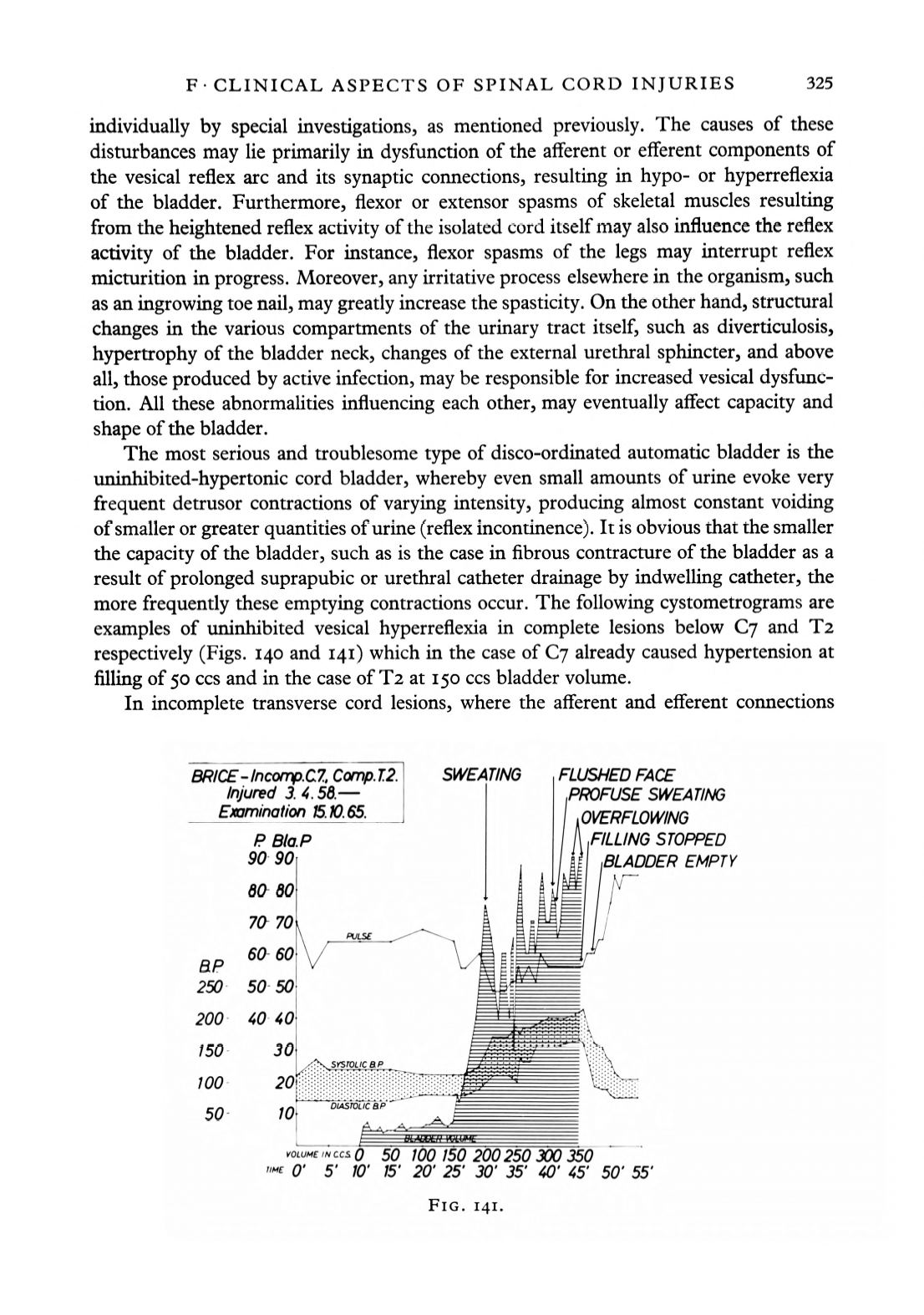
more frequently these emptying contractions occur. The following cystometrograms are
examples of uninhibited vesical hyperreflexia in complete lesions below
Cj
and T2
respectively (Figs. 140 and 141) which in the case of
Cj
already caused hypertension at
filling of 50 ccs and in the case of T2 at 150 ccs bladder volume.
In incomplete transverse cord lesions, where the afferent and efferent connections
BRICE-lncomp.C7, Comp.T.2.
Injured 3. 4.
5ft—
Examination 15.10.65.
SWEATING
FLUSHED FACE
PROFUSE SWEATING
OVERFLOWING
.FILLING STOPPED
.BLADDER EMPTY
VOLUME,Hcci
50 100150200250300350
0' 5' 10'
15' 20' 25' 30' 35' 40' 45' 50' 55'
FIG. 141.


