F- CLINICAL ASPECTS OF SPINAL CORD INJURIES
329
bladder volume and bladder pressure, measuring blood pressure, pulse, respiration,
sweating, pilo-erection, vasomotor and temperature changes. All these various recordings
had to be carried out simultaneously and timed at regular intervals. The results obtained
were reported in various publications (Guttmann & Whitteridge, 1947; Gilliatt, Gutt-
mann & Whitteridge, 1947; Guttmann, 1963, 1954, 1968; Cunningham, Guttmann,
Whitteridge & Whyndham, 1953). In due course our findings were confirmed in various
countries by many other workers in this field (Thompson & Witham, 1948; Robertson
& Wolff, 1950; Bors & French, 1952; Kurnick, 1956; Hodgson & Wood, 1958; Martens,
Harms & Jungmann, 1960; Rousseau, Freedman, Boyarsky & Abramson, 1962; Garnier
& Gertsch, 1963-64; Corbett, Frankel & Harris, 1971; and others), some of them using
modern sophisticated monitoring techniques which allowed the study of the various
parameters mentioned above to be carried out by only one or two workers.
The symptomatology of the autonomic hyperreflexia as a result of bladder distension
is demonstrated by the results obtained in one of my first patients with a complete
lesion at T4 (Fig. 143). As can be seen, during the experiment of bladder filling, marked
by the two vertical lines, the increasing bladder volume elicited detrusor contractions
which became increasingly powerful. There was a sharp rise in both systolic and diastolic
blood pressure with values up to 240/135. This was associated with a marked bradycardia.
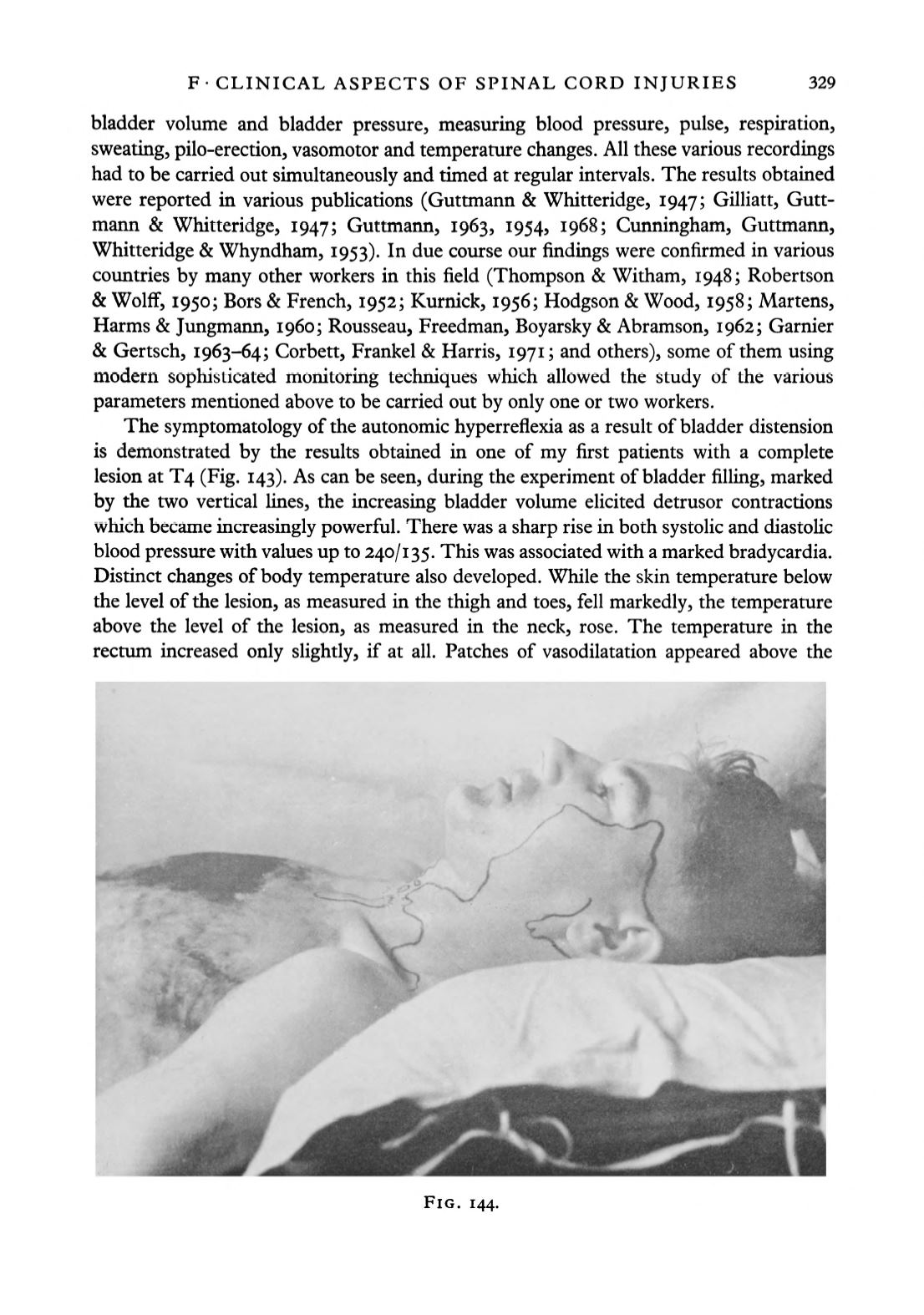
Distinct changes of body temperature also developed. While the skin temperature below
the level of the lesion, as measured in the thigh and toes, fell markedly, the temperature
above the level of the lesion, as measured in the neck, rose. The temperature in the
rectum increased only slightly, if at all. Patches of vasodilatation appeared above the
FIG. 144.


