F CLINICAL ASPECTS OF SPINAL CORD INJURIES
339
blood volume and skin temperature. This leads to a large scale compensatory redistribution
of blood within the vascular bed in areas above the level of the spinal cord transection
shown by vasodilatation in fingers and face including the nasal mucosa. Thus hemostasis
is safeguarded in all patients of middle and, in particular, lower thoracic lesions, and blood
pressure within narrow limits is maintained. However, in high thoracic and cervical
lesions the finger vessels are also involved, as shown by their intense vasoconstriction,
and therefore the remaining compensatory vasodilator response is unable to prevent the
sharp rise of blood pressure. It is known that in man the fingers receive their vasomotor
\~FULL FEELING IN STOMACH
Yv
FACE SWEATING
\\
-MARKED SWEATING TO T7
*fi
\\
-SPASMS IN LEGS
i
^
,|
\EMPTYING STARTED
Of\\
I
.1 I I
.
I. II
I
70j
60'
50
40
BL V
30030
20020
100 10,
L B. C6 COMPLETE
11 2 60
Room temp. 62°F
Catheter inserted 1hr 15mins prior
to commencement of recording
BLADEfR VOLUME
4
3
2
i
BP
225
P
90 200
60 175
70 150
60 125
50 10(
40
75'
30 50
20 25
SYSTOLIC BP
Minutes 5
10
15 20 25 30 35 40 45 50 55 60 65 70 75~ 6V~~d5
90 95
fOO 105
7/0
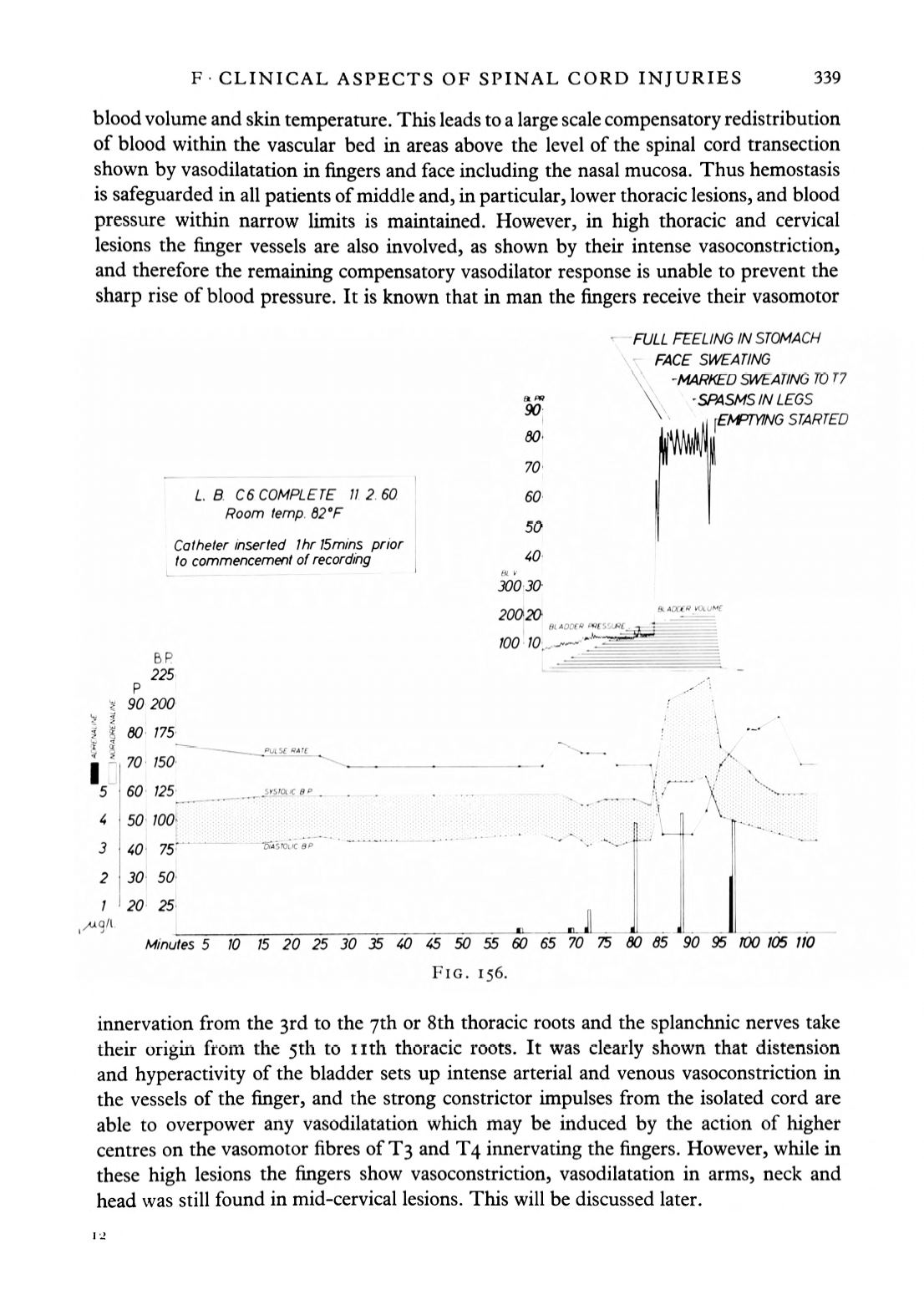
FIG. 156.
innervation from the 3rd to the yth or 8th thoracic roots and the splanchnic nerves take
their origin from the 5th to nth thoracic roots. It was clearly shown that distension
and hyperactivity of the bladder sets up intense arterial and venous vasoconstriction in
the vessels of the finger, and the strong constrictor impulses from the isolated cord are
able to overpower any vasodilatation which may be induced by the action of higher
centres on the vasomotor fibres of T3 and T4 innervating the fingers. However, while in
these high lesions the fingers show vasoconstriction, vasodilatation in arms, neck and
head was still found in mid-cervical lesions. This will be discussed later.
\'2


