340
CHAPTER 26
There is no evidence that the changes in heart output are responsible for the blood
pressure changes but changes in the peripheral vascular resistance play a very important,
if not the most important, part. The increase of blood pressure is most likely to be
responsible for the observed bradycardia—sometimes with a pulse rate of 48 p.m.—as
part of a depressor reflex elicited by the intact aortic and carotid sinus nerves. The ques
tion arises whether the catecholamines, adrenaline and noradrenaline, are liberated and
to what extent they are responsible for the raised blood pressure.
2.3. 60 HALL George
15. COMPLETE
Room temp. 77°F.
BP
200
I
I
Q
i
AJQI
3
2
1
§
P
I
60 150\
o
ij
70 125
n
60 100
50 75
40 50
30 25
Bl.Pr
90
60
70
VASODILATION TO r.7
SWEATING ON CHEST
APEX BEAT 1"LATERAL
Bl.V
600 60\
500 50
400 40
300 30
200 20
100
10
-ARMS COLD
\SHIVERING
-BLADDER PRESSURE •
DIAS70LIC BP
I__LI
iJ
I
Minutes 5
10
15
20 25 30 35 40 45 50 55 60 65
70
75 60
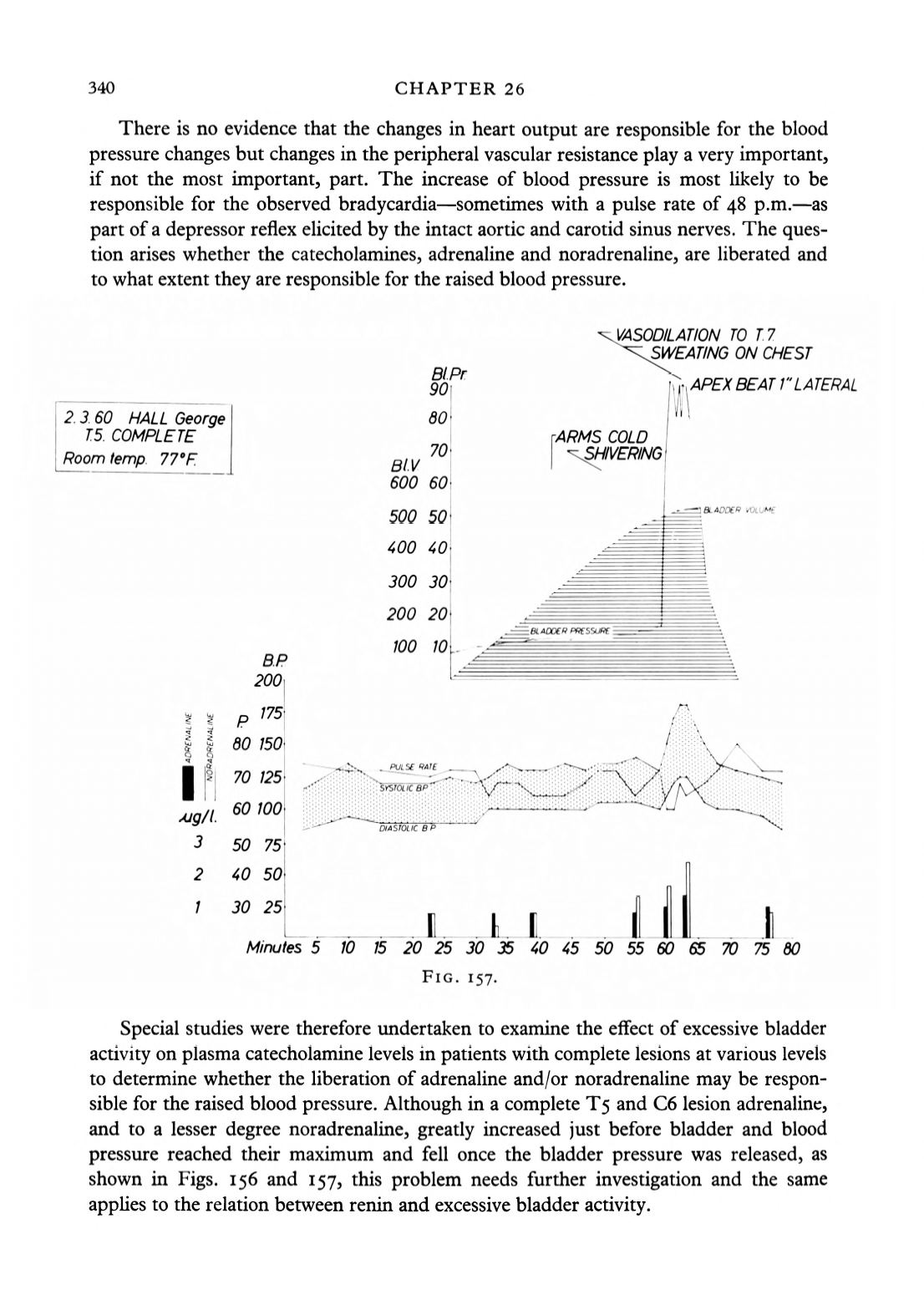
FIG. 157.
Special studies were therefore undertaken to examine the effect of excessive bladder
activity on plasma catecholamine levels in patients with complete lesions at various levels
to determine whether the liberation of adrenaline and/or noradrenaline may be respon
sible for the raised blood pressure. Although in a complete T5 and C6 lesion adrenaline,
and to a lesser degree noradrenaline, greatly increased just before bladder and blood
pressure reached their maximum and fell once the bladder pressure was released, as
shown in Figs. 156 and 157, this problem needs further investigation and the same
applies to the relation between rerun and excessive bladder activity.


