352
CHAPTER 26
Check-ups included urine culture, cell and protein counts, blood chemistry and intra
venous pyelogram. In some cases, cystograms and clearance tests were also included.
At the time of the publication of the report 298 males and 46 females had had check-ups.
Table 14 demonstrates the state of the urine on arrival at the Centre in relation to
treatment before arrival. As can be seen, the results where no catheterization or only
intermittent catheterization had been employed by the referring hospital are infinitely
superior to those where a Gibbon catheter was used and even more so to those where a
Foley catheter was employed. Already at this stage a greater percentage of females were
infected.
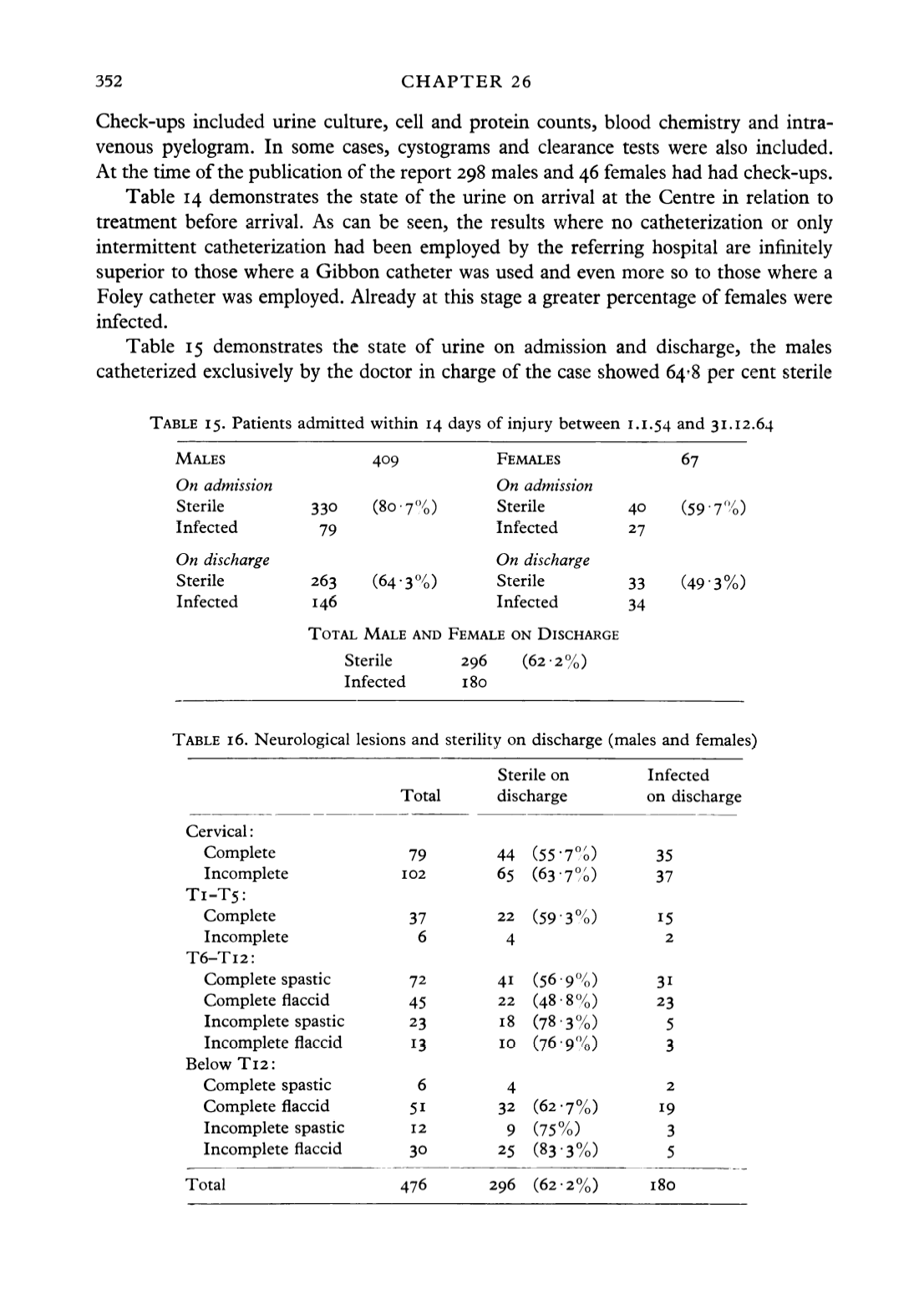
Table 15 demonstrates the state of urine on admission and discharge, the males
catheterized exclusively by the doctor in charge of the case showed 64-8 per cent sterile
TABLE 15. Patients admitted within 14 days of injury between 1.1.54 and 31.12.64
MALES
On admission
Sterile
Infected
On discharge
Sterile
Infected
330
79
263
146
409
(So-
(64-
7%)
3%)
FEMALES
On admission
Sterile
Infected
On discharge
Sterile
Infected
40
27
33
34
67
(59
(49
•7%)
•3%)
TOTAL MALE AND FEMALE ON DISCHARGE
Sterile
296
(62-2%)
Infected
180
TABLE 16. Neurological lesions and sterility on discharge (males and females)
Sterile on
Infected
Total
discharge
on discharge
Cervical:
Complete
79
44
(55'7%)
35
Incomplete
102
65
(63-7%)
37
Ti-T5:
Complete
37
22
(59 -3%)
15
Incomplete
64
2
T6-TI2:
Complete spastic
72
41
(56-9%)
31
Complete flaccid
45
22
(48-8%)
23
Incomplete spastic
23
18
(78-3%)
5
Incomplete flaccid
13
10
(76-9%)
3
Below Ti2:
Complete spastic
64
2
Complete flaccid
51
32
(62-7%)
19
Incomplete spastic
12
9
(75%)
3
Incomplete flaccid
30
25
(83-3%)
5
Total
476
296
(62-2%)
180


