362
CHAPTER 26
and in a considerable number of cases the infection was of an ascending type, including
pyrexial attacks, stone formation in bladder, ureter and kidneys, leading to pyo- or
hydronephrosis. It may be stressed that epididymo-orchitis was not prevented by supra-
pubic drainage. These findings did not prove the opinion held by urologists in that time
that suprapubic cystostomy 'if done early will prevent serious infection' (Riches, 1943),
nor has it been proved that urinary infection could be avoided if suprapubic cystostomy
was of high type (Donovan, 1947). As one would expect, the infection was introduced
and maintained by the suprapubic tube, whether it was of retaining type such as Pezzer,
Malecot, Foley or any other type of catheter, especially if the catheter was left in the
bladder for longer periods. In numerous cases, it was difficult to withdraw the suprapubic
catheter on admission as it was encrusted with phosphates. In lesions of any level where
the suprapubic drainage was continued for some time, the bladder was repeatedly found
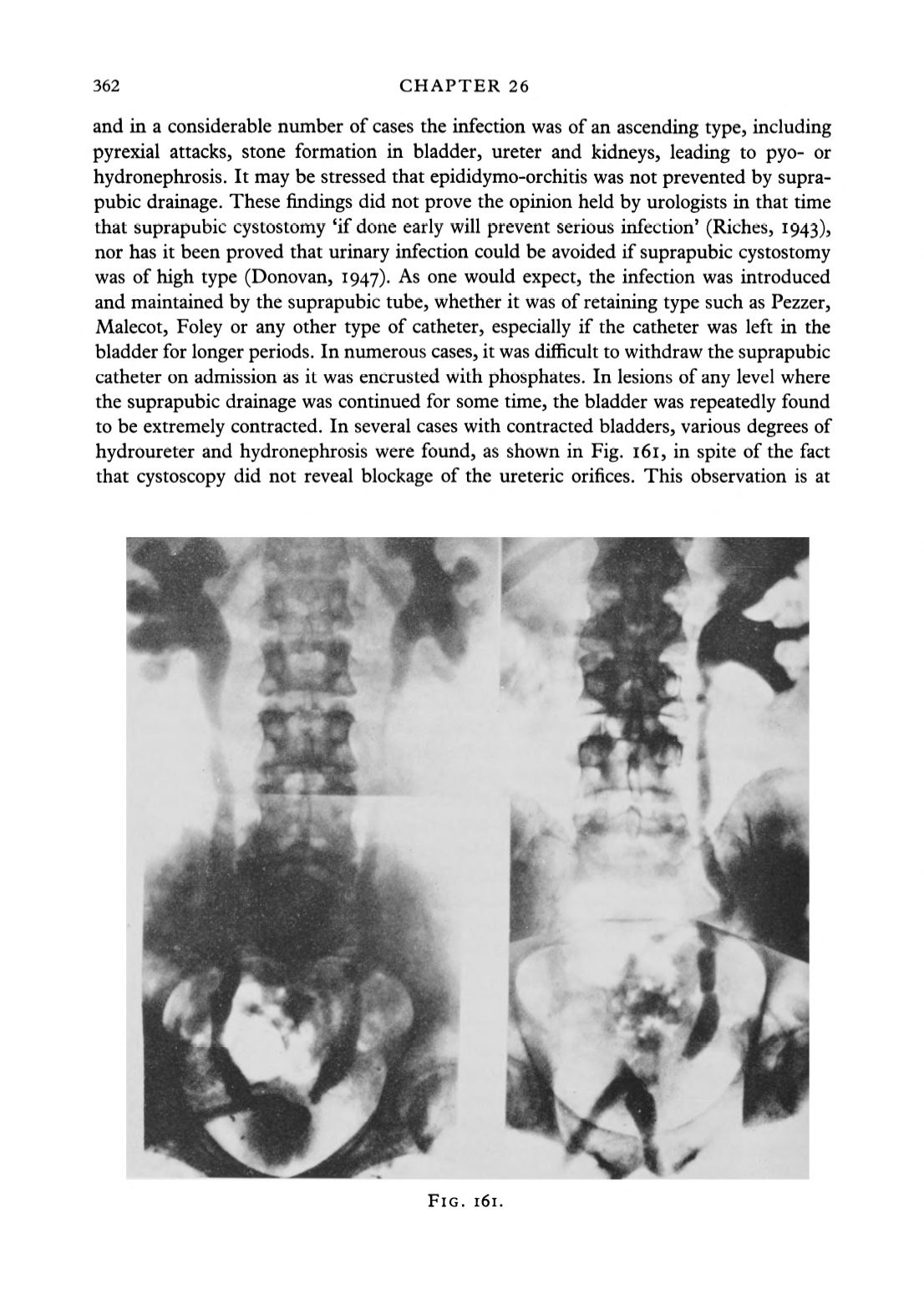
to be extremely contracted. In several cases with contracted bladders, various degrees of
hydroureter and hydronephrosis were found, as shown in Fig. 161, in spite of the fact
that cystoscopy did not reveal blockage of the ureteric orifices. This observation is at
FIG. 161.


