F- CLINICAL ASPECTS OF SPINAL CORD INJURIES
363
variance with the opinion held generally at that time that the main factor in the develop
ment of hydroureter and hydronephrosis was back pressure from the dilated bladder.
Experience has shown that there is no evidence that the neurological level of a spinal
cord lesion as such is responsible for the vesico-ureteric reflux, but that the chronic
inflammatory changes of the ureters themselves producing ureteritis and periureteritis
are the decisive factors. On the one hand, these changes lead to impairment of the elasti
city and destruction of the valve-like action of the ureteric orifices, resulting in vesico-
ureteric reflux as already suggested by previous observations (Hagner, 1912; Kretschner
& Greer, 1914; Prather, 1944; Talbot, 1949; and others); on the other hand the ureteritis
leads to impairment of elasticity and contractility of the ureter itself. Adhesions between
ureter and surrounding tissues caused by peri-ureteritis are responsible for the increased
tortuosity and kinking of the ureter which gives rise to mechanical obstruction.
In my Monograph of 1953 evidence has been given of the bacteria, such as Staph
pyogenes, Str. haemolyticus, coli, proteus, which were obtained from cultures taken
from the bladder end of the catheter and which were different from the urine cultures.
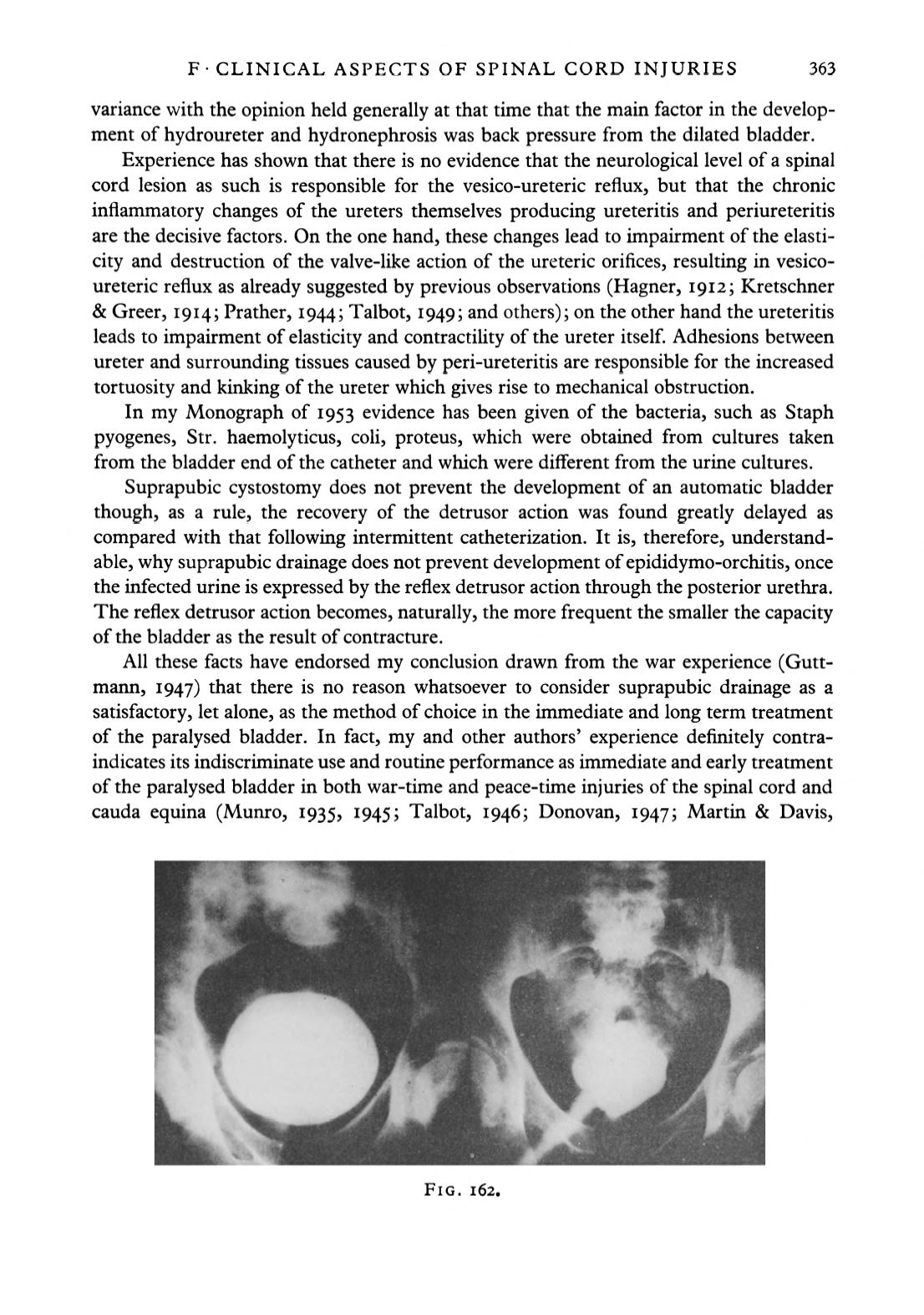
Suprapubic cystostomy does not prevent the development of an automatic bladder
though, as a rule, the recovery of the detrusor action was found greatly delayed as
compared with that following intermittent catheterization. It is, therefore, understand
able, why suprapubic drainage does not prevent development of epididymo-orchitis, once
the infected urine is expressed by the reflex detrusor action through the posterior urethra.
The reflex detrusor action becomes, naturally, the more frequent the smaller the capacity
of the bladder as the result of contracture.
All these facts have endorsed my conclusion drawn from the war experience (Gutt-
mann, 1947) that there is no reason whatsoever to consider suprapubic drainage as a
satisfactory, let alone, as the method of choice in the immediate and long term treatment
of the paralysed bladder. In fact, my and other authors' experience definitely contra-
indicates its indiscriminate use and routine performance as immediate and early treatment
of the paralysed bladder in both war-time and peace-time injuries of the spinal cord and
cauda equina (Munro, 1935, 1945; Talbot, 1946; Donovan, 1947; Martin & Davis,
FIG. 162.


