F- CLINICAL ASPECTS OF SPINAL CORD INJURIES
355
TABLE 18. Hydronephrosis and reflux related to neurological lesions
Hydronephrosis
Reflux
Cervical:
Complete
Incomplete
Ti-Ts:
Complete
Incomplete
T6-TI2:
Complete spastic
Complete flaccid
Incomplete spastic
Incomplete flaccid
Below T12:
Complete spastic
Complete flaccid
Incomplete spastic
Incomplete flaccid
4
5
4
o
5
8
o
i
Total
35
21
TABLE 19. Time between injury and first diagnosis of complications
Time after injury
Less than 3 months
3 to 6 months
Over 6 to 12 months
Over i to 2 years
Over 2 to 3 years
Over 3 to 4 years
Over 4 to 5 years
Over 5 to 6 years
Over 6 to 7 years
Hydronephrosis
o
6
ii
6
6
3
2
I
Reflux
2
8
5
3
i
o
i
i
Stones
0
o
2 (i bladder)
3
3 (i bladder)
2
i (i bladder)
Total
35
21
ii (3 bladder)
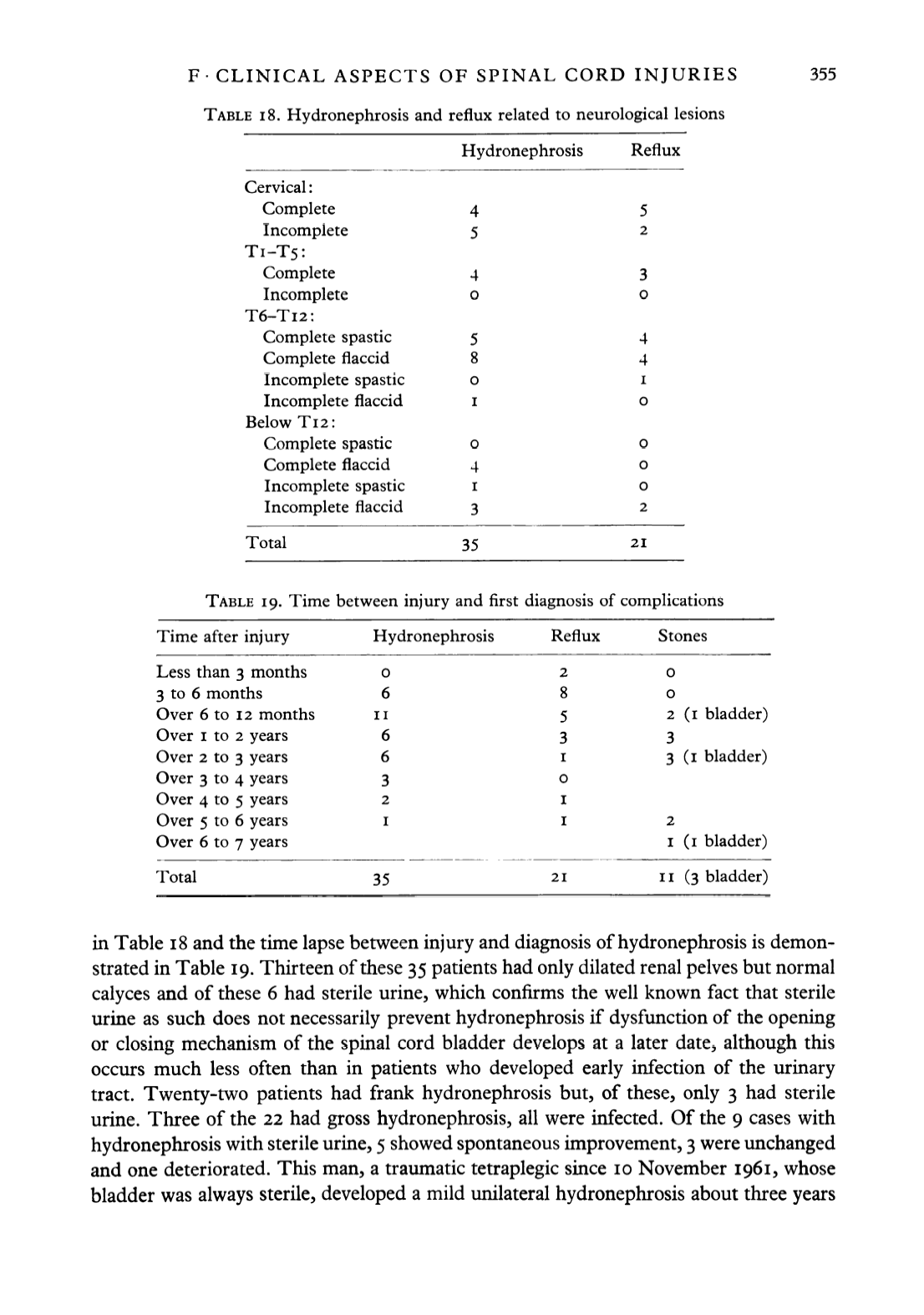
in Table 18 and the time lapse between injury and diagnosis of hydronephrosis is demon
strated in Table 19. Thirteen of these 35 patients had only dilated renal pelves but normal
calyces and of these 6 had sterile urine, which confirms the well known fact that sterile
urine as such does not necessarily prevent hydronephrosis if dysfunction of the opening
or closing mechanism of the spinal cord bladder develops at a later date, although this
occurs much less often than in patients who developed early infection of the urinary
tract. Twenty-two patients had frank hydronephrosis but, of these, only 3 had sterile
urine. Three of the 22 had gross hydronephrosis, all were infected. Of the 9 cases with
hydronephrosis with sterile urine, 5 showed spontaneous improvement, 3 were unchanged
and one deteriorated. This man, a traumatic tetraplegic since 10 November 1961, whose
bladder was always sterile, developed a mild unilateral hydronephrosis about three years


