F- CLINICAL ASPECTS OF SPINAL CORD INJURIES
521
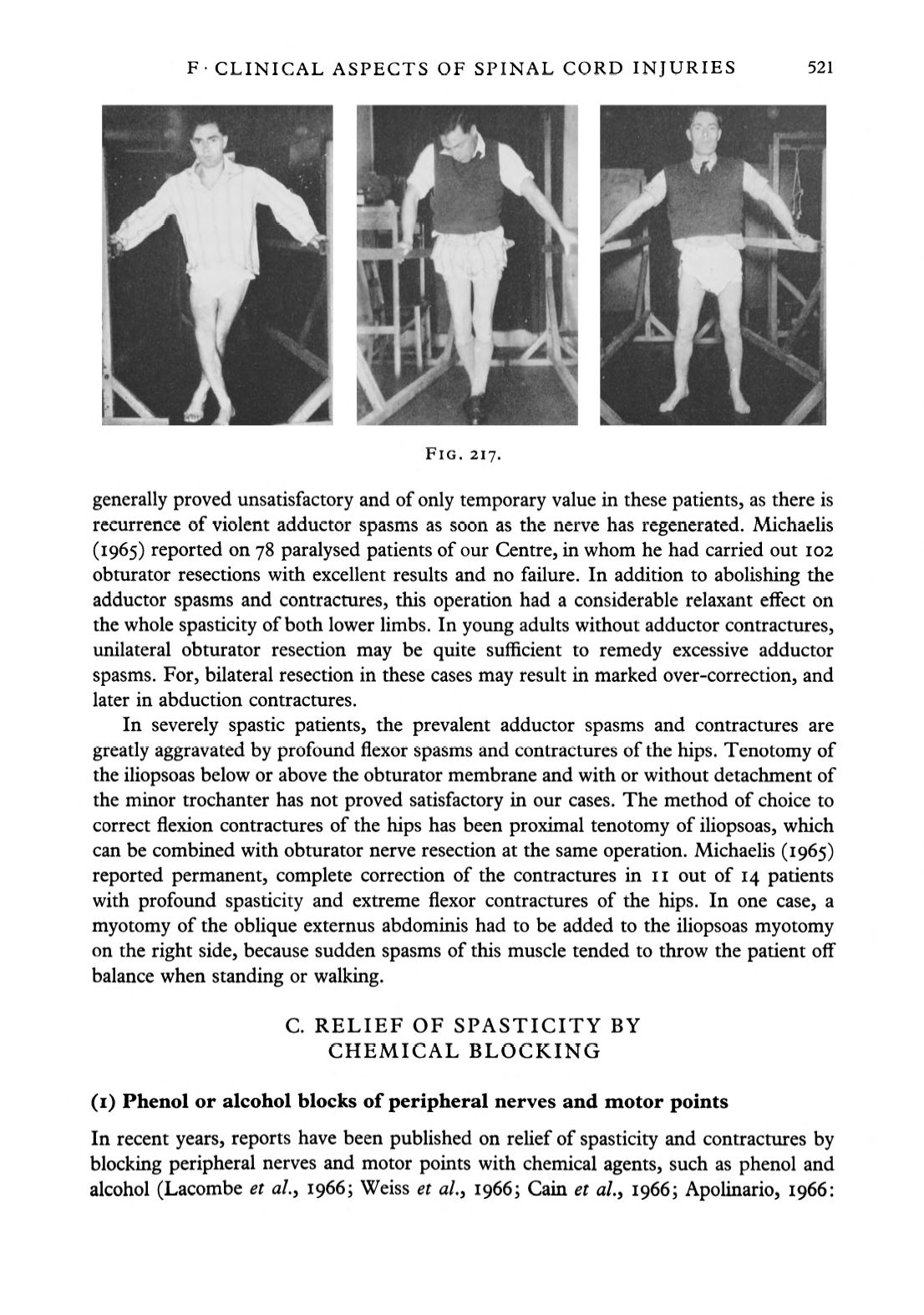
FIG. 217.
generally proved unsatisfactory and of only temporary value in these patients, as there is
recurrence of violent adductor spasms as soon as the nerve has regenerated. Michaelis
(1965) reported on 78 paralysed patients of our Centre, in whom he had carried out 102
obturator resections with excellent results and no failure. In addition to abolishing the
adductor spasms and contractures, this operation had a considerable relaxant effect on
the whole spasticity of both lower limbs. In young adults without adductor contractures,
unilateral obturator resection may be quite sufficient to remedy excessive adductor
spasms. For, bilateral resection in these cases may result in marked over-correction, and
later in abduction contractures.
In severely spastic patients, the prevalent adductor spasms and contractures are
greatly aggravated by profound flexor spasms and contractures of the hips. Tenotomy of
the iliopsoas below or above the obturator membrane and with or without detachment of
the minor trochanter has not proved satisfactory in our cases. The method of choice to
correct flexion contractures of the hips has been proximal tenotomy of iliopsoas, which
can be combined with obturator nerve resection at the same operation. Michaelis (1965)
reported permanent, complete correction of the contractures in n out of 14 patients
with profound spasticity and extreme flexor contractures of the hips. In one case, a
myotomy of the oblique externus abdominis had to be added to the iliopsoas myotomy
on the right side, because sudden spasms of this muscle tended to throw the patient off
balance when standing or walking.
C. RELIEF OF SPASTICITY BY
CHEMICAL BLOCKING
(i) Phenol or alcohol blocks of peripheral nerves and motor points
In recent years, reports have been published on relief of spasticity and contractures by
blocking peripheral nerves and motor points with chemical agents, such as phenol and
alcohol (Lacombe
et al. y
1966; Weiss
et at.,
1966; Cain
et
a/., 1966; Apolinario, 1966:


