F- CLINICAL ASPECTS OF SPINAL CORD INJURIES
621
An example is Jim L., now aged 41, who, before he was called up to the Army, was
an apprentice in cabinet making. In 1953, he was wounded in the Korean War and
sustained a complete paraplegia below T3. He developed his dormant artistic talent in
painting and sculpturing and after leaving the Centre received training from a professional
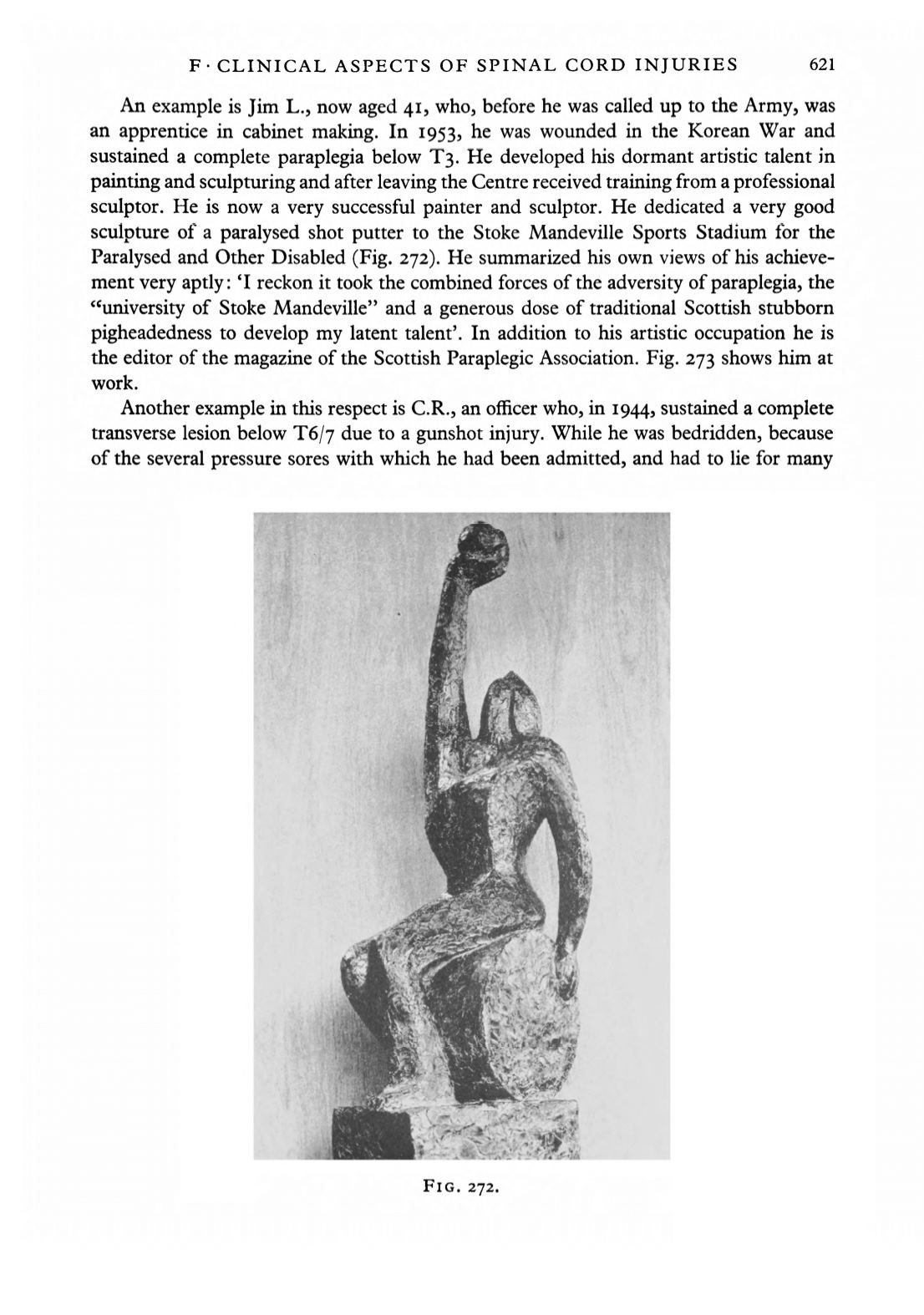
sculptor. He is now a very successful painter and sculptor. He dedicated a very good
sculpture of a paralysed shot putter to the Stoke Mandeville Sports Stadium for the
Paralysed and Other Disabled (Fig. 272). He summarized his own views of his achieve
ment very aptly: 'I reckon it took the combined forces of the adversity of paraplegia, the
"university of Stoke Mandeville" and a generous dose of traditional Scottish stubborn
pigheadedness to develop my latent talent'. In addition to his artistic occupation he is
the editor of the magazine of the Scottish Paraplegic Association. Fig. 273 shows him at
work.
Another example in this respect is C.R., an officer who, in 1944, sustained a complete
transverse lesion below T6/7 due to a gunshot injury. While he was bedridden, because
of the several pressure sores with which he had been admitted, and had to lie for many


