208
CHAPTER 19
Skotnikov, 1958; Rosak, 1961; Benassy
et
a/., 1960, 1963; Michaelis, 1964; Freehafer &
Yurick, 1966; Couvee, 1971; Rossier, 1972). A more detailed statistic was published by
Wharton & Morgan (1970). They found 90 patients amongst 447 cases with heterotopic
ossifications (20 per cent). Twenty patients (3 per cent) had serious articular restrictions.
In spite of the numerous publications, there is still discrepancy of opinion regarding
the classification and terminology of this process, and different descriptions are used in the
literature such as para-articular ossification (the term adopted by the writer), para-
osteoarthropathia, osteosis neurotica para-articularis, heterotopic ossification, dystrophic
ossification, neurogenic ossifying fibromyopathy, neurogenic ossifying fibromyositis
and myositis ossificans circumscripta traumatica.
The aetiology and pathogenesis of the para-articular ossification is still obscure.
However, there is general agreement that the transformation of the connective tissue
into osteid tissue, leading to ossification, always develops below the level of the spinal
cord lesion. All stages of ossification from collagen into bone containing Haversian
systems may be demonstrated.
Various hypotheses have been advanced to explain the aetiology of para-articular
ossifications in spinal cord lesions. On the one hand, lack of passive and active exercise
has been considered as the cause for promoting this condition, but one should then
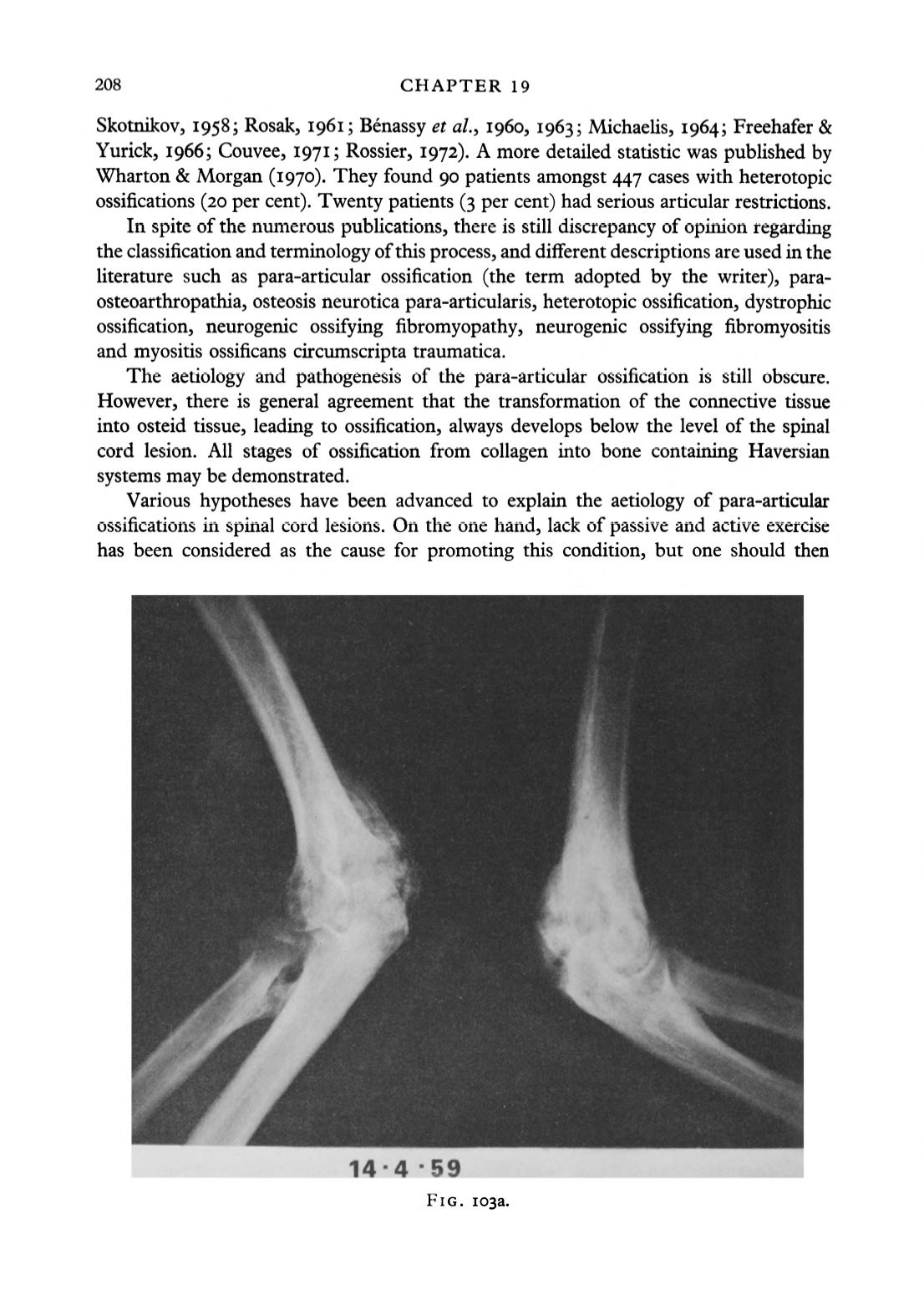
14-4 -59
FIG. 1033.


