210
CHAPTER 19
generally called myositis ossificans. Benassy
et al.
(1960, 1963) suggest changes of the
O2 and CC>2 exchange in the proximal blood circulation of the paralysed limbs as an
important factor in thepathogenesis of the para-articular ossification. How far this process
of para-articular ossification has the same or similar underlying aetiology (constitutional
calciogenic diathesis) as the rare disease of myositis ossificans progressive of non-
paralysed, mainly young individuals, which affects in early stages neck and back muscles,
in particular latissimus dorsi and trapezius, is still unknown. The onset of this disease
is characterized by attacks of stiffness, swelling and tenderness. There is hyperplasia of
the intermuscular connective tissue with deposits of calcium between the muscle fibres.
The eventually ossified connective tissue lies lamellated or in flat sheets within the axis
of the muscles. There is no doubt about the (constitutionally) increased capacity of the
connective tissue for ossification (calciogenic diathesis); however, the underlying cause
of the anomaly of the mineral metabolism is unknown.
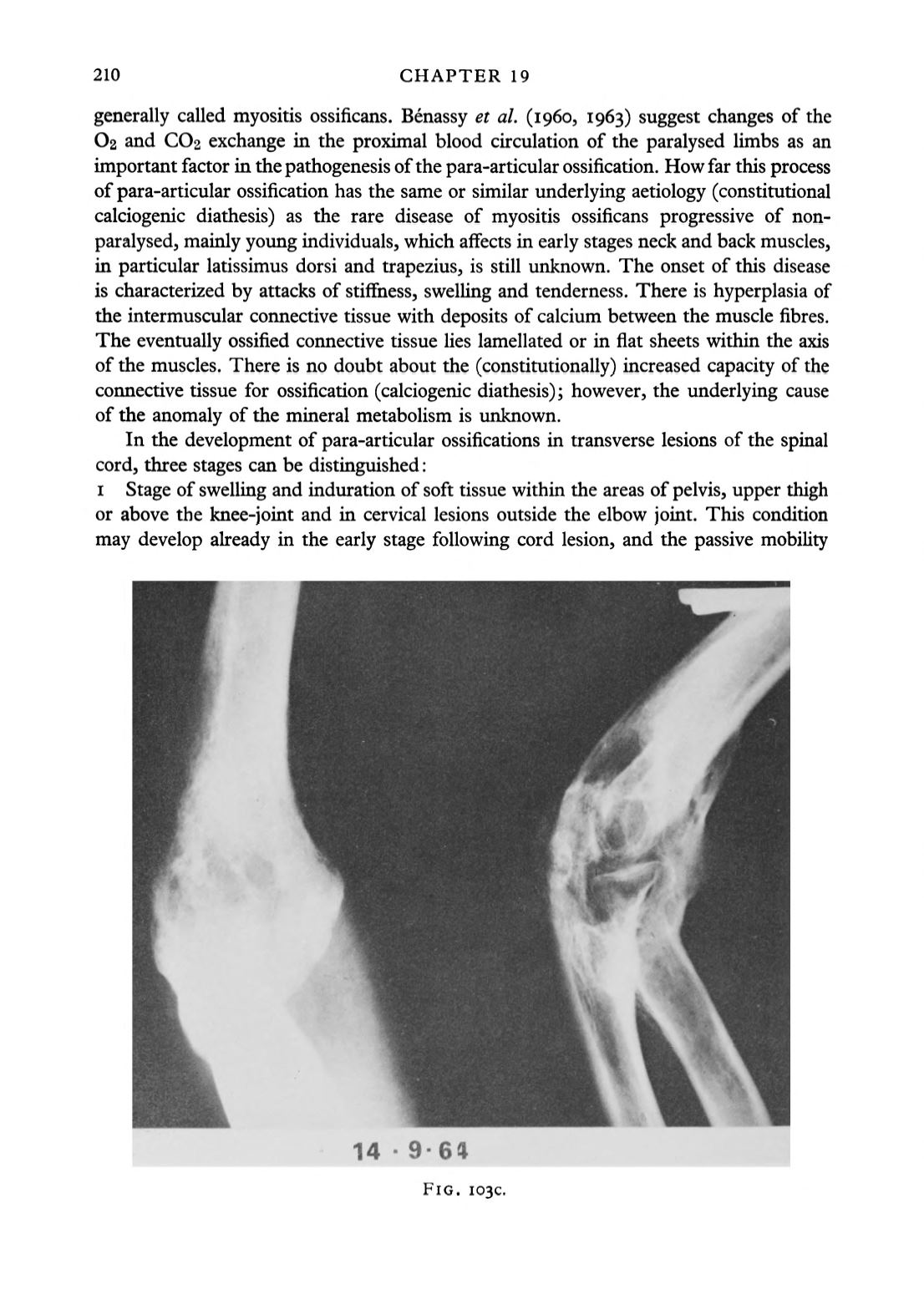
In the development of para-articular ossifications in transverse lesions of the spinal
cord, three stages can be distinguished:
i
Stage of swelling and induration of soft tissue within the areas of pelvis, upper thigh
or above the knee-joint and in cervical lesions outside the elbow joint. This condition
may develop already in the early stage following cord lesion, and the passive mobility


