550
CHAPTER 33
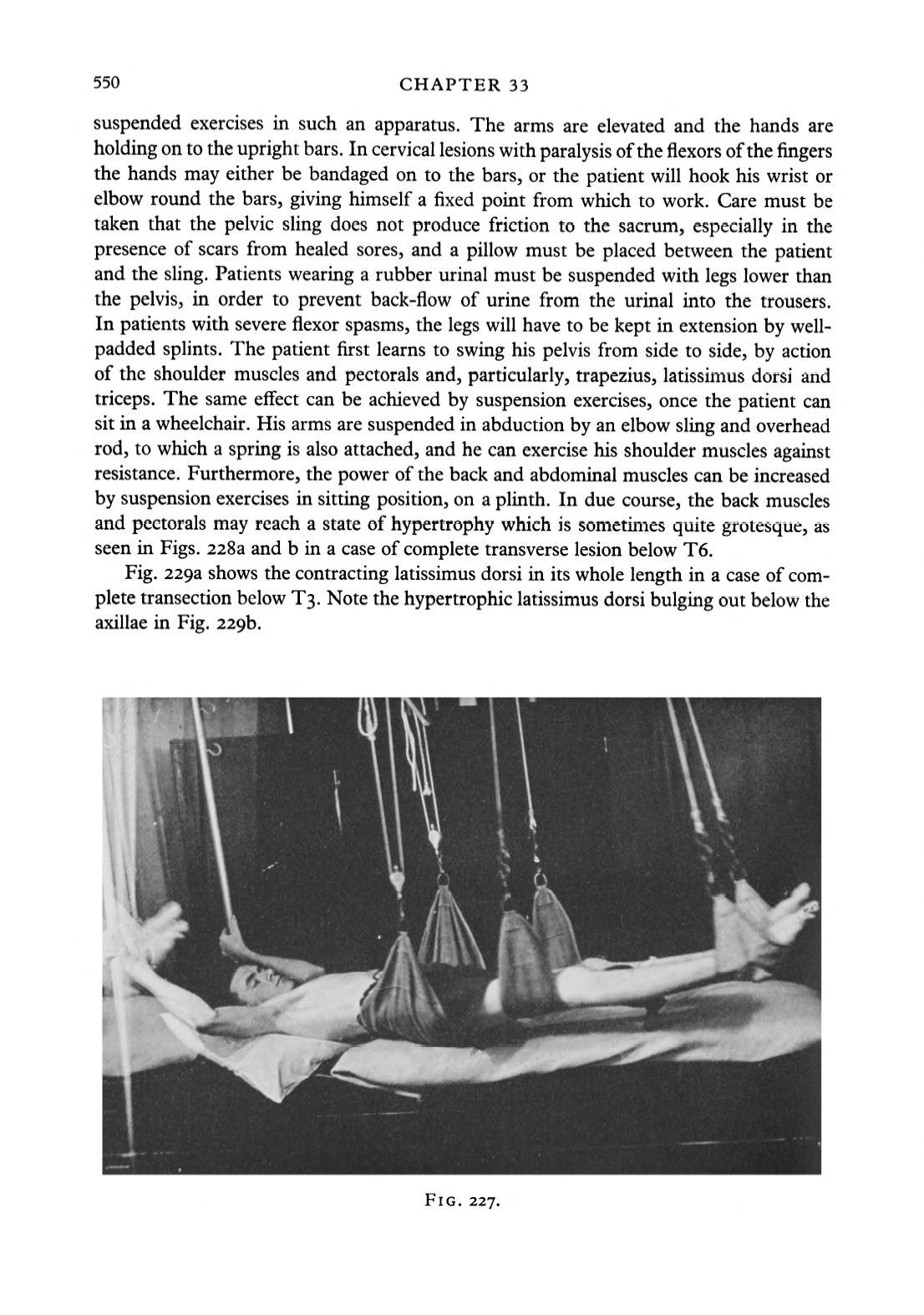
suspended exercises in such an apparatus. The arms are elevated and the hands are
holding on to the upright bars. In cervical lesions with paralysis of the flexors of the fingers
the hands may either be bandaged on to the bars, or the patient will hook his wrist or
elbow round the bars, giving himself a fixed point from which to work. Care must be
taken that the pelvic sling does not produce friction to the sacrum, especially in the
presence of scars from healed sores, and a pillow must be placed between the patient
and the sling. Patients wearing a rubber urinal must be suspended with legs lower than
the pelvis, in order to prevent back-flow of urine from the urinal into the trousers.
In patients with severe flexor spasms, the legs will have to be kept in extension by well-
padded splints. The patient first learns to swing his pelvis from side to side, by action
of the shoulder muscles and pectorals and, particularly, trapezius, latissimus dorsi and
triceps. The same effect can be achieved by suspension exercises, once the patient can
sit in a wheelchair. His arms are suspended in abduction by an elbow sling and overhead
rod, to which a spring is also attached, and he can exercise his shoulder muscles against
resistance. Furthermore, the power of the back and abdominal muscles can be increased
by suspension exercises in sitting position, on a plinth. In due course, the back muscles
and pectorals may reach a state of hypertrophy which is sometimes quite grotesque, as
seen in Figs. 228a and b in a case of complete transverse lesion below T6.
Fig. 2293 shows the contracting latissimus dorsi in its whole length in a case of com
plete transection below T3. Note the hypertrophic latissimus dorsi bulging out below the
axillae in Fig. 229b.
FIG. 227.


