560
CHAPTER 33
proved invaluable for the development of movement patterns, which promote a new
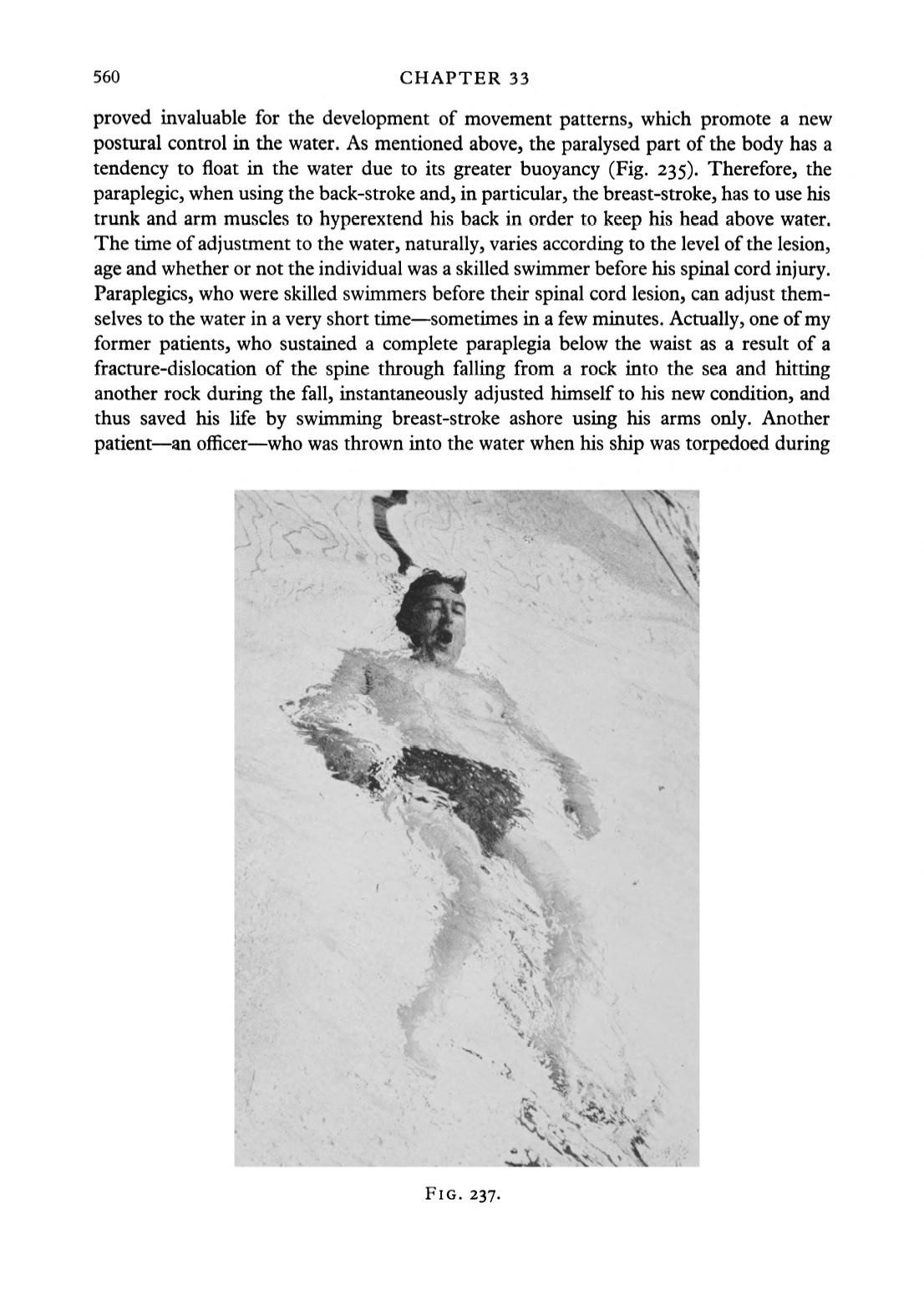
postural control in the water. As mentioned above, the paralysed part of the body has a
tendency to float in the water due to its greater buoyancy (Fig. 235). Therefore, the
paraplegic, when using the back-stroke and, in particular, the breast-stroke, has to use his
trunk and arm muscles to hyperextend his back in order to keep his head above water.
The time of adjustment to the water, naturally, varies according to the level of the lesion,
age and whether or not the individual was a skilled swimmer before his spinal cord injury.
Paraplegics, who were skilled swimmers before their spinal cord lesion, can adjust them
selves to the water in a very short time—sometimes in a few minutes. Actually, one ofmy
former patients, who sustained a complete paraplegia below the waist as a result of a
fracture-dislocation of the spine through falling from a rock into the sea and hitting
another rock during the fall, instantaneously adjusted himself to his new condition, and
thus saved his life by swimming breast-stroke ashore using his arms only. Another
patient—an officer—who was thrown into the water when his ship was torpedoed during
FIG. 237.


