570
CHAPTER 33
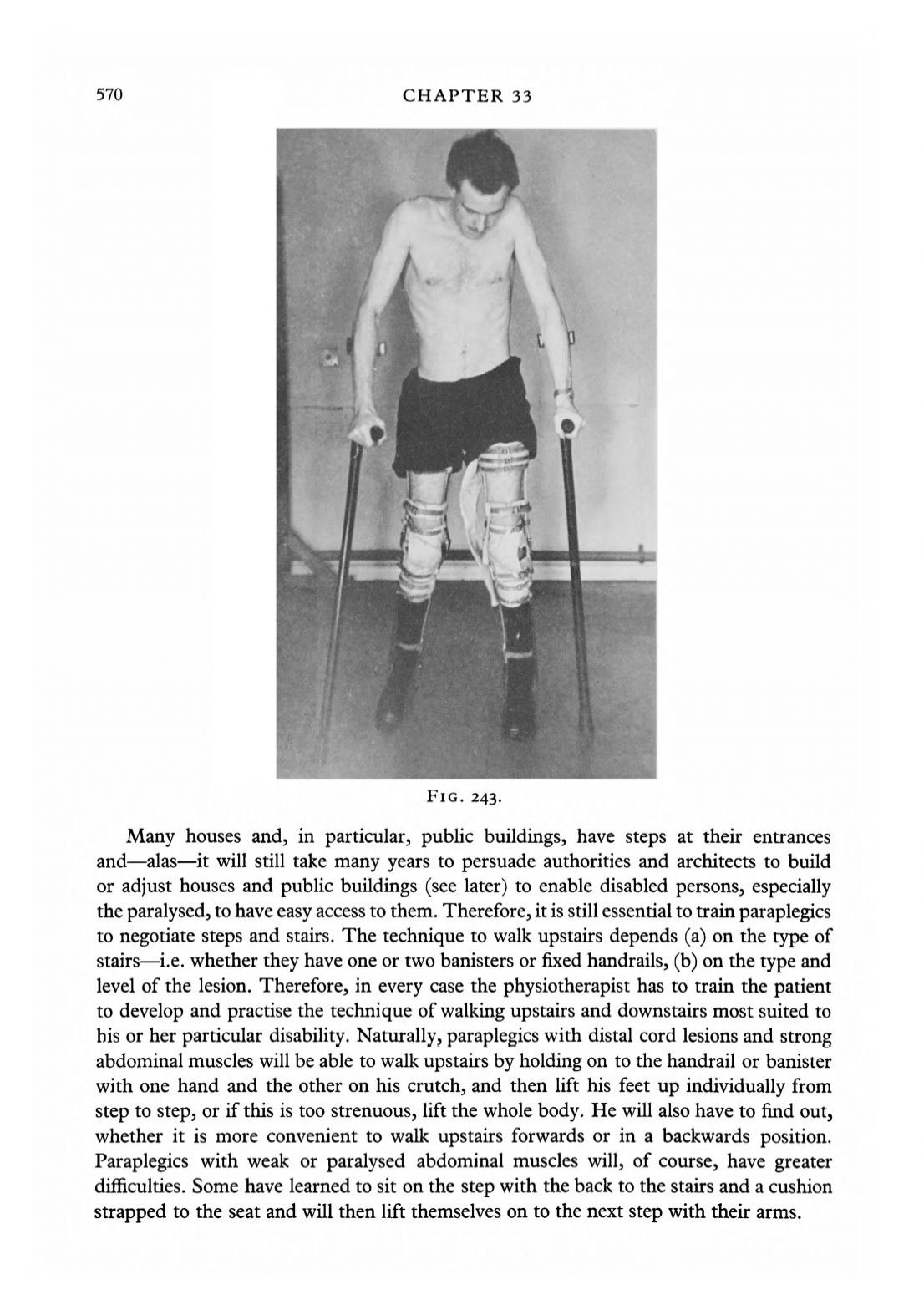
FIG. 243.
Many houses and, in particular, public buildings, have steps at their entrances
and—alas—it will still take many years to persuade authorities and architects to build
or adjust houses and public buildings (see later) to enable disabled persons, especially
the paralysed, to have easy access to them. Therefore, it is still essential to train paraplegics
to negotiate steps and stairs. The technique to walk upstairs depends (a) on the type of
stairs—i.e. whether they have one or two banisters or fixed handrails, (b) on the type and
level of the lesion. Therefore, in every case the physiotherapist has to train the patient
to develop and practise the technique of walking upstairs and downstairs most suited to
his or her particular disability. Naturally, paraplegics with distal cord lesions and strong
abdominal muscles will be able to walk upstairs by holding on to the handrail or banister
with one hand and the other on his crutch, and then lift his feet up individually from
step to step, or if this is too strenuous, lift the whole body. He will also have to find out,
whether it is more convenient to walk upstairs forwards or in a backwards position.
Paraplegics with weak or paralysed abdominal muscles will, of course, have greater
difficulties. Some have learned to sit on the step with the back to the stairs and a cushion
strapped to the seat and will then lift themselves on to the next step with their arms.


