562
CHAPTER 33
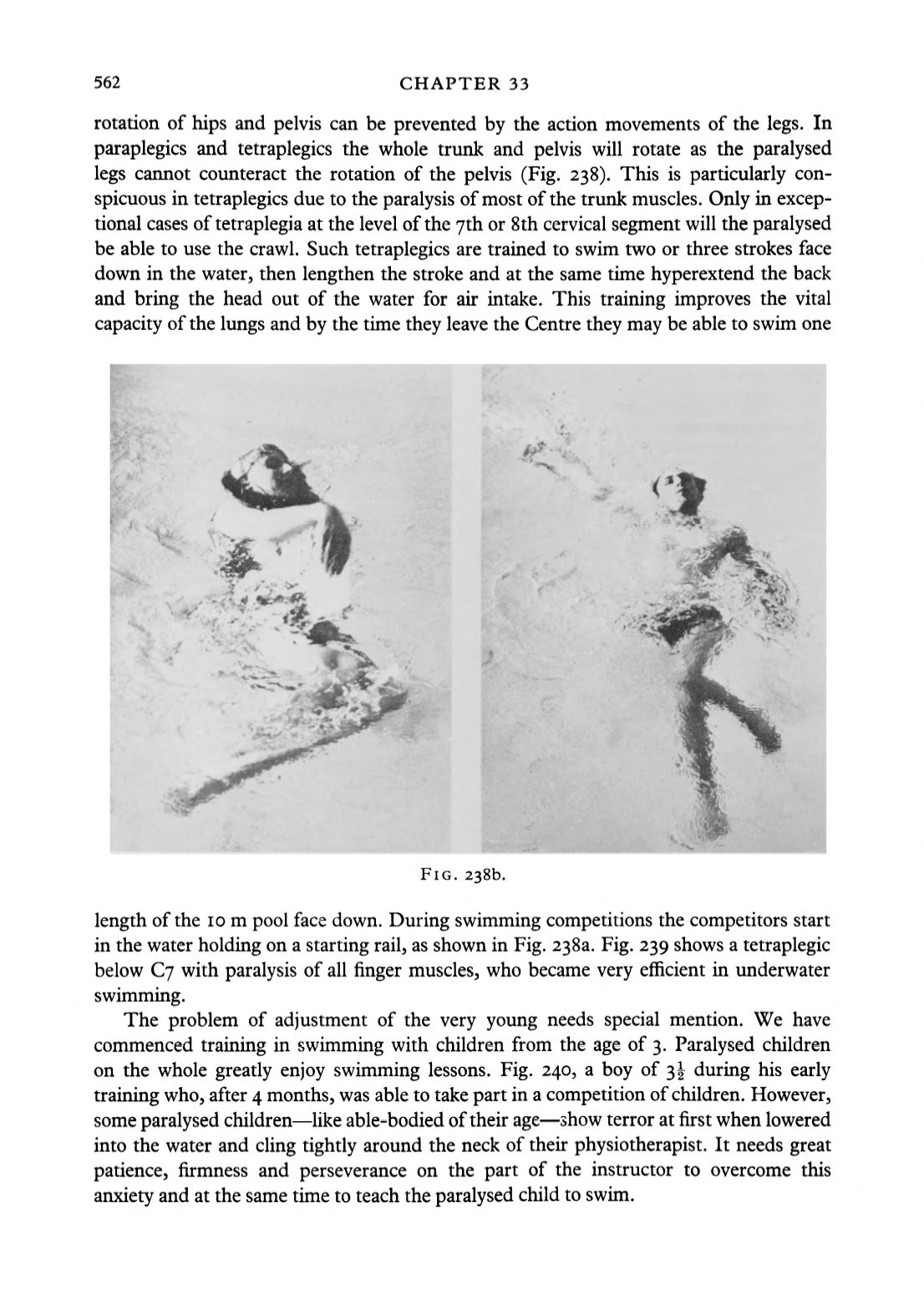
rotation of hips and pelvis can be prevented by the action movements of the legs. In
paraplegics and tetraplegics the whole trunk and pelvis will rotate as the paralysed
legs cannot counteract the rotation of the pelvis (Fig. 238). This is particularly con
spicuous in tetraplegics due to the paralysis of most of the trunk muscles. Only in excep
tional cases of tetraplegia at the level of the yth or 8th cervical segment will the paralysed
be able to use the crawl. Such tetraplegics are trained to swim two or three strokes face
down in the water, then lengthen the stroke and at the same time hyperextend the back
and bring the head out of the water for air intake. This training improves the vital
capacity of the lungs and by the time they leave the Centre they may be able to swim one
FIG. 2385.
length of the 10 m pool face down. During swimming competitions the competitors start
in the water holding on a starting rail, as shown in Fig. 2383. Fig. 239 shows a tetraplegic
below Cy with paralysis of all finger muscles, who became very efficient in underwater
swimming.
The problem of adjustment of the very young needs special mention. We have
commenced training in swimming with children from the age of 3. Paralysed children
on the whole greatly enjoy swimming lessons. Fig. 240, a boy of 3^ during his early
training who, after 4 months, was able to take part in a competition of children. However,
some paralysed children—like able-bodied of their age—show terror at first when lowered
into the water and cling tightly around the neck of their physiotherapist. It needs great
patience, firmness and perseverance on the part of the instructor to overcome this
anxiety and at the same time to teach the paralysed child to swim.


