F- CLINICAL ASPECTS OF SPINAL CORD INJURIES
553
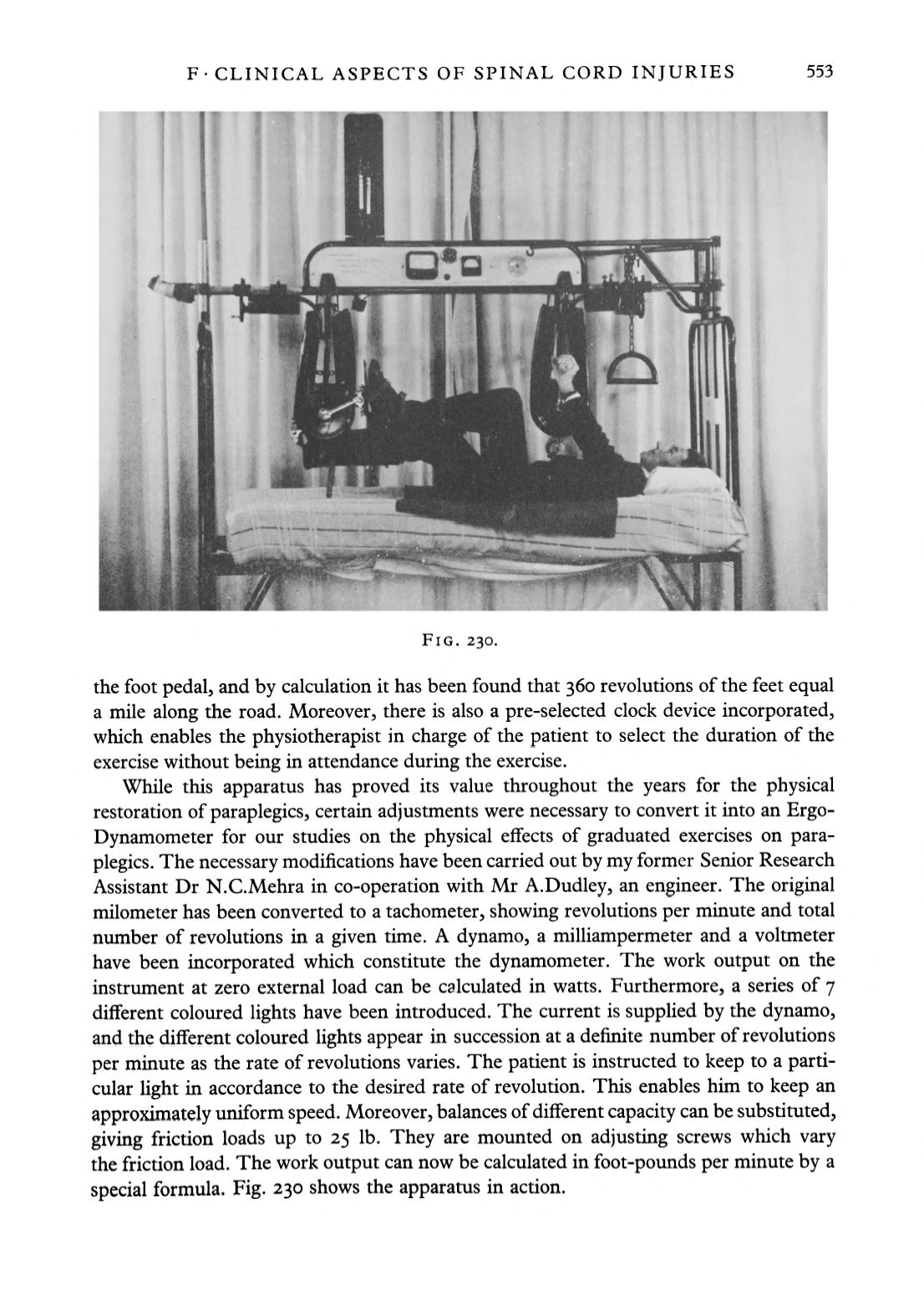
FIG. 230.
the foot pedal, and by calculation it has been found that 360 revolutions of the feet equal
a mile along the road. Moreover, there is also a pre-selected clock device incorporated,
which enables the physiotherapist in charge of the patient to select the duration of the
exercise without being in attendance during the exercise.
While this apparatus has proved its value throughout the years for the physical
restoration of paraplegics, certain adjustments were necessary to convert it into an Ergo-
Dynamometer for our studies on the physical effects of graduated exercises on para
plegics. The necessary modifications have been carried out by my former Senior Research
Assistant Dr N.C.Mehra in co-operation with Mr A.Dudley, an engineer. The original
milometer has been converted to a tachometer, showing revolutions per minute and total
number of revolutions in a given time. A dynamo, a milliampermeter and a voltmeter
have been incorporated which constitute the dynamometer. The work output on the
instrument at zero external load can be calculated in watts. Furthermore, a series of 7
different coloured lights have been introduced. The current is supplied by the dynamo,
and the different coloured lights appear in succession at a definite number of revolutions
per minute as the rate of revolutions varies. The patient is instructed to keep to a parti
cular light in accordance to the desired rate of revolution. This enables him to keep an
approximately uniform speed. Moreover, balances of different capacity can be substituted,
giving friction loads up to 25 Ib. They are mounted on adjusting screws which vary
the friction load. The work output can now be calculated in foot-pounds per minute by a
special formula. Fig. 230 shows the apparatus in action.


