F- CLINICAL ASPECTS OF SPINAL CORD INJURIES
551
The Stoke Mandeville bed-cycle
As a result of observations, that alternating passive movements of the paralysed legs
have a beneficial effect on spasticity by relaxation, the writer designed in 1946 a pedal-
exerciser for promoting self-activated exercises by the paraplegic to relieve the work of
the physiotherapist (Guttmann, 1949). This apparatus, which was later constructed and
manufactured by Standard Sales Ltd, 113 Newington Causeway, London, S.E.I, was
originally designed for patients still confined to bed but is now used in physiotherapy
departments in various countries as an essential piece of equipment for patients needing
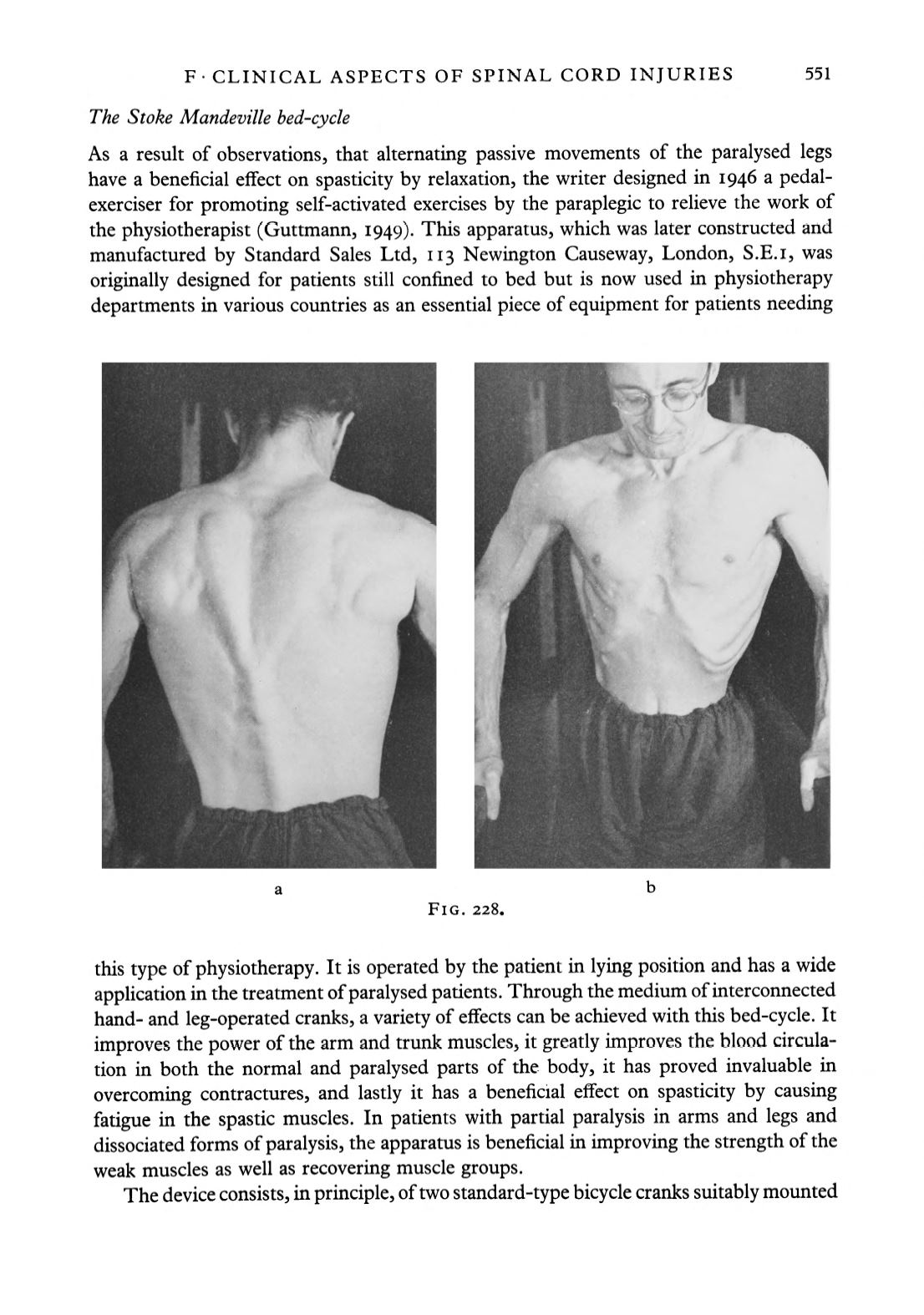
FIG. 228.
this type of physiotherapy. It is operated by the patient in lying position and has a wide
application in the treatment of paralysed patients. Through the medium of interconnected
hand- and leg-operated cranks, a variety of effects can be achieved with this bed-cycle. It
improves the power of the arm and trunk muscles, it greatly improves the blood circula
tion in both the normal and paralysed parts of the body, it has proved invaluable in
overcoming contractures, and lastly it has a beneficial effect on spasticity by causing
fatigue in the spastic muscles. In patients with partial paralysis in arms and legs and
dissociated forms of paralysis, the apparatus is beneficial in improving the strength of the
weak muscles as well as recovering muscle groups.
The device consists, in principle, of two standard-type bicycle cranks suitably mounted


