F- CLINICAL ASPECTS OF SPINAL CORD INJURIES
565
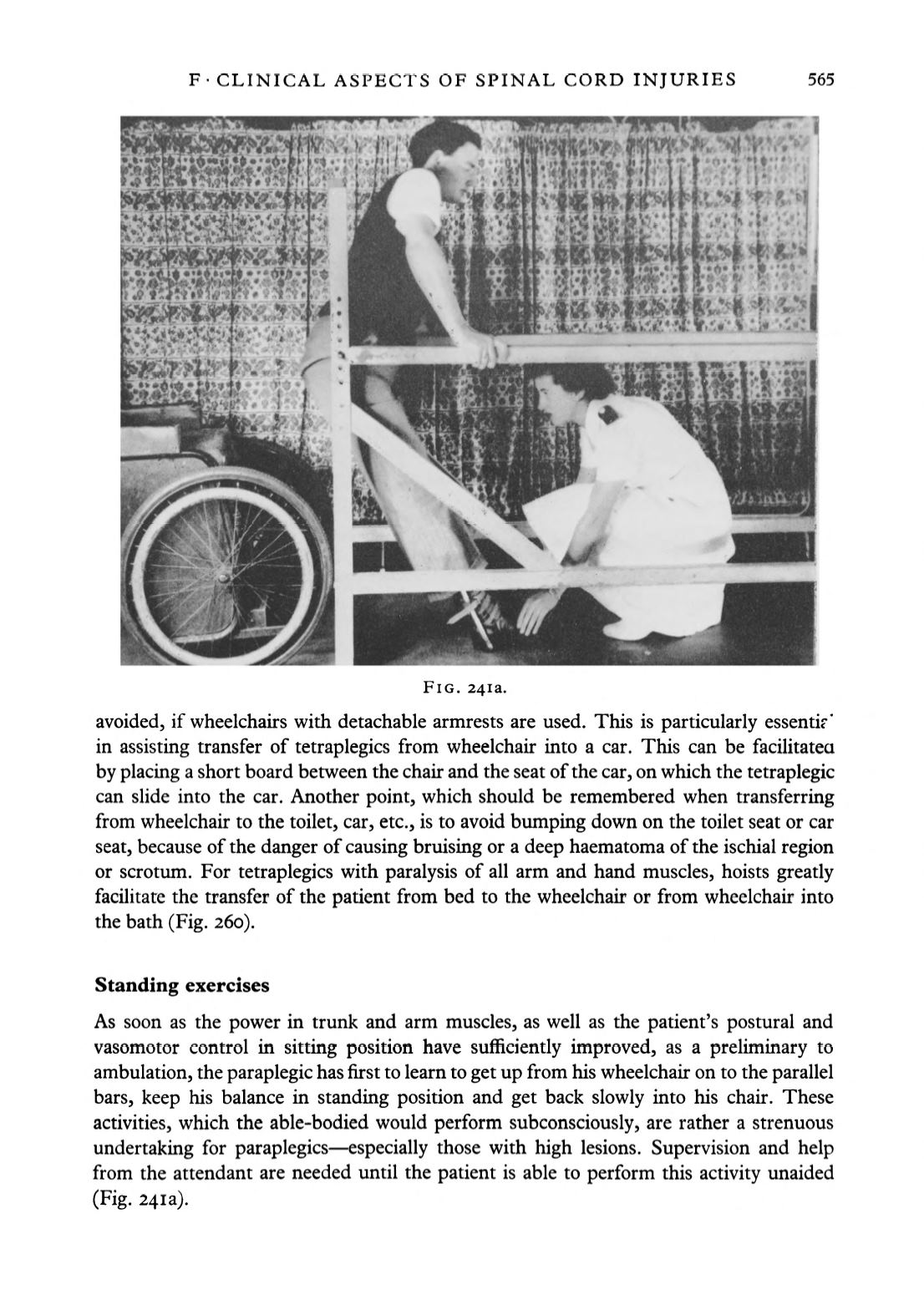
FIG. 2413.
avoided, if wheelchairs with detachable armrests are used. This is particularly essentir*
in assisting transfer of tetraplegics from wheelchair into a car. This can be facilitated
by placing a short board between the chair and the seat of the car, on which the tetraplegic
can slide into the car. Another point, which should be remembered when transferring
from wheelchair to the toilet, car, etc., is to avoid bumping down on the toilet seat or car
seat, because of the danger of causing bruising or a deep haematoma of the ischial region
or scrotum. For tetraplegics with paralysis of all arm and hand muscles, hoists greatly
facilitate the transfer of the patient from bed to the wheelchair or from wheelchair into
the bath (Fig. 260).
Standing exercises
As soon as the power in trunk and arm muscles, as well as the patient's postural and
vasomotor control in sitting position have sufficiently improved, as a preliminary to
ambulation, the paraplegic has first to learn to get up from his wheelchair on to the parallel
bars, keep his balance in standing position and get back slowly into his chair. These
activities, which the able-bodied would perform subconsciously, are rather a strenuous
undertaking for paraplegics—especially those with high lesions. Supervision and help
from the attendant are needed until the patient is able to perform this activity unaided
(Fig. 2413).


